
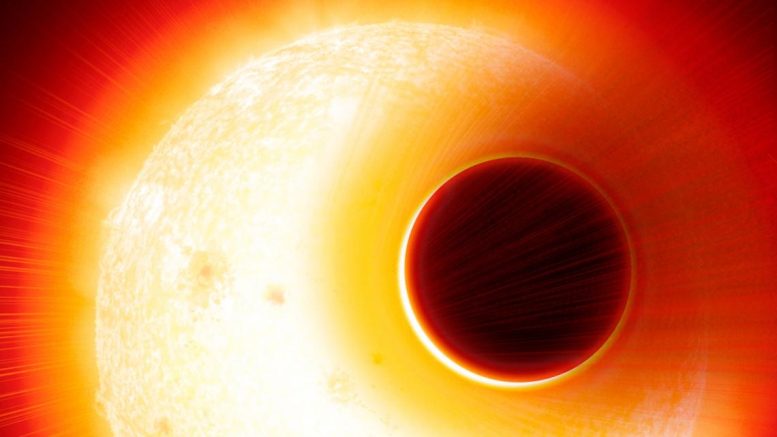
Researchers have identified the first signature of a magnetic field surrounding a planet outside of our solar system. Earth’s magnetic field acts as a shield against energetic particles from the sun known as the solar wind. Magnetic fields could play similar roles on other planets.
An international team of astronomers used data from the Hubble Space Telescope to discover the signature of a magnetic field in a planet outside our solar system. The finding, described in a paper in the journal Nature Astronomy, marks the first time such a feature has been seen on an exoplanet.
A magnetic field best explains the observations of an extended region of charged carbon particles that surround the planet and stream away from it in a long tail. Magnetic fields play a crucial role in protecting planetary atmospheres, so the ability to detect the magnetic fields of exoplanets is a significant step toward better understanding what these alien worlds may look like.
The team used Hubble to observe the exoplanet HAT-P-11b, a Neptune-sized planet 123 light-years from Earth, pass directly across the face of its host star six times in what is known as a “transit.” The observations were made in the ultraviolet light spectrum, which is just beyond what the human eye can see.
Hubble detected carbon ions – charged particles that interact with magnetic fields – surrounding the planet in what is known as a magnetosphere. A magnetosphere is a region around a celestial object (such as Earth) that is formed by the object’s interaction with the solar wind emitted by its host star.
Magnetospheres and Habitability
“This is the first time the signature of an exoplanet’s magnetic field has been directly detected on a planet outside our solar system,” said Gilda Ballester, an adjunct research professor at the University of Arizona Lunar and Planetary Laboratory and one of the paper’s co-authors. “A strong magnetic field on a planet like Earth can protect its atmosphere and surface from direct bombardment of the energetic particles that make up the solar wind. These processes heavily affect the evolution of life on a planet like Earth because the magnetic field shelters organisms from these energetic particles.”
The discovery of HAT-P-11b’s magnetosphere is a significant step toward an improved understanding of the habitability of an exoplanet. Not all planets and moons in our solar system have their own magnetic fields, and the connection between magnetic fields and a planet’s habitability still needs more study, according to the researchers.
“HAT-P-11 b has proven to be a very exciting target, because Hubble’s UV transit observations have revealed a magnetosphere, seen as both an extended ion component around the planet and long tail of escaping ions,” Ballester said, adding that this general method could be used to detect magnetospheres on a variety of exoplanets and to assess their role in potential habitability.
Carbon Ion Tail: Evidence of a Magnetosphere
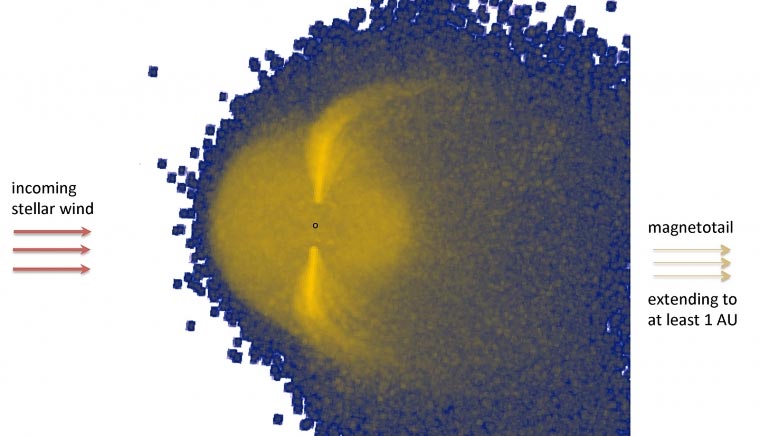
Ballester, a principal investigator of one of the Hubble Space Telescope programs that observed HAT-P-11b, contributed to the selection of this specific target for UV studies. A key discovery was the observation of carbon ions not only in a region surrounding the planet, but also extending in a long tail that streamed away from the planet at average speeds of 100,000 mph. The tail reached into space for at least 1 astronomical unit, the distance between Earth and sun.
Researchers led by the paper’s first author, Lotfi Ben-Jaffel at the Institute of Astrophysics in Paris, then used 3D computer simulations to model interactions between the planet’s uppermost atmospheric regions and magnetic field with the incoming solar wind.
“Just like Earth’s magnetic field and its immediate space environment interact with the impinging solar wind, which consists of charged particles traveling at about 900,000 mph, there are interactions between HAT-P-11b’s magnetic field and its immediate space environment with the solar wind from its host star, and those are very complex,” Ballester explained.
The physics in the magnetospheres of Earth and HAT-P-11b are the same; however, the exoplanet’s close proximity to its star – just one-twentieth of the distance from the Earth to the sun – causes its upper atmosphere to warm and essentially “boil off” into space, resulting in the formation of the magnetotail.
Unexpected Atmospheric Composition
Researchers also found that the metallicity of HAT-P-11b’s atmosphere – the number of chemical elements in an object that are heavier than hydrogen and helium – is lower than expected. In our solar system, the icy gas planets, Neptune and Uranus, are rich in metals but have weak magnetic fields, while the much larger gas planets, Jupiter and Saturn, have low metallicity and strong magnetic fields. HAT-P-11b’s low atmospheric metallicity challenges current models of exoplanet formation, the authors say.
“Although HAT-P-11b’s mass is only 8% of that of Jupiter, we think the exoplanet more resembles a mini-Jupiter than a Neptune,” Ballester said. “The atmospheric composition we see on HAT-P-11b suggests that further work needs to be done to refine current theories of how certain exoplanets form in general.”
Reference: “Signatures of strong magnetization and a metal-poor atmosphere for a Neptune-sized exoplanet” by Lotfi Ben-Jaffel, Gilda E. Ballester, Antonio García Muñoz, Panayotis Lavvas, David K. Sing, Jorge Sanz-Forcada, Ofer Cohen, Tiffany Kataria, Gregory W. Henry, Lars Buchhave, Thomas Mikal-Evans, Hannah R. Wakeford and Mercedes López-Morales, 16 December 2021, Nature Astronomy.
DOI: 10.1038/s41550-021-01505-x
The Hubble Space Telescope is a project of international cooperation between NASA and the European Space Agency. The observations were made through the following programs: Small HST Program #14625 dedicated to HAT-P-11b (principal investigator Gilda E. Ballester) and the HST Treasury Program #14767 named PanCET: The Panchromatic Comparative Exoplanetary Treasury program (co- principal investigators David K. Sing and Mercedes López-Morales).
The paper, “Signatures of Strong Magnetization and a Metal-Poor Atmosphere for a Neptune-Size Exoplanet” is published in the December 16 issue of Nature Astronomy. Co-authors in addition to Ballester and Ben-Jaffel are Antonio García Muñoz, Panayotis Lavvas, David K. Sing, Jorge Sanz-Forcada, Ofer Cohen, Tiffany Kataria, Gregory W. Henry, Lars Buchahave, Thomas Mikal-Evans, Hannah R. Wakeford, and Mercedes López-Morales.
Never miss a breakthrough: Join the SciTechDaily newsletter.
Follow us on Google and Google News.
1 Comment
If they want to find life in the Milky Way like Earth, this is possible, but outside the Milky Way, life is infinite, similar to the Earth, the distance of 123 light years is more than a thousand trillion kilometers, and this is possible for now. Humans can experience such a safari