
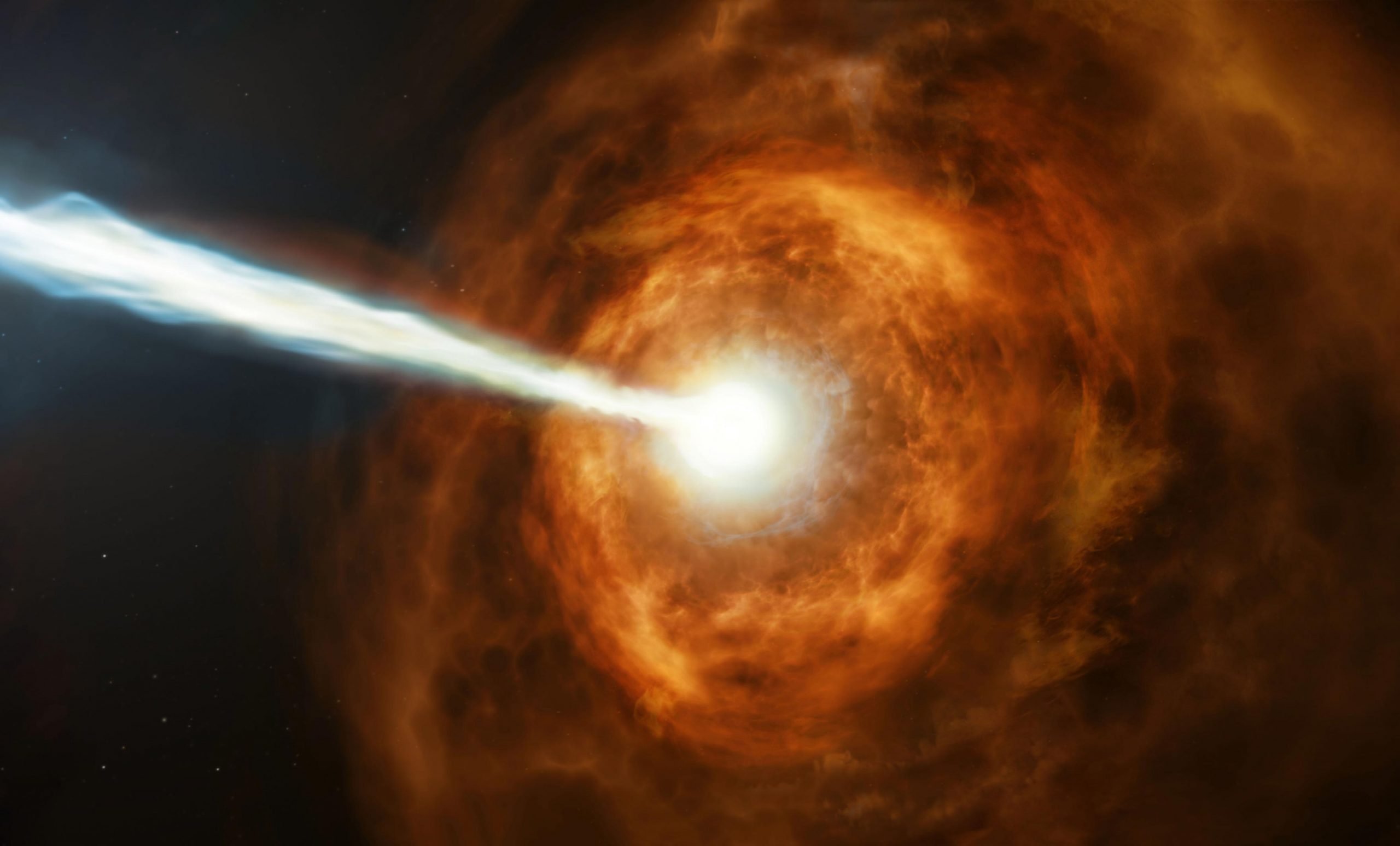
Rare Star’s Giant Gamma-Ray Burst GRB 204015A Captured Close to Our Home Galaxy
Earth gets blasted by mild short gamma-ray bursts (GRBs) most days. But sometimes a giant flare like GRB 200415A arrives at our galaxy, sweeping along energy that dwarfs our sun. In fact, the most powerful explosions in the universe are gamma-ray bursts.
Now scientists have shown that GRB 200415A came from another possible source for short GRBs. It erupted from a very rare, powerful neutron star called a magnetar.
Previous detected GRB’s came from relatively far away from our home galaxy the Milky Way. But this one was from much closer to home, in cosmic terms.
GRB explosions can disrupt mobile phone reception on earth, but they can also be messengers from the very early history of the universe.
A Different End Game
“Our sun is a very ordinary star. When it dies, it will get bigger and become a red giant star. After that, it will collapse into a small compact star called a white dwarf.
“But stars that are a lot more massive than the sun play a different end game,” says Prof Soebur Razzaque from the University of Johannesburg.
Razzaque lead a team predicting GRB behavior for research published in Nature Astronomy on January 13, 2021.
“When these massive stars die, they explode into a supernova. What’s left after that is a very small compact star, small enough to fit in a valley about 12 miles (about 20km) across. This star is called a neutron star. It’s so dense that just a spoonful of it would weigh tons on earth,” he says.
It’s these massive stars and what’s left of them that cause the biggest explosions in the universe.
On April 15, 2020, a giant wave of X-rays and gamma rays lasting only a fraction of a second swept across the solar system, triggering detectors on NASA and European spacecraft. The GRB 200415A event was a giant flare from a magnetar, a type of city-sized neutron star that boasts the strongest magnetic fields known. Prof Soebur Razzaque from the University of Johannesburg shares what happens during a giant flare, and how these powerful explosions can tell us more about the history of the universe. Animation Credit: NASA’s Goddard Space Flight Center/Chris Smith (USRA/GESTAR). Video Credit: Therese van Wyk, University of Johannesburg.
A Telling Split Second
Scientists have known for a while that supernovas spout long GRB’s, which are bursts longer than two seconds. In 2017, they found out that two neutron stars spiraling into each other can also give off a short GRB. The 2017 burst came from a safe 130 million light-years away from us.
But that could not explain any of the other GRBs that researchers could detect in our sky on almost a daily basis.
This changed in a split of a second at 4:42 a.m. U.S. Eastern Time on April 15, 2020.
On that day, a giant flare GRB swept past Mars. It announced itself to satellites, a spacecraft, and the International Space Station orbiting around our planet.
It was the first known giant flare since the 2008 launch of NASA’s Fermi Gamma-ray space telescope. And it lasted just 140 milliseconds, about the blink of an eye.
But this time, the orbiting telescopes and instruments captured way more data about the giant flare GRB than the previous one detected 16 years previously.
Bursts From Another Source
The elusive cosmic visitor was named GRB 200415A. The Inter Planetary Network (IPN), a consortium of scientists, figured out where the giant flare came from. GRB 200415A exploded from a magnetar in galaxy NGC 253, in the Sculptor constellation, they say.
All the previously known GRB’s were traced to supernovas or two neutron stars spiraling into each other.
“In the Milky Way there are tens of thousands of neutron stars,” says Razzaque. “Of those, only 30 are currently known to be magnetars.
“Magnetars are up to a thousand times more magnetic than ordinary neutron stars. Most emit X-rays every now and then. But so far, we know of only a handful of magnetars that produced giant flares. The brightest we could detect was in 2004. Then GRB 200415A arrived in 2020.”
Galaxy NGC 253 is outside our home, the Milky Way, but it is a mere 11.4 million light years from us. That is relatively close when talking about the nuclear frying power of a giant flare GRB.
A giant flare is so much more powerful than solar flares from our sun, it’s hard to imagine. Large solar flares from our sun disrupt cell phone reception and power grids sometimes.
The giant flare GRB in 2004 disrupted communication networks also.
Second Wave Nabbed for the First Time
“No two gamma-ray bursts (GRBs) are ever the same, even if they happen in a similar way. And no two magnetars are the same either. We’re still trying to understand how stars end their life and how these very energetic gamma rays are produced, says Razzaque.
“It’s only in the last 20 years or so, that we have all the instruments in place to detect these GRB events in many different ways – in gravitational waves, radio waves, visible light, X-rays, and gamma rays.”
“GRB 200415A was the first time ever that both the first and second explosions of a giant flare were detected,” he says.
Understanding the Second Wave
In 2005 research, Razzaque predicted a first and second explosion during a giant flare.
For the current research in Nature Astronomy, he headed a team including Jonathan Granot from the Open University in Israel, Ramandeep Gill from the George Washington University, and Matthew Baring from the Rice University.
They developed an updated theoretical model, or prediction, of what a second explosion in a giant flare GRB would look like. After April 15, 2020, they could compare their model with data measured from GRB 200415A.
“The data from the Fermi Gamma-ray Burst Monitor (Fermi GBM) tells us about the first explosion. Data from the Fermi Large Area Telescope (Fermi LAT) tells us about the second,” says Razzaque.
“The second explosion occurred about 20 seconds after the first one, and has much higher gamma-ray energy than the first one. It also lasted longer. We still need to understand what happens after a few hundred seconds though.”
Messengers About Deep Time
If the next giant flare GRB happens closer to our home galaxy the Milky Way, a powerful radio telescope on the ground such as MeerKAT in South Africa, may be able to detect it, he says.
“That would be an excellent opportunity to study the relationship between very high energy gamma-ray emissions and radio wave emissions in the second explosion. And that would tell us more about what works and doesn’t work in our model.”
The better we understand these fleeting explosions, the better we may understand the universe we live in.
A star dying soon after the beginning of the universe could be disrupting cell phone reception today.
“Even though gamma-ray bursts explode from a single star, we can detect them from very early in the history of the universe. Even going back to when the universe was a few hundred million years old,” says Razzaque.
“That is at an extremely early stage of the evolution of the universe. The stars that died at that time… we are only detecting their gamma-ray bursts now, because light takes time to travel.
“This means that gamma-ray bursts can tell us more about how the universe expands and evolves over time.”
Reference: “High-energy emission from a magnetar giant flare in the Sculptor galaxy” by The Fermi-LAT Collaboration, 13 January 2021, Nature Astronomy.
DOI: 10.1038/s41550-020-01287-8
Never miss a breakthrough: Join the SciTechDaily newsletter.
Follow us on Google and Google News.
6 Comments
I don’t understand why these are called “gamma” rays. By convention, gamma rays are produced in atomic nuclei by radioactive decay. Such production precludes directionality and, thus, any “beam”. Is it true that these so-called gamma rays are merely electromagnetic waves, photons, of gamma energy that have been produced by other than nuclear means?
Good question!
The usual classification is to name the photon energies according to wavelength bands [“Electromagnetic spectrum” @ Wikipedia ].
“The types of electromagnetic radiation are broadly classified into the following classes (regions, bands or types):
– Gamma radiation
– X-ray radiation
– Ultraviolet radiation
– Visible light
– Infrared radiation
– Microwave radiation
– Radio waves
This classification goes in the increasing order of wavelength, which is characteristic of the type of radiation.
There are no precisely defined boundaries between the bands of the electromagnetic spectrum; rather they fade into each other like the bands in a rainbow (which is the sub-spectrum of visible light).”
“The distinction between X-rays and gamma rays is partly based on sources: the photons generated from nuclear decay or other nuclear and subnuclear/particle process are always termed gamma rays, whereas X-rays are generated by electronic transitions involving highly energetic inner atomic electrons.”
“The convention that EM radiation that is known to come from the nucleus, is always called “gamma ray” radiation is the only convention that is universally respected, however. Many astronomical gamma ray sources (such as gamma ray bursts) are known to be too energetic (in both intensity and wavelength) to be of nuclear origin. Quite often, in high energy physics and in medical radiotherapy, very high energy EMR (in the >10 MeV region)—which is of higher energy than any nuclear gamma ray—is not called X-ray or gamma-ray, but instead by the generic term of “high energy photons.””
So this is a bit fluid, even though the classical convention can be heeded at times.
Here the interaction seems to cause a properly “particle process” generated gamma ray burst. From the abstract: “After a propagation delay, the outflow interacts with environmental gas and produces shock waves that accelerate electrons to very high energies; these electrons then emit GeV γ rays as optically thin synchrotron radiation.”
A NASA astrophysicist source includes synchrotron radiation gamma rays
[ https://heasarc.gsfc.nasa.gov/docs/cgro/epo/vu/overview/whatare/process.html ]. “The origin of gamma rays is intimately tied the physics of elementary particles, such as protons, neutrons, and electrons. Some of the known physical processes that can produce gamma rays are:
Synchrotron Radiation is produced when charged particles such as electrons spiral at speeds approaching the speed of light in the presence of a magnetic field. Supernovae and supernova remnants produce a lot of synchrotron radiation.
…”
Re directionality, synchrotron radiation can be such and the radiation cone will be narrower the higher the electron (and so photon) energy.
“Another dramatic effect of relativity is that the radiation pattern is distorted from the isotropic dipole pattern expected from non-relativistic theory into an extremely forward-pointing cone of radiation.”
[ https://en.wikipedia.org/wiki/Synchrotron_light_source ]
Wow, I can’t believe a legitimate conversation is happening in a comment section online (no matter the topic). Thank you for bringing me hope for humanity 🙂
AT&T and other companies had major outages. Was this the cause of the outages. Home internet and mobile phones reported down that day.
You are saying that when a star die that emits gamma rays. Is these rays are good living being?