
Close Menu
    Facebook X (Twitter) Instagram
    SciTechDaily
    • Biology
    • Chemistry
    • Earth
    • Health
    • Physics
    • Science
    • Space
    • Technology
    Facebook X (Twitter) Pinterest YouTube RSS
    SciTechDaily
    Home»Space»NASA’s Curiosity Rover Views Mercury Passing in Front of the Sun
    Space

    NASA’s Curiosity Rover Views Mercury Passing in Front of the Sun

    By Guy Webster, Jet Propulsion LaboratoryJune 11, 2014No Comments3 Mins Read
    Facebook Twitter Pinterest Telegram LinkedIn WhatsApp Email Reddit
    Share
    Facebook Twitter LinkedIn Pinterest Telegram Email Reddit
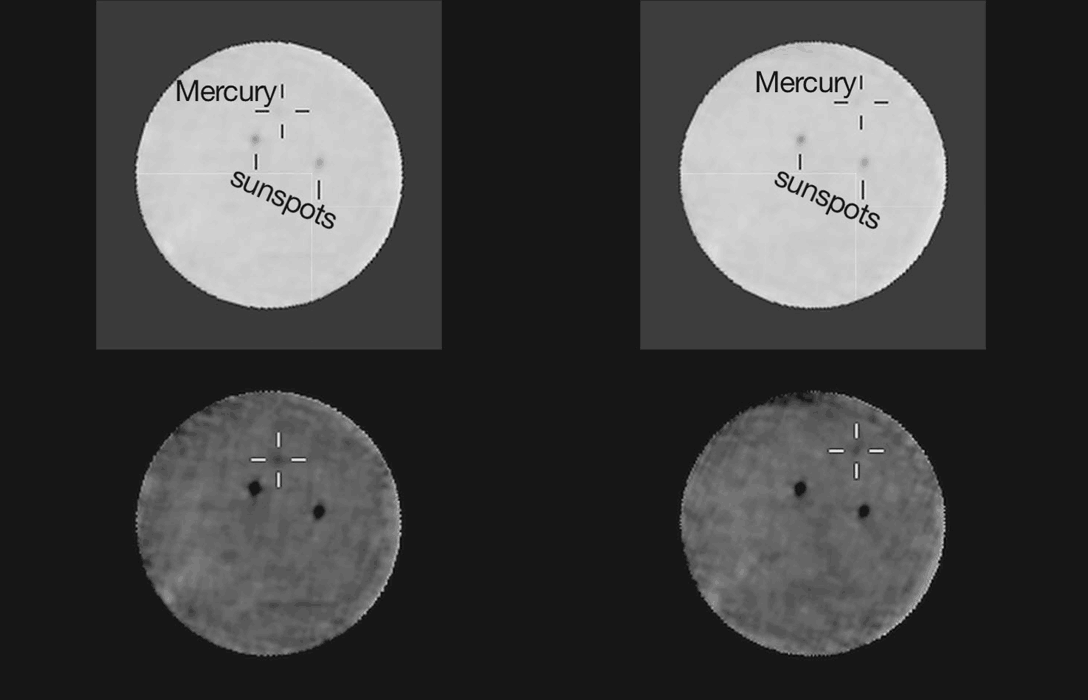
    Curiosity Rover Views Mercury Passing in Front of the Sun
    This animated blink comparison shows five versions of observations that NASA’s Curiosity made about one hour apart while Mercury was passing in front of the sun on June 3, 2014. Two sunspots, each about the diameter of Earth, also appear, moving much less than Mercury during the hour. Credit: NASA/JPL-Caltech/MSSS/Texas A&M

    This new animated image from NASA’s Curiosity rover shows Mercury passing in front of the Sun.

    NASA’s Curiosity Mars rover has imaged the planet Mercury passing in front of the sun, visible as a faint darkening that moves across the face of the sun.

    This is the first transit of the sun by a planet observed from any planet other than Earth, and also the first imaging of Mercury from Mars. Mercury fills only about one-sixth of one pixel as seen from such a great distance, so the darkening does not have a distinct shape, but its position follows Mercury’s expected path based on orbital calculations.

    The observation by the telephoto camera of Curiosity’s two-eyed Mast Camera instrument is available online at: http://www.jpl.nasa.gov/video/?id=1309

    “This is a nod to the relevance of planetary transits to the history of astronomy on Earth,” said Mark Lemmon of Texas A&M University, College Station, a member of the Mastcan science team. “Observations of Venus transits were used to measure the size of the solar system, and Mercury transits were used to measure the size of the sun.”

    The observations were made on June 3, 2014, from Curiosity’s position inside Gale Crater on Mars. In addition to showing the Mercury transit, the same Mastcam frames show two sunspots approximately the size of Earth. The sunspots move only at the pace of the sun’s rotation, much slower than the movement of Mercury.

    Many viewers on Earth observed a Venus transit in June 2012, the last visible from Earth this century. The next Mercury transit visible from Earth will be May 9, 2016. Mercury and Venus transits are visible more often from Mars than from Earth, and Mars also offers a vantage point for seeing Earth transits. The next of each type visible from Mars will be Mercury in April 2015, Venus in August 2030, and Earth in November 2084.

    NASA’s Mars Science Laboratory Project is using Curiosity to assess ancient habitable environments and major changes in Martian environmental conditions. NASA’s Jet Propulsion Laboratory, a division of the California Institute of Technology, Pasadena, built the rover and manages the project for NASA’s Science Mission Directorate in Washington.

    Never miss a breakthrough: Join the SciTechDaily newsletter.
    Follow us on Google and Google News.

    Astronomy Curiosity Rover JPL NASA Texas A&M University
    Share. Facebook Twitter Pinterest LinkedIn Email Reddit

    Related Articles

    NASA’s Curiosity Prepares for Use of Its Arm and Tools

    Curiosity Sends Back Radioed Words and New Telephoto View of Mars

    NASA’s Curiosity Readies for First Drive on Mars

    Curiosity’s ChemCam Laser Analyzes Its First Martian Rock

    Color HiRISE Image of Curiosity Rover on Mars

    First 360-Degree Color Panorama From NASA’s Curiosity Mars Rover

    Curiosity’s First Color Image of Mars

    Image of NASA’s Curiosity and its Parachute Heading Towards the Surface of Mars

    Mission Engineers Prepare for Curiosity’s Landing on Mars

    Leave A Reply Cancel Reply

    • Facebook
    • Twitter
    • Pinterest
    • YouTube

    Don't Miss a Discovery

    Subscribe for the Latest in Science & Tech!

    Trending News

    Scientists Warn That This Common Pet Fish Can Wreck Entire Ecosystems

    Scientists Make Breakthrough in Turning Plastic Trash Into Clean Fuel Using Sunlight

    This Popular Supplement May Interfere With Cancer Treatment, Scientists Warn

    Scientists Finally Solved One of Water’s Biggest Mysteries

    Could This New Weight-Loss Pill Disrupt the Entire Market? Here’s What You Should Know About Orforglipron

    Earth’s Crust Is Tearing Open in Africa, and It Could Form a New Ocean

    Breakthrough Bowel Cancer Trial Leaves Patients Cancer-Free for Nearly 3 Years

    Natural Compound Shows Powerful Potential Against Rheumatoid Arthritis

    Follow SciTechDaily
    • Facebook
    • Twitter
    • YouTube
    • Pinterest
    • Newsletter
    • RSS
    SciTech News
    • Biology News
    • Chemistry News
    • Earth News
    • Health News
    • Physics News
    • Science News
    • Space News
    • Technology News
    Recent Posts
    • The Most Effective Knee Arthritis Treatments Aren’t What You Expect
    • Scientists Develop Bioengineered Chewing Gum That Could Help Fight Oral Cancer
    • Popular Weight-Loss Drugs Found To Cut Heart Attack and Stroke Risk
    • After 37 Years, the World’s Longest-Running Soil Warming Experiment Uncovers a Startling Climate Secret
    • NASA Satellite Captures First-Ever High-Res View of Massive Pacific Tsunami
    Copyright © 1998 - 2026 SciTechDaily. All Rights Reserved.
    • Science News
    • About
    • Contact
    • Editorial Board
    • Privacy Policy
    • Terms of Use

    Type above and press Enter to search. Press Esc to cancel.