
Close Menu
    Facebook X (Twitter) Instagram
    SciTechDaily
    • Biology
    • Chemistry
    • Earth
    • Health
    • Physics
    • Science
    • Space
    • Technology
    Facebook X (Twitter) Pinterest YouTube RSS
    SciTechDaily
    Home»Space»New Research Pokes Holes in the Current Understanding of Galaxy Formation
    Space

    New Research Pokes Holes in the Current Understanding of Galaxy Formation

    By Susan Gawlowicz, Rochester Institute of TechnologyJune 11, 2014No Comments4 Mins Read
    Facebook Twitter Pinterest Telegram LinkedIn WhatsApp Email Reddit
    Share
    Facebook Twitter LinkedIn Pinterest Telegram Email Reddit
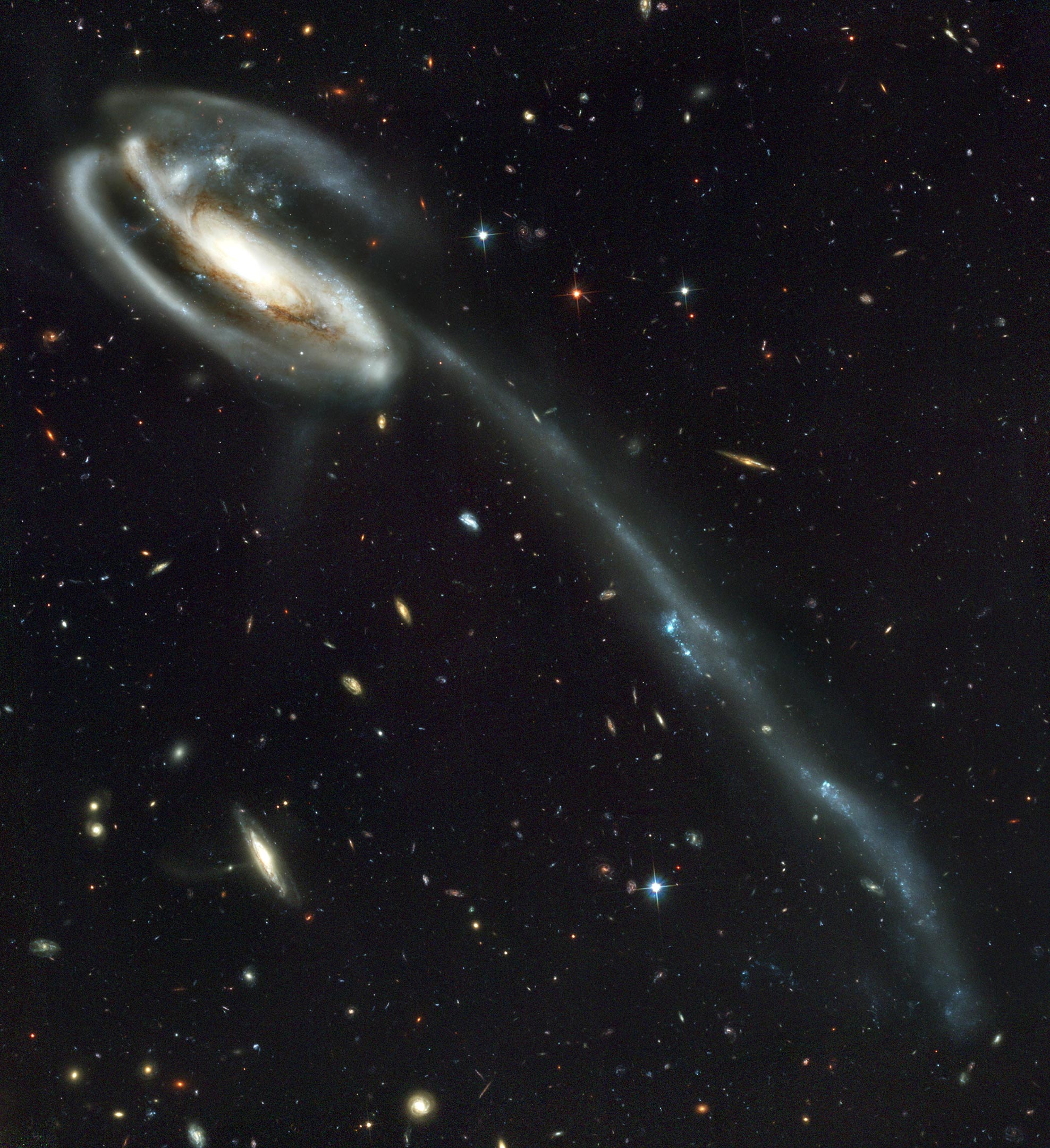
    Tadpole Galaxy UGC 10214 Hubble ACS
    An optical image of the “Tadpole” galaxy, an interacting galaxy, taken by the Hubble Space Telescope. Material stripped from the galaxy during its collision with a smaller galaxy (seen in the upper left corner of the larger interaction partner) forms a long tidal tail. Young blue stars, star clusters, and tidal dwarf galaxies are born in this tidal debris. These objects move in a common direction within a plane defined by the orientation and motion of their tidal tail. A similar galaxy interaction might have occurred in the Local Group in the past, which could explain the distribution of dwarf galaxies in co-rotating planes. Credit: NASA, Holland Ford (JHU), the ACS Science Team, and ESA

    A new study led by Marcel Pawlowski at Case Western Reserve University pokes holes in the current understanding of galaxy formation and questions the accepted model of the origin and evolution of the universe.

    Dwarf galaxies that orbit the Milky Way and the Andromeda galaxies defy the accepted model of galaxy formation, and recent attempts to wedge them into the model are flawed, reports an international team of astrophysicists.

    David Merritt, professor of astrophysics at Rochester Institute of Technology, co-authored “Co-orbiting satellite galaxy structures are still in conflict with the distribution of primordial dwarf galaxies,” to be published in an upcoming issue of Monthly Notices of the Royal Astronomical Society.

    The study pokes holes in the current understanding of galaxy formation and questions the accepted model of the origin and evolution of the universe. According to the standard paradigm, 23 percent of the mass of the universe is shaped by invisible particles known as dark matter.

    “The model predicts that dwarf galaxies should form inside of small clumps of dark matter and that these clumps should be distributed randomly about their parent galaxy,” Merritt said. “But what is observed is very different. The dwarf galaxies belonging to the Milky Way and Andromeda are seen to be orbiting in huge, thin disk-like structures.”

    The study, led by Marcel Pawlowski at Case Western Reserve University, critiques three recent papers by different international teams, all of which concluded that the satellite galaxies support the standard model. The critique by Merritt and his colleagues found “serious issues” with all three studies.

    The team of 14 scientists from six different countries replicated the earlier analyses using the same data and cosmological simulations and came up with much lower probabilities—roughly one-tenth of a percent—that such structures would be seen in the Milky Way and the Andromeda galaxy.

    “The earlier papers found structures in the simulations that no one would say really looked very much like the observed planar structures,” said Merritt.

    In their paper, Merritt and his co-authors write that, “Either the selection of model satellites is different from that of the observed ones, or an incomplete set of observational constraints has been considered, or the observed satellite distribution is inconsistent with basic assumptions. Once these issues have been addressed, the conclusions are different: Features like the observed planar structures are very rare.”

    The standard cosmological model is the frame of reference for many generations of scientists, some of whom are beginning to question its ability to accurately reproduce what is observed in the nearby universe. Merritt counts himself among the small and growing group that is questioning the accepted paradigm.

    “Our conclusion tends to favor an alternate, and much older, model: that the satellites were pulled out from another galaxy when it interacted with the Local Group galaxies in the distant past,” he said. “This ‘tidal’ model can naturally explain why the observed satellites are orbiting in thin disks.”

    Scientific progress embraces challenges to upheld theories and models for a reason, Merritt notes.

    “When you have a clear contradiction like this, you ought to focus on it,” Merritt said. “This is how progress in science is made.”

    Reference: “Co-orbiting satellite galaxy structures are still in conflict with the distribution of primordial dwarf galaxies” by Marcel S. Pawlowski, Benoit Famaey, Helmut Jerjen, David Merritt, Pavel Kroupa, Jörg Dabringhausen, Fabian Lüghausen, Duncan A. Forbes, Gerhard Hensler, François Hammer, Mathieu Puech, Sylvain Fouquet, Hector Flores and Yanbin Yang, 20 June 2014, MNRAS.
    DOI: 10.1093/mnras/stu1005
    arXiv: 1406.1799

    Never miss a breakthrough: Join the SciTechDaily newsletter.
    Follow us on Google and Google News.

    Astronomy Astrophysics Galaxy Evolution Rochester Institute of Technology
    Share. Facebook Twitter Pinterest LinkedIn Email Reddit

    Related Articles

    Ancient Dusty Galaxies Discovered at the Edge of the Universe Rewrite Cosmic History

    Scientists Find Cosmic “Fingerprints” of Mysterious Dark Matter

    NASA’s Webb Telescope Discovers 300 Mysterious Objects That Shouldn’t Exist

    Dwarf Galaxies’ Big Secret: New Study Reveals How They Transform Into Ultra-Compact Dwarfs

    Highly Eccentric Black Hole Merger Detected for the First Time

    Sending a Tiny Telescope Past Saturn Could Solve Some of the Biggest Mysteries of the Universe

    Dissecting the Anatomy of Planetary Nebulae Using the Hubble Space Telescope

    Discovery Solves Decades Old Discrepancies

    Using Infrared Images from Hubble & Spitzer, Scientists Discover 25 Distant Galaxies

    Leave A Reply Cancel Reply

    • Facebook
    • Twitter
    • Pinterest
    • YouTube

    Don't Miss a Discovery

    Subscribe for the Latest in Science & Tech!

    Trending News

    The Universe Is Expanding Too Fast and Scientists Can’t Explain Why

    “Like Liquid Metal”: Scientists Create Strange Shape-Shifting Material

    Early Warning Signals of Esophageal Cancer May Be Hiding in Plain Sight

    Common Blood Pressure Drug Shows Surprising Power Against Deadly Antibiotic-Resistant Superbug

    Scientists Uncover Dangerous Connection Between Serotonin and Heart Valve Disease

    Scientists Discover a “Protector” Protein That Could Help Reverse Hair Loss

    Bone-Strengthening Discovery Could Reverse Osteoporosis

    Scientists Uncover Hidden Trigger Behind Stem Cell Aging

    Follow SciTechDaily
    • Facebook
    • Twitter
    • YouTube
    • Pinterest
    • Newsletter
    • RSS
    SciTech News
    • Biology News
    • Chemistry News
    • Earth News
    • Health News
    • Physics News
    • Science News
    • Space News
    • Technology News
    Recent Posts
    • Forgotten Medicinal Plant Shows Promise in Fighting Dangerous Superbugs
    • Millions Take These IBS Drugs, But a New Study Finds Serious Risks
    • 5 Common Myths About Learning a New Language, Debunked
    • The Neanderthal “Love Story” Isn’t What It Seems
    • Scientists Unlock Hidden Secrets of 2,300-Year-Old Mummies Using Cutting-Edge CT Scanner
    Copyright © 1998 - 2026 SciTechDaily. All Rights Reserved.
    • Science News
    • About
    • Contact
    • Editorial Board
    • Privacy Policy
    • Terms of Use

    Type above and press Enter to search. Press Esc to cancel.