
Discovery of Previously Unknown Effect Makes Compact, Ultra-Fast Control of Spin Qubits Possible
Australian engineers have discovered a new way of precisely controlling single electrons nestled in quantum dots that run logic gates. What’s more, the new mechanism is less bulky and requires fewer parts, which could prove essential to making large-scale silicon quantum computers a reality.
The serendipitous discovery, made by engineers at the quantum computing start-up Diraq and UNSW Sydney, is detailed on January 12 in the journal Nature Nanotechnology.
“This was a completely new effect we’d never seen before, which we didn’t quite understand at first,” said lead author Dr. Will Gilbert, a quantum processor engineer at Diraq, a UNSW spin-off company based at its Sydney campus. “But it quickly became clear that this was a powerful new way of controlling spins in a quantum dot. And that was super exciting.”
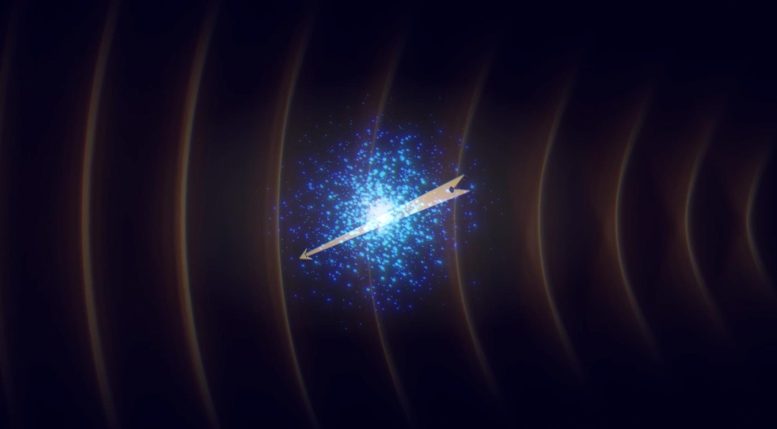
Logic gates are the basic building block of all computation; they allow ‘bits’ – or binary digits (0s and 1s) – to work together to process information. However, a quantum bit (or qubit) exists in both of these states at once, a condition known as a ‘superposition’. This allows a multitude of computation strategies – some exponentially faster, some operating simultaneously – that are beyond classical computers. Qubits themselves are made up of ‘quantum dots’, tiny nanodevices which can trap one or a few electrons. Precise control of the electrons is necessary for computation to occur.
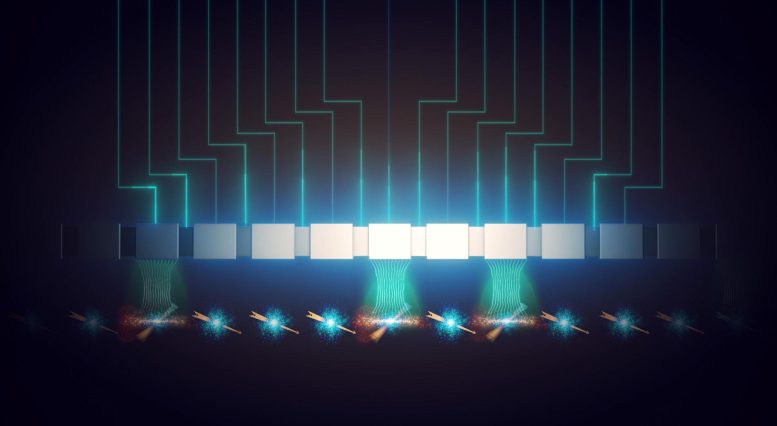
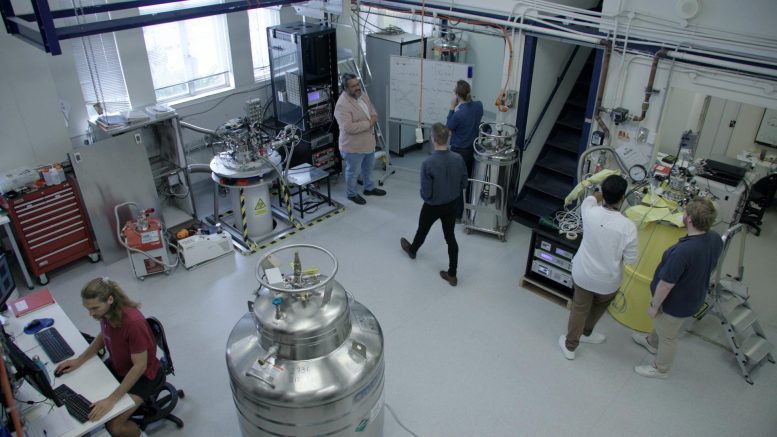
Diraq engineers have discovered a new way of precisely controlling single electrons nestled in quantum dots that run logic gates, bringing the reality of achieving billion-qubit quantum chips closer. What’s more, the new mechanism is less bulky and requires fewer parts, which could prove essential to making large-scale silicon quantum computers a reality. Credit: Diraq
Using Electric Rather Than Magnetic Fields
While experimenting with different geometrical combinations of devices just billionths of a meter in size that control quantum dots, along with various types of minuscule magnets and antennas that drive their operations, Dr. Tuomo Tanttu stumbled across a strange effect.
“I was trying to really accurately operate a two-qubit gate, iterating through a lot of different devices, slightly different geometries, different materials stacks, and different control techniques,” recalls Dr. Tanttu, a measurement engineer at Diraq. “Then this strange peak popped up. It looked like the rate of rotation for one of the qubits was speeding up, which I’d never seen in four years of running these experiments.”
What he had discovered, the engineers later realized, was a new way of manipulating the quantum state of a single qubit by using electric fields, rather than the magnetic fields they had been using previously. Since the discovery was made in 2020, the engineers have been perfecting the technique – which has become another tool in their arsenal to fulfil Diraq’s ambition of building billions of qubits on a single chip.
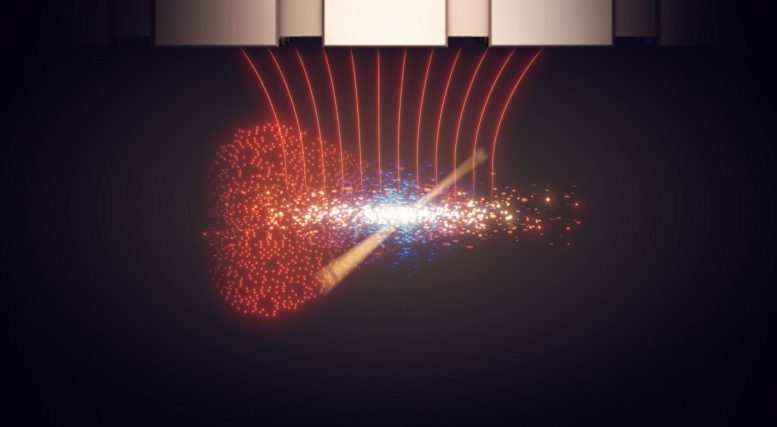
“This is a new way to manipulate qubits, and it’s less bulky to build – you don’t need to fabricate cobalt micro-magnets or an antenna right next to the qubits to generate the control effect,” said Gilbert. “It removes the requirement of placing extra structures around each gate. So, there’s less clutter.”
Controlling single electrons without disturbing others nearby is essential for quantum information processing in silicon. There are two established methods: ‘electron spin resonance’ (ESR) using an on-chip microwave antenna; and electric dipole spin resonance (EDSR), which relies on an induced gradient magnetic field. The newly discovered technique is known as ‘intrinsic spin-orbit EDSR’.
“Normally, we design our microwave antennas to deliver purely magnetic fields,” said Dr. Tanttu. “But this particular antenna design generated more of an electric field than we wanted – and that turned out to be lucky, because we discovered a new effect we can use to manipulate qubits. That’s serendipity for you.”
Discovery Brings Silicon Quantum Computing Closer
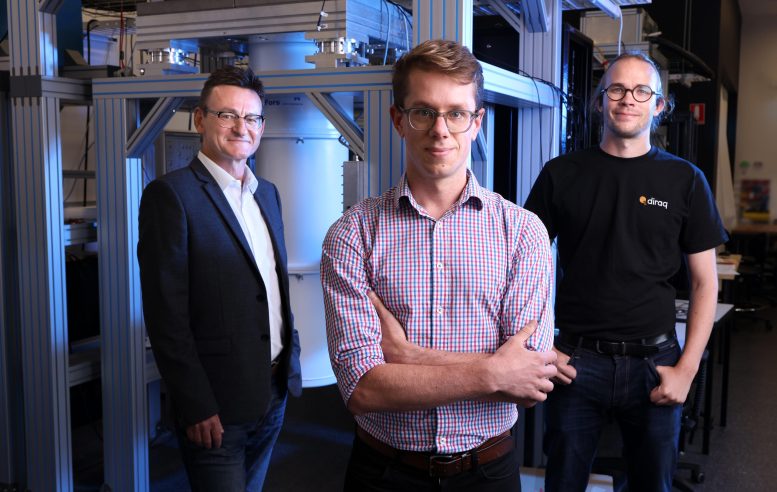
“This is a gem of new mechanism, which just adds to the trove of proprietary technology we’ve developed over the past 20 years of research,” said Prof Andrew Dzurak, CEO and Founder of Diraq, and a Professor in Quantum Engineering at UNSW, who led the team that built the first quantum logic gate in silicon in 2015.
“It builds on our work to make quantum computing in silicon a reality, based on essentially the same semiconductor component technology as existing computer chips, rather than relying on exotic materials,” he added. “Since it is based on the same CMOS technology as today’s computer industry, our approach will make it easier and faster to scale up for commercial production and achieve our goal of fabricating billions of qubits on a single chip.”
CMOS (or complementary metal-oxide-semiconductor, pronounced ‘see-moss’) is the fabrication process at the heart of modern computers. It is used for making all sorts of integrated circuit components – including microprocessors, microcontrollers, memory chips, and other digital logic circuits, as well as analog circuits such as image sensors and data converters.
Building a quantum computer has been called the “space race of the 21st century” – a difficult and ambitious challenge with the potential to deliver revolutionary tools for tackling otherwise impossible calculations, such as the design of complex drugs and advanced materials, or the rapid search of massive, unsorted databases.
“We often think of landing on the Moon as humanity’s greatest technological marvel,” said Dzurak. “But the truth is, today’s CMOS chips – with billions of operating devices integrated together to work like a symphony, and which you carry in your pocket – that’s an astounding technical achievement, and one that’s revolutionized modern life. Quantum computing will be equally astonishing.”
Reference: “On-demand electrical control of spin qubits” by Will Gilbert, Tuomo Tanttu, Wee Han Lim, MengKe Feng, Jonathan Y. Huang, Jesus D. Cifuentes, Santiago Serrano, Philip Y. Mai, Ross C. C. Leon, Christopher C. Escott, Kohei M. Itoh, Nikolay V. Abrosimov, Hans-Joachim Pohl, Michael L. W. Thewalt, Fay E. Hudson, Andrea Morello, Arne Laucht, Chih Hwan Yang, Andre Saraiva and Andrew S. Dzurak, 12 January 2023, Nature Nanotechnology.
DOI: 10.1038/s41565-022-01280-4
About Diraq
Diraq aims to redefine scalable quantum computing by creating billions of qubits on a single chip, compared to the hundreds of qubits possible today. Relying on proprietary technology developed over 20 years of research and with over A$100 million in funding across nine patent families, Diraq’s approach relies on the existing silicon manufacturing processes used by foundries to produce today’s semiconductor components, known as CMOS, forging a faster and cheaper road to market. It aims to be an end-to-end quantum computing provider, creating quantum hardware and software as a full-stack, cloud-accessible service.
About UNSW Engineering
UNSW Engineering is the powerhouse of engineering research in Australia, made up of nine schools and 36 research centers. Ranked in the world’s top 50 engineering faculties and equal fifth globally in sustainability (equal first in Australia); it’s also ranked #1 in Australia for graduates who create start-ups. UNSW itself tops the list of Australian universities with the most millionaire graduates.
Never miss a breakthrough: Join the SciTechDaily newsletter.
Follow us on Google and Google News.
4 Comments
Awesome, good work keep it up
Can you please stop making these kind of misleading article with catching titles that are the farthest thing from reality you could have? Clearly the author of this piece either doesn’t know anything about QM-stuff or their main intent is to incentivise click-based articles as mediocre as theirs.
Spin is natural intrinsic quantum property of electron has magnitude 1/2.But,artificial spin geñerated here in qubits is due to magnetism of
rotation of electron produced from applied electric field on these precisely.
Still seems like a QC is a long way off- about as far as fusion!