

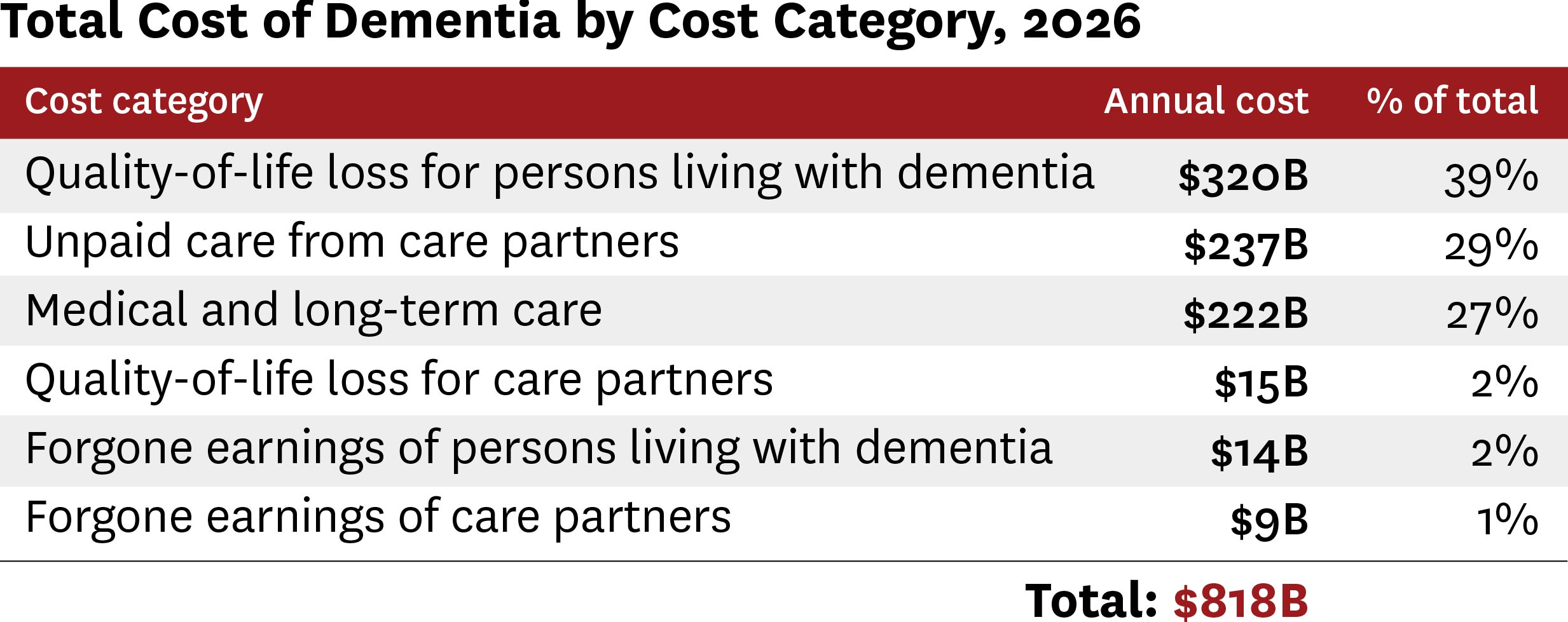
Lost quality of life accounts for the largest share of dementia’s estimated $818 billion U.S. toll, offering a broader measure of what better care could preserve.
Family members and friends caring for Americans with dementia provide billions of hours of unpaid help, often during their prime working years. Their time, lost earnings, and the physical and emotional strain of caregiving contribute to an economic burden that reaches far beyond medical bills.
A new study led by the University of Southern California (USC) estimates that Alzheimer’s disease and related dementias will cost the United States $818 billion in 2026, driven largely by costs borne by people living with dementia and those who care for them. The figure includes medical and long-term care spending alongside the estimated value of unpaid caregiving, forgone earnings, and diminished quality of life. These broader losses often go uncounted in other estimates of dementia’s economic toll.
As new care models help people with dementia stay at home longer while supporting their families, the distribution of care costs could change. New therapies are also slowing Alzheimer’s, and FDA-approved blood tests can detect the disease before symptoms appear.
“Remarkable innovations can alter the trajectory of dementia in the United States if they are used effectively,” said Dana Goldman, founding director of the USC Schaeffer Institute. “The evidence we are building on dementia costs will provide the healthcare system with a clearer understanding of these and future innovations.”
Dementia’s largest cost is lost well-being
Understanding those changes requires accounting for both the money spent on care and the losses absorbed by patients and families. The study, published in Alzheimer’s & Dementia: The Journal of the Alzheimer’s Association, estimates the following for 2026:
- Dementia population: An estimated 5.7 million Americans are living with dementia, including 5.1 million ages 65 and older.
- Quality of life: Declines in cognition, function, and independence among people with dementia account for $320 billion in estimated quality-of-life losses, the largest component of the total cost. Informal care partners experience an additional $15 billion in losses related to emotional and physical strain.
- Unpaid caregiving: About 5.2 million people provide 6.8 billion hours of unpaid care for family members or friends with dementia. The model values that time at $237 billion.
- Medical and long-term care: These costs total $222 billion. Medicare and Medicaid cover about 70%, or $154 billion, while patients and families pay 20%, or $46 billion, out of pocket.
- Lost earnings: People with dementia and their care partners forgo a combined $23 billion in annual earnings.
These estimates come from the U.S. Cost of Dementia Project, a multiyear research effort funded through a cooperative agreement with the National Institute on Aging. Researchers build the model using large, nationally representative datasets, including the Health and Retirement Study and administrative health data from the Centers for Medicare and Medicaid Services.
The accounting is still being refined. Following last year’s inaugural report, the researchers expanded the 2026 peer-reviewed estimates to include forgone earnings among people living with dementia and new models of health-related quality-of-life impacts on care partners. They also published a peer-reviewed methods paper this year to make their data, assumptions, and modeling accessible and transparent.
Forecasting who will bear dementia’s costs
Beyond calculating annual totals, the team uses dynamic microsimulation, a method that follows simulated individuals over time, to project how new treatments, care models, and policies could affect future dementia costs. Those projections include often-hidden consequences for well-being and finances. The project aims to provide the most comprehensive accounting yet of dementia’s economic impact, tracking changes in who bears the costs and when to inform policy and treatment decisions.
“By providing annual, comprehensive and transparent estimates of dementia’s total costs, our research can help guide decisions about how to allocate resources as the dementia population is set to grow substantially,” said lead researcher Julie Zissimopoulos, principal investigator of the U.S. Cost of Dementia Project, co-director of the Aging and Cognition program at the USC Schaeffer Center for Health Policy & Economics, and a professor at the USC Price School of Public Policy. “With our modeling approach, we can ask and answer questions such as: How will a new treatment that slows dementia improve quality of life or affect demand for nursing home care?”
Reference: “The cost of dementia in the United States in 2026” by Johanna Thunell, Bryan Tysinger, Matthew Baumgart, Maria Carrillo, Eileen Crimmins, Dana Goldman, Hanke Heun-Johnson, Mireille Jacobson, Geoff Joyce, Duncan Leaf, Lycia Tramujas Vasconcellos Neumann and Julie Zissimopoulos, 24 June 2026, Alzheimer’s & Dementia.
DOI: 10.1002/alz.71480
This work was funded through a cooperative agreement with the National Institute on Aging (U01AG086827).
Never miss a breakthrough: Join the SciTechDaily newsletter.
Follow us on Google and Google News.