
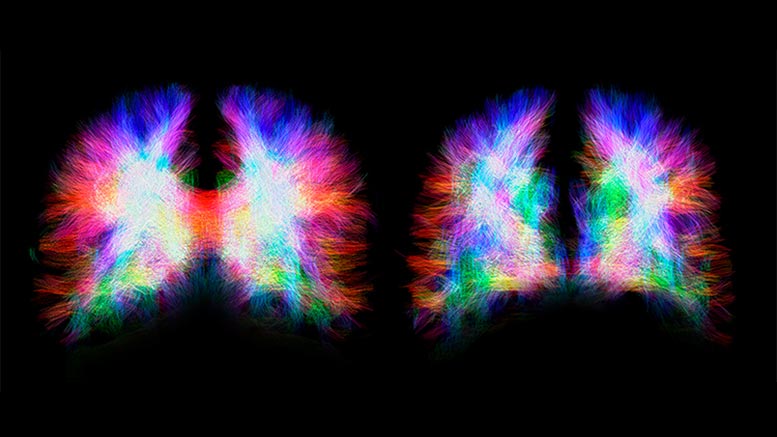
People born without a corpus callosum do not have a bridge between the two cerebral hemispheres. Neuroscientists from UNIGE have shown how the brain manages to adapt.
One in 4,000 people is born without a corpus callosum, a brain structure consisting of neural fibers that are used to transfer information from one hemisphere to the other. A quarter of these individuals do not have any symptoms, while the remainder either have low intelligence quotients or suffer from severe cognitive disorders. In a study published in the journal Cerebral Cortex, neuroscientists from the University of Geneva (UNIGE) discovered that when the neuronal fibers that act as a bridge between the hemispheres are missing, the brain reorganizes itself and creates an impressive number of connections inside each hemisphere. These create more intra-hemispheric connections than in a healthy brain, indicating that plasticity mechanisms are involved. It is thought that these mechanisms enable the brain to compensate for the losses by recreating connections to other brain regions using alternative neural pathways.
The corpus callosum develops in utero between the tenth and twentieth week of gestation. Agenesis of the corpus callosum is a congenital brain malformation in which this brain structure fails to develop, resulting in one out of 4,000 babies born without a corpus callosum. When it is missing, nothing replaces this structure measuring about ten centimeters, with the exception of cerebrospinal fluid. This means that the information transmitted from one hemisphere to the other can no longer be conveyed by the neuronal projections from the corpus callosum. “Their role in a healthy brain,” begins Vanessa Siffredi, a researcher in UNIGE’s Faculty of Medicine, “is to ensure the functioning of various cognitive and sensorimotor functions.” Surprisingly, 25% of people with this malformation have no visible signs; 50% have average intelligence quotients and learning difficulties; and the remaining 25% suffer from severe cognitive disorders.
Mysterious fibers
The scientific literature shows that, in the absence of the corpus callosum, certain fibers designed to serve as a bridge between the hemispheres, known as Probst bundles, bypass the absent brain area and curl up inside each hemisphere. “The back-up zones vary from one individual to another. And we don’t understand their functions,” explains the neuroscientist. The UNIGE scientists – working in collaboration with their colleagues at the University of Melbourne – set out to understand this variability and to examine the role of the fibers. Using MRI brain imaging, they studied the anatomical and functional links between different brain regions of approximately 20 Australian children aged 8 to 17 suffering from agenesis of the corpus callosum.
A salutary role
This approach first made it possible to observe the physical relationships between the different regions of the brain, i.e. their structural links. In children with corpus callosum agenesis, the neural fibers inside each hemisphere are greater in number and of higher quality than in healthy brains. Furthermore, the UNIGE scientists succeeded in determining the correlations between the activity of different brain regions and their functional links. “If two regions are active together, it means they are communicating with each other,” explains Dr. Siffredi. The data shows that intra- and inter-hemispheric functional connectivity of brains without the corpus callosum are comparable to those of healthy brains. “Remarkably, communication between the two hemispheres is maintained. We think that plasticity mechanisms, such as the strengthening of structural bonds within each hemisphere, compensated for the lack of neuronal fibers between hemispheres. New connections are created and the signals can be re-routed so that communication is preserved between the two hemispheres.”
Predicting cognitive impairment
The Geneva neuroscientists likewise observed a correlation between the increase in intra-hemispheric connections and cognitive skills. This information is very interesting for clinical work since, as agenesis is currently detected by means of ultrasound during pregnancy, it is often proposed that a pregnancy be terminated. “In the not-too-distant future, we could imagine using MRI imaging to predict whether the malformation observed by ultrasound runs the risk of being associated with cognitive impairment or not, and so better inform future parents,” concludes Dr. Siffredi.
Reference: “Structural Neuroplastic Responses Preserve Functional Connectivity and Neurobehavioural Outcomes in Children Born Without Corpus Callosum” by Vanessa Siffredi, Maria G Preti, Valeria Kebets, Silvia Obertino, Richard J Leventer, Alissandra McIlroy, Amanda G Wood, Vicki Anderson, Megan M Spencer-Smith and Dimitri Van De Ville, 27 October 2020, Cerebral Cortex.
DOI: 10.1093/cercor/bhaa289
Never miss a breakthrough: Join the SciTechDaily newsletter.
Follow us on Google and Google News.