
Close Menu
    Facebook X (Twitter) Instagram
    SciTechDaily
    • Biology
    • Chemistry
    • Earth
    • Health
    • Physics
    • Science
    • Space
    • Technology
    Facebook X (Twitter) Pinterest YouTube RSS
    SciTechDaily
    Home»Space»Hubble Sees Barred Spiral Galaxy NGC 4700
    Space

    Hubble Sees Barred Spiral Galaxy NGC 4700

    By NASAJuly 27, 2012No Comments2 Mins Read
    Facebook Twitter Pinterest Telegram LinkedIn WhatsApp Email Reddit
    Share
    Facebook Twitter LinkedIn Pinterest Telegram Email Reddit
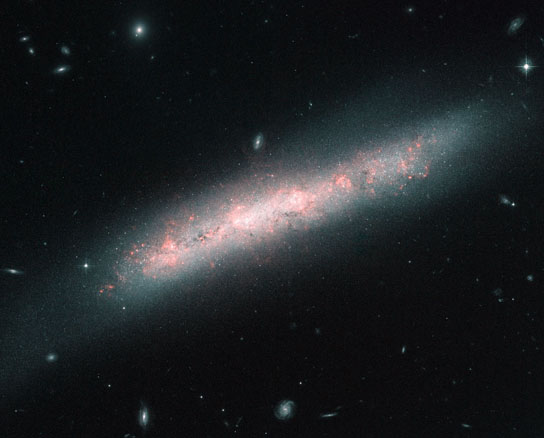
    The galaxy NGC 4700
    NGC 4700, a barred spiral galaxy in the Virgo constellation, lies about 50 million light-years away.

    Discovered in March 1786 and located in the constellation of Virgo, NGC 4700 is classified as a barred spiral galaxy and is about 50 million light-years away from us.

    The galaxy NGC 4700 bears the signs of the vigorous birth of many new stars in this image captured by the NASA/ESA Hubble Space Telescope.

    The many bright, pinkish clouds in NGC 4700 are known as H II regions, where intense ultraviolet light from hot young stars is causing nearby hydrogen gas to glow. H II regions often come part-and-parcel with the vast molecular clouds that spawn fresh stars, thus giving rise to the locally-ionized gas.

    In 1610, French astronomer Nicolas-Claude Fabri de Peiresc peered through a telescope and found what turned out to be the first H II region on record: the Orion Nebula, located relatively close to our Solar System here in the Milky Way. Astronomers study these regions throughout the Milky Way and those easily seen in other galaxies to gauge the chemical makeup of cosmic environments and their influence on the formation of stars.

    NGC 4700 appears to be an edge-on galaxy. It was discovered back in March 1786 by the British astronomer William Herschel who noted it as a “very faint nebula.” NGC 4700, along with many other relatively close galaxies, is found in the constellation of Virgo (The Virgin) and is classified as a barred spiral galaxy, similar in structure to the Milky Way. It lies about 50 million light-years from us and is moving away from us at about 1400 km/second due to the expansion of the Universe.

    Never miss a breakthrough: Join the SciTechDaily newsletter.
    Follow us on Google and Google News.

    Galaxy Hubble Space Telescope NASA
    Share. Facebook Twitter Pinterest LinkedIn Email Reddit

    Related Articles

    A Spiral Within a Spiral, Galaxy ESO 498-G5

    Hubble Captures Image of NGC 891 in the Constellation of Andromeda

    Looking Inside a Stellar Cloud

    Hubble Captures New Image of Messier 9

    Brightest Gravitationally Magnified Galaxy Discovered

    Stars of the Antlia Dwarf Galaxy

    Dark Matter Core of Abell 520 Differs from Bullet Cluster

    Researchers Discover First Intermediate-Mass Black Hole

    Hubble Observes Rare Blue Stars in Andromeda’s Core

    Leave A Reply Cancel Reply

    • Facebook
    • Twitter
    • Pinterest
    • YouTube

    Don't Miss a Discovery

    Subscribe for the Latest in Science & Tech!

    Trending News

    This Experimental Drug Repaired the Gut and Reversed Severe Fatty Liver Disease

    Physicists Just Turned a Black Hole Energy Theory Into Reality

    Stanford Scientists Solve a 252-Million-Year-Old Mass Extinction Mystery

    The Ancient Survival Mechanism Making Weight Loss So Difficult

    Just 3,000 Steps a Day May Help Protect the Brain From Alzheimer’s

    “Weird Clams” Reveal a New Invasion Along the U.S. Northeast Coast

    Archaeologists Decapitated Tutankhamun and Glued His Body Back Together

    New Black Hole Theory Solves a 50-Year-Old Problem

    Follow SciTechDaily
    • Facebook
    • Twitter
    • YouTube
    • Pinterest
    • Newsletter
    • RSS
    SciTech News
    • Biology News
    • Chemistry News
    • Earth News
    • Health News
    • Physics News
    • Science News
    • Space News
    • Technology News
    Recent Posts
    • The Oldest Known Right-Handed Animal May Have Lived 550 Million Years Ago
    • MIT’s Tiny Flying Robot Just Learned To Move Like a Real Insect
    • Why Are Bees Struggling To Survive This Summer?
    • Antarctic Meltwater Is Making Glaciers Slide Faster Toward the Ocean
    • Ancient Dog Skulls Rewrite the Story of Canine Evolution
    Copyright © 1998 - 2026 SciTechDaily. All Rights Reserved.
    • Science News
    • About
    • Contact
    • Editorial Board
    • Privacy Policy
    • Terms of Use

    Type above and press Enter to search. Press Esc to cancel.