
Close Menu
    Facebook X (Twitter) Instagram
    SciTechDaily
    • Biology
    • Chemistry
    • Earth
    • Health
    • Physics
    • Science
    • Space
    • Technology
    Facebook X (Twitter) Pinterest YouTube RSS
    SciTechDaily
    Home»Earth»Oil in the Ocean Weathered by Photooxidation in Just Hours to Days
    Earth

    Oil in the Ocean Weathered by Photooxidation in Just Hours to Days

    By University of Miami Rosenstiel School of Marine & Atmospheric ScienceMarch 18, 2021No Comments4 Mins Read
    Facebook Twitter Pinterest Telegram LinkedIn WhatsApp Email Reddit
    Share
    Facebook Twitter LinkedIn Pinterest Telegram Email Reddit
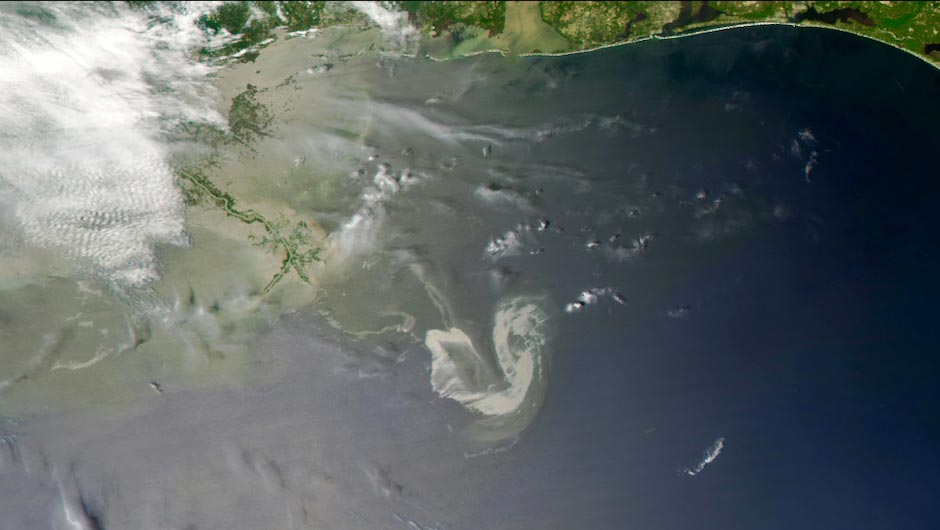
    Deepwater Horizon Oil Spill Satellite Image
    Satellite image taken on May 9, 2010 of the Deepwater Horizon oil spill site in the Gulf of Mexico. Credit: MODIS on NASA’s AQUA satellite, May 9, 2010 @ 190848 UTC. Downlink and processed at the UM Rosenstiel School’s Center for Southeastern Tropical Advanced Remote Sensing (CSTARS)

    Study provides new details on the fate of spilled oil in the marine environment, effectiveness of chemical dispersants.

    A new study lead by scientists at the University of Miami (UM) Rosenstiel School of Marine and Atmospheric Science demonstrates that under realistic environmental conditions oil drifting in the ocean after the DWH oil spill photooxidized into persistent compounds within hours to days, instead over long periods of time as was thought during the 2010 Deepwater Horizon oil spill. This is the first model results to support the new paradigm of photooxidation that emerged from laboratory research.

    After an oil spill, oil droplets on the ocean surface can be transformed by a weathering process known as photooxidation, which results in the degradation of crude oil from exposure to light and oxygen into new by-products over time. Tar, a by-product of this weathering process, can remain in coastal areas for decades after a spill. Despite the significant consequences of this weathering pathway, photooxidation was not taken into account in oil spill models or the oil budget calculations during the Deepwater Horizon spill.
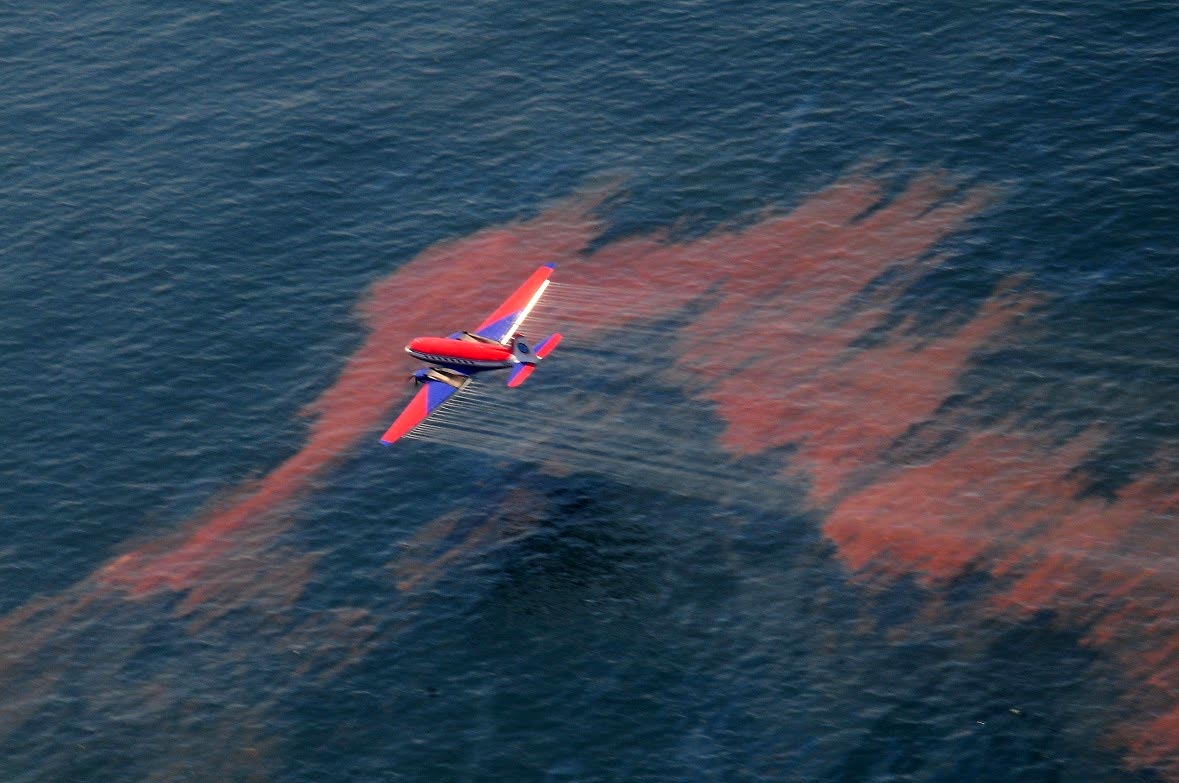
    Droping Dispersants on Sunlight-Weathered Oil
    The crew of a Basler BT-67 fixed-wing aircraft releases oil dispersant over an oil discharge from the mobile offshore drilling unit, Deepwater Horizon, off the shore of Louisiana, May 5, 2010. Credit: U.S. Coast Guard photo by Petty Officer 3rd Class Stephen Lehmann.

    The UM Rosenstiel School research team developed the first oil-spill model algorithm that tracks the dose of solar radiation oil droplets receive as they rise from the deep sea and are transported at the ocean surface. The authors found that the weathering of oil droplets by solar light occurred within hours to days, and that roughly 75 percent of the photooxidation during the Deepwater Horizon oil spill occurred on the same areas where chemical dispersants were sprayed from aircraft. Photooxidized oil is known to reduce the effectiveness of aerial dispersants.

    “Understanding the timing and location of this weathering process is highly consequential. said Claire Paris, a UM Rosenstiel School faculty and senior author of the study. “It helps directing efforts and resources on fresh oil while avoiding stressing the environment with chemical dispersants on oil that cannot be dispersed.”

    Deepwater Horizon Surface Dispersant Application
    Surface dispersant application (red tracks) and their envelope (gray polygon) during the Deepwater Horizon oil spill. Dashed and solid circles represent areas containing Q75 percentile of POCs formation, at a radial distance of 83 km and 111 km for the low and high thresholds, respectively; 93.9% and 99.3% of surface dispersant applications (total ca. 973,000 Gallons) occurred in the region where 75% of POC formation occurred, for the lower solar irradiance threshold (1.16*107 J m -2) and higher irradiance threshold (6.60*107 J m -2, Ward et al., 2018a), respectively. Credit: University of Miami Rosenstiel School of Marine & Atmospheric Science

    “Photooxidized compounds like tar persist longer in the environment, so modeling the likelihood of photooxidation is critically important not only for guiding first response decisions during an oil spill and restoration efforts afterward, but it also needs to be taken into account on risk assessments before exploration activities,” added Ana Carolina Vaz, assistant scientist at UM’s Cooperative Institute for Marine and Atmospheric Studies and lead author of the study.

    Reference: “A Coupled Lagrangian-Earth System Model for Predicting Oil Photooxidation” by Ana Carolina Vaz, Claire Beatrix Paris and Robin Faillettaz, 19 February 2021, Frontiers in Marine Science.
    DOI: 10.3389/fmars.2021.576747

    The study was supported by the Gulf of Mexico Research Initiative (GoMRI): C-IMAGE III (Center for the Integrated Modeling and Analysis of the Gulf Ecosystem) and RECOVER 2 (Relationship of Effects of Cardiac Outcomes in fish for Validation of Ecological Risk).

    Never miss a breakthrough: Join the SciTechDaily newsletter.
    Follow us on Google and Google News.

    Ecology Oceanography Pollution University of Miami
    Share. Facebook Twitter Pinterest LinkedIn Email Reddit

    Related Articles

    UN Decade on Ecosystem Restoration: UN Urges Intense Restoration of Nature to Address Climate and Biodiversity Crises

    Science and Social Media Show How Ship’s Plastic Cargo Dispersed From Florida to Norway

    Scientists Sound Alarm: Unprecedented Mercury Accumulation in Pacific Ocean Trenches

    Urgent Need for More Research on the Impact of Sunscreen on Coral Reefs

    A Sea of Garbage: Ocean Floor Landfills

    Stanford Researchers Develop an Innovative New Way to Predict Beach Water Quality

    Toxic Oil Spread From Deepwater Horizon Was Actually Larger Than Previously Thought

    Washington State Launches New Plan to Combat Ocean Acidification

    New Chinese Survey Reveals Extensive Coastal Pollution

    Leave A Reply Cancel Reply

    • Facebook
    • Twitter
    • Pinterest
    • YouTube

    Don't Miss a Discovery

    Subscribe for the Latest in Science & Tech!

    Trending News

    Scientists May Have Discovered How To Heal Damaged Kidneys

    Interstellar Visitor 3I/ATLAS Is Bursting With an Unexpected Chemical

    Scientists Just Found All 5 Genetic “Letters” of DNA and RNA on an Asteroid

    The 4,000-Year-Old City That Defied History’s Rules on Wealth and Power

    The World’s Biggest Population Fear Has Flipped – and It Could Change Everything

    This “Fake” Pill Improved Memory and Physical Performance in Just 3 Weeks

    Scientists Say Frequent Ejaculation May Improve Sperm Quality and Fertility

    Scientists Have Found “The Heaven Sword” After Years of Looking

    Follow SciTechDaily
    • Facebook
    • Twitter
    • YouTube
    • Pinterest
    • Newsletter
    • RSS
    SciTech News
    • Biology News
    • Chemistry News
    • Earth News
    • Health News
    • Physics News
    • Science News
    • Space News
    • Technology News
    Recent Posts
    • Common Laxative May Help Reverse Depression-Related Brain Fog
    • The Surprising Reason Frozen Fruit May Be Just As Nutritious as Fresh
    • Scientists Discover the Oldest Known Fossils of Humans’ Closest Invertebrate Relatives
    • Watch What Happened When a Lost Elephant Calf Returned to Her Family
    • 17,000 Brain Scans Reveal Surprising Ethnic Differences in Alzheimer’s Biology
    Copyright © 1998 - 2026 SciTechDaily. All Rights Reserved.
    • Science News
    • About
    • Contact
    • Editorial Board
    • Privacy Policy
    • Terms of Use

    Type above and press Enter to search. Press Esc to cancel.