
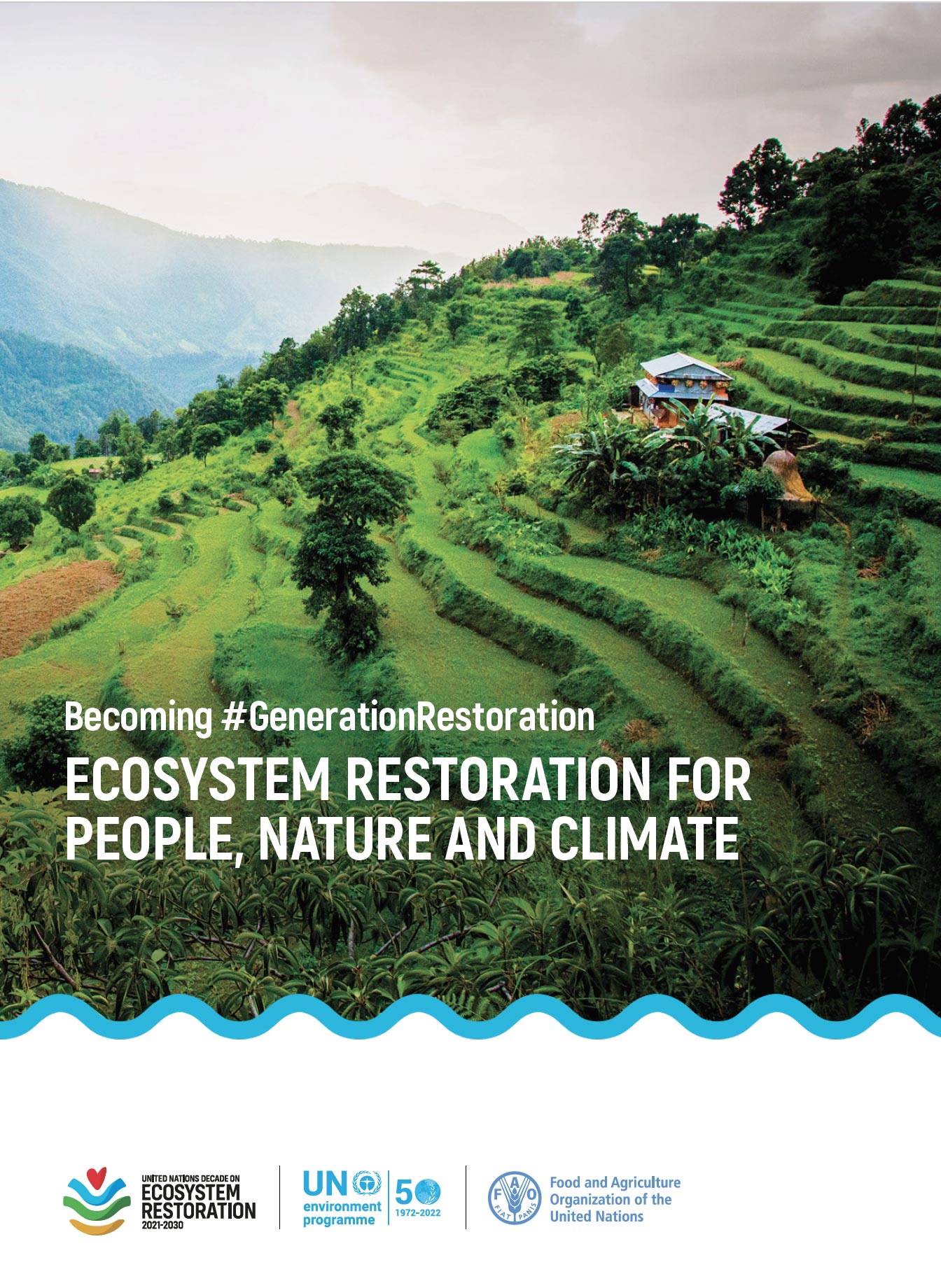
Launching the UN Decade on Ecosystem Restoration, UN calls on countries to meet commitments to restore 1 billion hectares of land.
Facing the triple threat of climate change, loss of nature and pollution, the world must deliver on its commitment to restore at least one billion degraded hectares of land in the next decade — an area about the size of China. Countries also need to add similar commitments for oceans, according to a new report by the UN Environment Programme (UNEP) and the Food and Agriculture Organization of the UN (FAO), launched as the UN Decade on Ecosystem Restoration 2021-2030 gets underway.
The report, #GenerationRestoration: Ecosystem restoration for People, Nature and Climate, highlights that humanity is using about 1.6 times the amount of services that nature can provide sustainably.
Economic and Ecological Incentives for Restoration
That means conservation efforts alone are insufficient to prevent large-scale ecosystem collapse and biodiversity loss. Global terrestrial restoration costs — not including costs of restoring marine ecosystems — are estimated to be at least USD 200 billion per year by 2030. The report outlines that every 1 USD invested in restoration creates up to USD 30 in economic benefits.
Ecosystems requiring urgent restoration include farmlands, forests, grasslands and savannahs, mountains, peatlands, urban areas, freshwaters, and oceans.
Communities living across almost two billion of degraded hectares of land include some of the world’s poorest and marginalized.
“This report presents the case for why we must all throw our weight behind a global restoration effort. Drawing on the latest scientific evidence, it sets out the crucial role played by ecosystems, from forests and farmland to rivers and oceans, and it charts the losses that result from a poor stewardship of the planet,” UNEP Executive Director, Inger Andersen, and FAO Director-General, QU Dongyu, wrote in the report’s foreword.
“Degradation is already affecting the well-being of an estimated 3.2 billion people — that is 40 percent of the world’s population. Every single year we lose ecosystem services worth more than 10 percent of our global economic output,” they added, stressing that “massive gains await us” by reversing these trends.
Restoration Benefits for Climate, Health, and Biodiversity
Ecosystem restoration is the process of halting and overturning degradation, resulting in cleaner air and water, extreme weather mitigation, better human health, and recovered biodiversity, including improved pollination of plants. Restoration encompasses a wide continuum of practices, from reforestation to re-wetting peatlands and coral rehabilitation.
It contributes to the realization of multiple Sustainable Development Goals (SDGs), including health, clean water, and peace and security, and to the objectives of the three ‘Rio Conventions’ on Climate, Biodiversity, and Desertification.
Actions that prevent, halt and reverse degradation are necessary to meet the Paris Agreement target of keeping global temperature rise well below 2 degrees Celsius.
Restoration Efficiency and Economic Multipliers
Restoration, if combined with stopping further conversion of natural ecosystems, may help avoid 60 percent of expected biodiversity extinctions. It can be highly efficient in producing multiple economic, social and ecological benefits concurrently — for example, agroforestry alone has the potential to increase food security for 1.3 billion people, while investments in agriculture, mangrove protection and water management will help adapt to climate change, with benefits around four times the original investment.
Reliable monitoring of restoration efforts is essential, both to track progress and to attract private and public investments. In support of this effort, FAO and UNEP also launch today the Digital Hub for the UN Decade, which includes the Framework for Ecosystem Restoration Monitoring.
The Framework enables countries and communities to measure the progress of restoration projects across key ecosystems, helping to build ownership and trust in restoration efforts. It also incorporates the Drylands Restoration Initiatives Platform, which collects and analyses data, shares lessons and assists in the design of drylands restoration projects, and an interactive geospatial mapping tool to assess the best locations for forest restoration.
Restoration must involve all stakeholders including individuals, businesses, associations, and governments. Crucially, it must respect the needs and rights of Indigenous Peoples and local communities, and incorporate their knowledge, experience and capacities to ensure restoration plans are implemented and sustained.
About the UN Decade on Ecosystem Restoration
The UN Decade on Ecosystem Restoration 2021-2030 is a rallying call for the protection and revival of ecosystems all around the world, for the benefit of people and nature. It aims to halt the degradation of ecosystems and restore them to achieve global goals. The United Nations General Assembly has proclaimed the UN Decade and it is led by the United Nations Environment Programme and the Food and Agriculture Organization of the United Nations. The UN Decade is building a strong, broad-based global movement to ramp up restoration and put the world on track for a sustainable future. That will include building political momentum for restoration as well as thousands of initiatives on the ground.
About the UN Environment Programme (UNEP)
UNEP is the leading global voice on the environment. It provides leadership and encourages partnership in caring for the environment by inspiring, informing and enabling nations and peoples to improve their quality of life without compromising that of future generations.
About the Food and Agriculture Organization of the United Nations (FAO)
The Food and Agriculture Organization (FAO) is a specialized agency of the United Nations that leads international efforts to defeat hunger and transform agri-food systems, making them more resilient, sustainable and inclusive. Our goal is to achieve food security for all and make sure that people have regular access to enough high-quality food to lead active, healthy lives. With over 194 Members, FAO works in over 130 countries worldwide.
Never miss a breakthrough: Join the SciTechDaily newsletter.
Follow us on Google and Google News.
1 Comment
For the UN to make such a statement while remaining silent on genocide; psychopathic are we?