
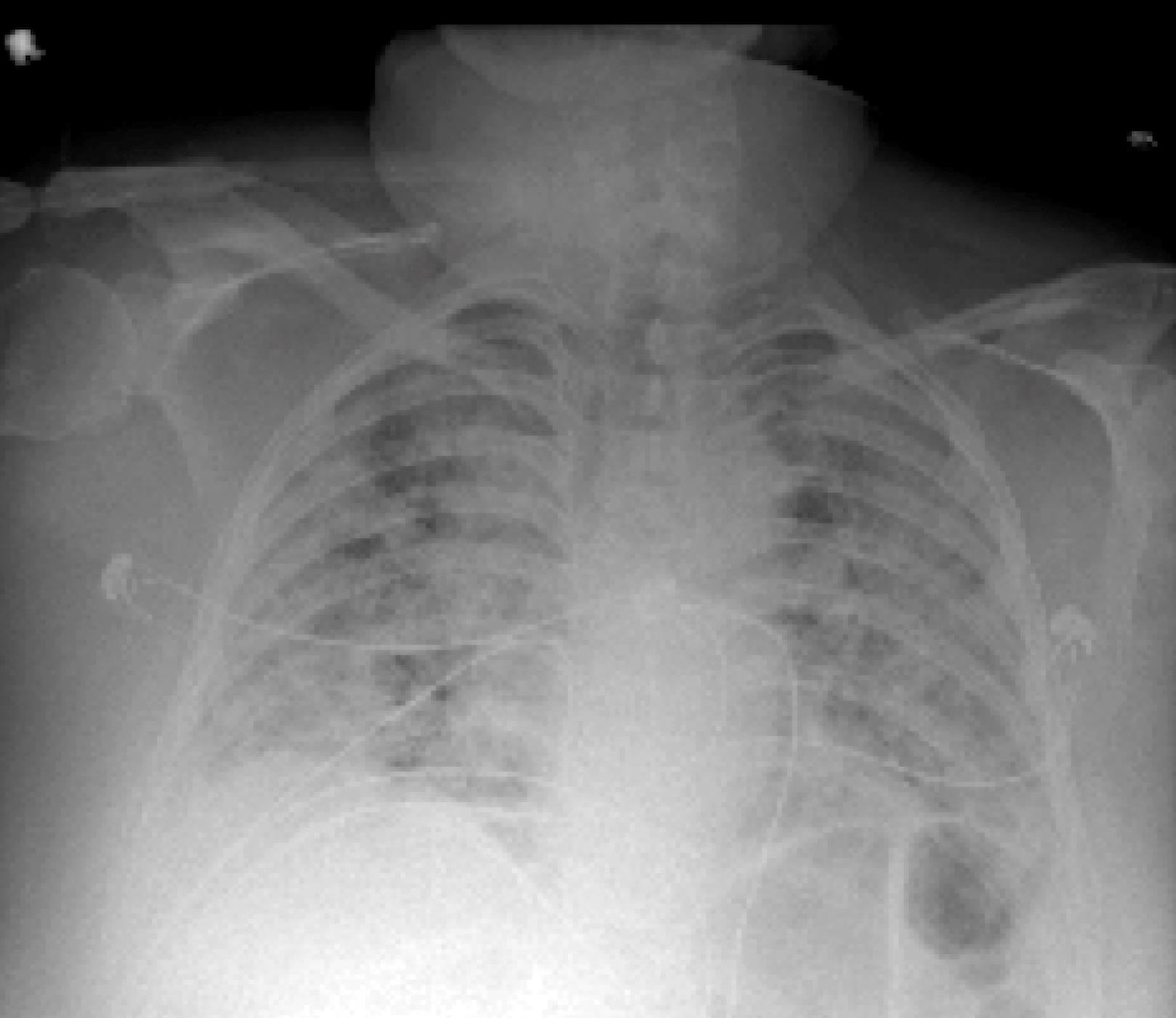
AI trained on X-rays and patient data predicts severe COVID-19 outcomes with 80% accuracy.
Trained to see patterns by analyzing thousands of chest X-rays, a computer program predicted with up to 80 percent accuracy which COVID-19 patients would develop life-threatening complications within four days, a new study finds.
Developed by researchers at NYU Grossman School of Medicine, the program used several hundred gigabytes of data gleaned from 5,224 chest X-rays taken from 2,943 seriously ill patients infected with SARS-CoV-2, the virus behind the infections.
Addressing the Urgency of Rapid Risk Prediction
The authors of the study, publishing in the journal npj Digital Medicine online May 12, cited the “pressing need” for the ability to quickly predict which COVID-19 patients are likely to have lethal complications so that treatment resources can best be matched to those at increased risk. For reasons not yet fully understood, the health of some COVID-19 patients suddenly worsens, requiring intensive care, and increasing their chances of dying.
In a bid to address this need, the NYU Langone team fed not only X-ray information into their computer analysis, but also patients’ age, race, and gender, along with several vital signs and laboratory test results, including weight, body temperature, and blood immune cell levels. Also factored into their mathematical models, which can learn from examples, were the need for a mechanical ventilator and whether each patient went on to survive (2,405) or die (538) from their infections.
Researchers then tested the predictive value of the software tool on 770 chest X-rays from 718 other patients admitted for COVID-19 through the emergency room at NYU Langone hospitals from March 3 to June 28, 2020. The computer program accurately predicted four out of five infected patients who required intensive care and mechanical ventilation and/or died within four days of admission.
“Emergency room physicians and radiologists need effective tools like our program to quickly identify those COVID-19 patients whose condition is most likely to deteriorate quickly so that health care providers can monitor them more closely and intervene earlier,” says study co-lead investigator Farah Shamout, PhD, an assistant professor in computer engineering at New York University’s campus in Abu Dhabi.
“We believe that our COVID-19 classification test represents the largest application of artificial intelligence in radiology to address some of the most urgent needs of patients and caregivers during the pandemic,” says Yiqiu “Artie” Shen, MS, a doctoral student at the NYU Data Science Center.
Room for Growth Through Continuous Learning
Study senior investigator Krzysztof Geras, PhD, an assistant professor in the Department of Radiology at NYU Langone, says a major advantage to machine-intelligence programs such as theirs is that its accuracy can be tracked, updated and improved with more data. He says the team plans to add more patient information as it becomes available. He also says the team is evaluating what additional clinical test results could be used to improve their test model.
Geras says he hopes, as part of further research, to soon deploy the NYU COVID-19 classification test to emergency physicians and radiologists. In the interim, he is working with physicians to draft clinical guidelines for its use.
Reference: “An artificial intelligence system for predicting the deterioration of COVID-19 patients in the emergency department” by Farah E. Shamout, Yiqiu Shen, Nan Wu, Aakash Kaku, Jungkyu Park, Taro Makino, Stanisław Jastrzębski, Jan Witowski, Duo Wang, Ben Zhang, Siddhant Dogra, Meng Cao, Narges Razavian, David Kudlowitz, Lea Azour, William Moore, Yvonne W. Lui, Yindalon Aphinyanaphongs, Carlos Fernandez-Granda and Krzysztof J. Geras, 12 May 2021, npj Digital Medicine.
DOI: 10.1038/s41746-021-00453-0
Funding support for the study was provided by National Institutes of Health grants P41 EB017183 and R01 LM013316; and National Science Foundation grants HDR-1922658 and HDR-1940097.
Besides Geras, Shamout, and Shen, other NYU Langone researchers involved in this study are co-lead investigators Nan Wu; Aakash Kaku; Jungkyu Park; and Taro Makino; and co-investigators Stanislaw Jastrzebski; Duo Wong; Ben Zhang; Siddhant Dogra; Men Cao; Narges Razavian; David Kudlowitz; Lea Azour; William Moore; Yvonne Lui; Yindalon Aphinyanaphongs; and Carlos Fernandez-Granda.
Never miss a breakthrough: Join the SciTechDaily newsletter.
Follow us on Google and Google News.