
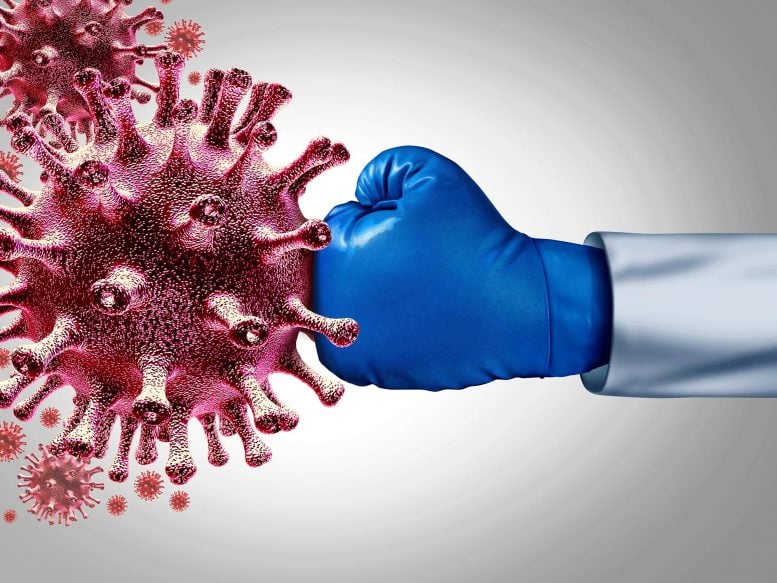
A single protein that appears necessary for the COVID-19 virus to reproduce and spread to other cells is a potential weakness that could be targeted by future therapies.
The molecule, known as transmembrane protein 41 B (TMEM41B), is believed to help shape the fatty outer membrane that protects the virus’ genetic material while it replicates inside an infected cell and before it infects another.
The latest finding comes from a pair of studies led by researchers at NYU Grossman School of Medicine and NYU Langone Health’s Perlmutter Cancer Center, and colleagues at Rockefeller University and elsewhere.
Published in the journal Cell online December 8, 2020, the studies revealed that TMEM41B was essential for SARS-CoV-2 to replicate. In a series of experiments, researchers compared how the COVID-19 virus reproduces in infected cells to the same processes in two dozen deadly flaviviruses, including those responsible for yellow fever, West Nile, and Zika disease. They also compared how it reproduces in infected cells to three other seasonal coronaviruses known to cause the common cold.
“Together, our studies represent the first evidence of transmembrane protein 41 B as a critical factor for infection by flaviviruses and, remarkably, for coronaviruses, such as SARS-CoV-2, as well,” says the studies’ co-senior investigator John T. Poirier, PhD.
“An important first step in confronting a new contagion like COVID-19 is to map the molecular landscape to see what possible targets you have to fight it,” says Poirier, an assistant professor of medicine at NYU Langone Health. “Comparing a newly discovered virus to other known viruses can reveal shared liabilities, which we hope serve as a catalog of potential vulnerabilities for future outbreaks.”
“While inhibiting transmembrane protein 41 B is currently a top contender for future therapies to stop coronavirus infection, our results identified over a hundred other proteins that could also be investigated as potential drug targets,” says Poirier, who also serves as director of the Preclinical Therapeutics Program at NYU Langone and Perlmutter Cancer Center.
For the studies, researchers used the gene-editing tool CRISPR to inactivate each of more than 19,000 genes in human cells infected with each virus, including SARS-CoV-2. They then compared the molecular effects of each shutdown on the virus’ ability to replicate.
In addition to TMEM41B, some 127 other molecular features were found to be shared among SARS-CoV-2 and other coronaviruses. These included common biological reactions, or pathways, involved in cell growth, cell-to-cell communication, and means by which cells bind to other cells. However, researchers say, TMEM41B was the only molecular feature that stood out among both families of viruses studied.
Interestingly, Poirier notes, mutations, or alterations, in TMEM41B are known to be common in one in five East Asians, but not in Europeans or Africans. He cautions, however, that it is too early to tell if this explains the relatively disproportionate severity of COVID-19 illness among some populations in the United States and elsewhere. Another study finding was that cells with these mutations were more than 50 percent less susceptible to flavivirus infection than those with no gene mutation.
Poirier says more research is needed to determine if TMEM41B mutations directly confer protection against COVID-19 and if East Asians with the mutation are less vulnerable to the disease.
The research team next plans to map out TMEM41B’s precise role in SARS-CoV-2 replication so they can start testing treatment candidates that may block it. The team also has plans to study the other common pathways for similar potential drug targets.
Poirier adds that the research team’s success in using CRISPR to map the molecular weaknesses in SARS-CoV-2 serves as a model for scientists worldwide to confront future viral outbreaks.
References:
“TMEM41B IS A PAN-FLAVIVIRUS HOST FACTOR” by H.-Heinrich Hoffmann, William M. Schneider, Kathryn Rozen-Gagnon, Linde A. Miles, Felix Schuster, Brandon Razooky, Eliana Jacobson, Xianfang Wu, Soon Yi, Charles M. Rudin, Margaret R. MacDonald, Laura K. McMullan, John T. Poirier and Charles M. Rice, 8 December 2020, Cell.
DOI: 10.1016/j.cell.2020.12.005
“Genome-scale identification of SARS-CoV-2 and pan-coronavirus host factor networks” by William M. Schneider, Joseph M. Luna, H.-Heinrich Hoffmann, Francisco J. Sánchez-Rivera, Andrew A. Leal, Alison W. Ashbrook, Jérémie Le Pen, Inna Ricardo-Lax, Eleftherios Michailidis, Avery Peace, Ansgar F. Stenzel, Scott W. Lowe, Margaret R. MacDonald, Charles M. Rice and John T. Poirier, 9 December 2020, Cell.
DOI: 10.1016/j.cell.2020.12.006
Study funding was provided by National Institutes of Health grants R01 AI091707, U19 AI111825, R01 CA190261, R01 CA213448, U01 CA2133359, R01 AI143295, R01 AI150275, R01 AI124690, R01 AI116943, P01 AI138938, P30 CA008748, P30 CA016087, R03 AI141855, R21 AI142010, T32 CA160001. Additional funding support was provided by the G. Harold and Leila Y. Mathers Charitable Foundation, the BAWD Foundation, and Fast Grants.
Besides Poirier, another NYU Langone researcher involved in these studies is Andrew Leal. Other collaborators included study co-senior investigator Charles Rice and study co-investigators William Schneider, Joseph Luna, Heinrich Hoffman, Alison Ashbrook, Jeremie Le Pen, Inna Ricardo-Lax, Eleftherios Michailidis, Avery Peace, Ansgar Stenzel, Margaret MacDonald, Kathryn Rozen-Gagnon, Felix Schuster, Brandon Razooky, Eliana Jacobson, Xianfang Wu, and Soon Yi, at Rockefeller University in New York City; Francisco-Sanchez-Rivera, Scott Lowe, Linda Miles, and Charles Rudin, at Memorial Sloan Kettering Cancer Center in New York City; and Laura McMullen, at the U.S. Centers for Disease Control and Prevention in Atlanta.
Never miss a breakthrough: Join the SciTechDaily newsletter.
Follow us on Google and Google News.