
Close Menu
    Facebook X (Twitter) Instagram
    SciTechDaily
    • Biology
    • Chemistry
    • Earth
    • Health
    • Physics
    • Science
    • Space
    • Technology
    Facebook X (Twitter) Pinterest YouTube RSS
    SciTechDaily
    Home»Earth»“Iron-Rich Blobs” Penetrate Deep Into Earth’s Mantle
    Earth

    “Iron-Rich Blobs” Penetrate Deep Into Earth’s Mantle

    By Eric Gershon, Yale UniversityDecember 19, 20121 Comment3 Mins Read
    Facebook Twitter Pinterest Telegram LinkedIn WhatsApp Email Reddit
    Share
    Facebook Twitter LinkedIn Pinterest Telegram Email Reddit
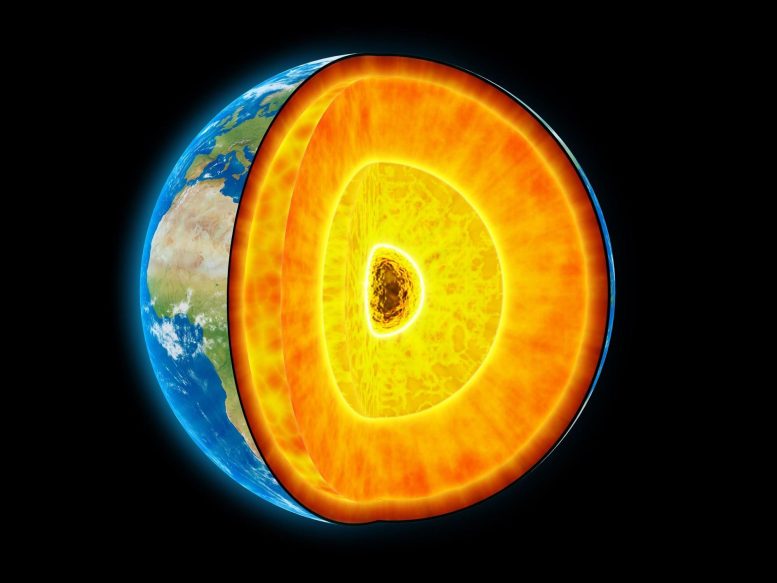
    Earth Interior Layers Illustration
    Scientists propose an explanation for the abundance of iron in the Earth’s largest interior layer.

    In a lab experiment, Yale researchers discovered that molten iron can deeply penetrate single crystals of magnesium iron oxide, resulting in “metal-rich blobs” that penetrate Earth’s mantle in larger amounts and deeper than previously thought possible.

    New research by Yale University scientists suggests an explanation for the amount of iron in the Earth’s largest interior layer, the mantle: migrating “iron-rich blobs” generated by chemical interactions in the zone between the planet’s core and mantle.

    Scientists have long known of the core’s rich iron content, but they have struggled to explain how the rocky mantle acquires iron in any abundance. The newly reported iron-enrichment process could also explain how other elements, such as platinum and hydrogen, get into the mantle, researchers said — attached to the iron.

    “Our work showed that there is a very efficient chemical interaction between the rocky part and the iron-rich part of Earth,” said geophysicist Shun-ichiro Karato, professor of geology and geophysics at Yale and principal investigator of research published online in the journal Nature. “We’ve discovered a new mechanism by which a lot more iron from the Earth’s core penetrates the mantle than previously thought possible, and a lot deeper into it. In the previous models, the penetration was limited to about one kilometer (3,300 feet) or less. Our model suggests penetration to about 100 kilometers (62 miles).”

    The mantle is a hot, dense, rocky layer between the Earth’s crust and its core.

    In a lab experiment, the researchers showed that molten iron can deeply penetrate single crystals of magnesium iron oxide, or (Mg,Fe)O, leading to the formation of what they call “metal-rich blobs.” A similar process might be at work deep within Earth, they said, as molten iron from the core interacts with iron oxide in the core-mantle boundary zone (the very bottom layer of the mantle). The iron has an affinity for iron oxide, and as it consumes more iron oxide, it pushes deeper into the mantle.

    The upward migration of iron-rich liquid has implications for several aspects of the interaction between the core and the mantle, the researchers said. It could explain large reductions in the velocity of seismic wave propagation, as well as the high electrical conductance of some regions in the mantle’s base layer, for example, they said. The movement of the iron-rich liquid could also account for the isotope signature of the core materials observed in some ocean islands, they said.

    Reference: “Deep penetration of molten iron into the mantle caused by a morphological instability” by Kazuhiko Otsuka and Shun-ichiro Karato, 12 December 2012, Nature.
    DOI: 10.1038/nature11663

    Kazuhiko Otsuka, a former graduate student in Yale’s Department of Geology & Geophysics, is lead author.

    The National Science Foundation provided support for the research.

    Never miss a breakthrough: Join the SciTechDaily newsletter.
    Follow us on Google and Google News.

    Geology Geophysics Planetary Science Yale University
    Share. Facebook Twitter Pinterest LinkedIn Email Reddit

    Related Articles

    Scientists Provide Evidence for Why Earth’s Early Climate Was More Stable and Warmer

    Yale Researchers ‘Look’ Deep Inside a Diamond Planet

    Arctic Sea Ice Loss is Impacting Atlantic Ocean Water Circulation System

    Study Suggests Habitable Zone Alone Isn’t Sufficient to Support Life

    Yale Researchers Find a Soft Spot in the Nazca Plate

    Flat-Slab Subduction in South America Mirrors Formation of Rocky Mountains

    Yale Study Reveals Parts of Ancient Antarctica Were as Warm as Today’s California Coast

    Study Reveals Ancient Impact of Massive Asteroid

    Study Reveals How and When Earth Developed Its Rigid Tectonic Plates

    1 Comment

    1. makhiya on February 9, 2017 8:35 am

      this is weried

      Reply
    Leave A Reply Cancel Reply

    • Facebook
    • Twitter
    • Pinterest
    • YouTube

    Don't Miss a Discovery

    Subscribe for the Latest in Science & Tech!

    Trending News

    This Experimental Drug Repaired the Gut and Reversed Severe Fatty Liver Disease

    Physicists Just Turned a Black Hole Energy Theory Into Reality

    Stanford Scientists Solve a 252-Million-Year-Old Mass Extinction Mystery

    The Ancient Survival Mechanism Making Weight Loss So Difficult

    Just 3,000 Steps a Day May Help Protect the Brain From Alzheimer’s

    “Weird Clams” Reveal a New Invasion Along the U.S. Northeast Coast

    Archaeologists Decapitated Tutankhamun and Glued His Body Back Together

    New Black Hole Theory Solves a 50-Year-Old Problem

    Follow SciTechDaily
    • Facebook
    • Twitter
    • YouTube
    • Pinterest
    • Newsletter
    • RSS
    SciTech News
    • Biology News
    • Chemistry News
    • Earth News
    • Health News
    • Physics News
    • Science News
    • Space News
    • Technology News
    Recent Posts
    • Quantum Computer Stores Data in Vibrations Like Notes on a Guitar
    • Astronomers Discover Two Super Puff Planets Lighter Than Cotton Candy
    • One Asteroid Collision May Have Rocked Earth, Mars, and the Moon
    • Scientists Restore the Sense of Touch With Electrical Brain Stimulation
    • New Study Reveals Herpesvirus Infection May Accelerate Alzheimer’s Disease
    Copyright © 1998 - 2026 SciTechDaily. All Rights Reserved.
    • Science News
    • About
    • Contact
    • Editorial Board
    • Privacy Policy
    • Terms of Use

    Type above and press Enter to search. Press Esc to cancel.