
Close Menu
    Facebook X (Twitter) Instagram
    SciTechDaily
    • Biology
    • Chemistry
    • Earth
    • Health
    • Physics
    • Science
    • Space
    • Technology
    Facebook X (Twitter) Pinterest YouTube RSS
    SciTechDaily
    Home»Earth»Study Reveals How and When Earth Developed Its Rigid Tectonic Plates
    Earth

    Study Reveals How and When Earth Developed Its Rigid Tectonic Plates

    By Eric Gershon, Yale UniversityApril 7, 2014No Comments3 Mins Read
    Facebook Twitter Pinterest Telegram LinkedIn WhatsApp Email Reddit
    Share
    Facebook Twitter LinkedIn Pinterest Telegram Email Reddit
    New Research Shows How and When Earth Developed Its Rigid Tectonic Plates
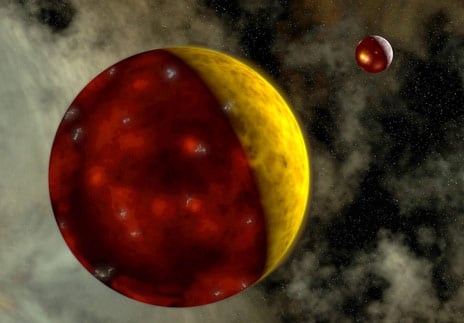
    New Yale-led research suggests how and when Earth came to develop one of its most distinct features — rigid tectonic plates — and why Venus, Earth’s twin-like neighbor, never has. Credit: Walter Myers

    Newly published research from Yale University and Université de Lyon in France shows how and when Earth developed its rigid tectonic plates and why Venus never has.

    “We think it all comes down to the behavior of tiny grains of minerals within rocks,” said Yale geophysicist David Bercovici, lead author of research published online April 6 in the journal Nature.

    Earth has a unique network of shifting plates embedded in its cold and rocky outermost layer, the lithosphere. The motion of these plates drives many Earth processes, including earthquakes and volcanic eruptions, while also stabilizing the planet’s climate and enabling life.

    Despite evidence that Earth’s solid surface was already in motion more than 4 billion years ago, global plate tectonics — replete with rigid plates and a variety of plate boundary types — appears not to have developed for a billion years more. And it never has on Venus, although the planet is so similar to Earth in size, composition, and gravity that it’s sometimes called “Earth’s twin sister.”

    Bercovici and co-author Yanick Ricard of the Université de Lyon in France argue that in Earth’s early days, mantle convection caused weak zones in the lithosphere. These zones persisted, developed into plate boundaries, and ultimately connected to form a global network of tectonic plates. The weak zones, they argue, resulted from the tendency of mineral grains in rocks to shrink as the rock deforms.

    “If the rock gets weaker where it deforms, then deformation focuses there, making the grains shrink faster, in turn making the rock weaker,” Bercovici said. “The weak zone narrows and intensifies until you get a distinct boundary. These are the plate boundaries.”

    This process does not happen on Venus, which has no plate visage, because its extremely high surface temperatures cause the grains to grow and weak zones to heal, he said.

    To illustrate their hypothesis, the scientists developed a theoretical model that explains how rock grains control the strength and weakness in the lithosphere.

    Said Bercovici, “The model uses physics at the 1-millimeter rock grain scale to explain how the whole planet behaves, and how plate tectonics emerged on Earth, but not on her twin.”

    The paper is titled “Plate tectonics, damage and inheritance.”

    The National Science Foundation and the Agence Nationale de la Recherche provided support for the research.

    Reference: “Plate tectonics, damage and inheritance” by David Bercovici and Yanick Ricard, 6 April 2014, Nature.
    DOI: 10.1038/nature13072


    Never miss a breakthrough: Join the SciTechDaily newsletter.
    Follow us on Google and Google News.

    Geophysics Planetary Science Tectonic Plates Yale University
    Share. Facebook Twitter Pinterest LinkedIn Email Reddit

    Related Articles

    Earth’s Strangest Magnetic Era: Scientists Decode the Ediacaran Mystery

    Yale Researchers Find a Soft Spot in the Nazca Plate

    Geophysicists Find Source Behind “Sudden” Tectonic Plate Movements

    New Model Reveals Spreading Continents Kick-Started Plate Tectonics

    Study Reveals Ancient Impact of Massive Asteroid

    Arctic Melt Season Is Lengthening by Several Days Each Decade

    Scientists Link Earth’s Westward Drift of Magnetic Field and Superrotation of Inner Core

    “Iron-Rich Blobs” Penetrate Deep Into Earth’s Mantle

    Unusual Indian Ocean Earthquakes May Signal Tectonic Breakup

    Leave A Reply Cancel Reply

    • Facebook
    • Twitter
    • Pinterest
    • YouTube

    Don't Miss a Discovery

    Subscribe for the Latest in Science & Tech!

    Trending News

    Scientists Uncover Potential Brain Risks of Popular Fish Oil Supplements

    Scientists Discover a Surprising Way To Make Bread Healthier and More Nutritious

    After 60 Years, Scientists Uncover Unexpected Brain Effects of Popular Diabetes Drug Metformin

    New Research Uncovers Hidden Side Effects of Popular Weight-Loss Drugs

    Scientists Rethink Extreme Warming After Surprising Ocean Discovery

    Landmark Study Links Never Marrying to Significantly Higher Cancer Risk

    Researchers Discover Unknown Beetle Species Just Steps From Their Lab

    Largest-Ever Study Finds Medicinal Cannabis Ineffective for Anxiety, Depression, PTSD

    Follow SciTechDaily
    • Facebook
    • Twitter
    • YouTube
    • Pinterest
    • Newsletter
    • RSS
    SciTech News
    • Biology News
    • Chemistry News
    • Earth News
    • Health News
    • Physics News
    • Science News
    • Space News
    • Technology News
    Recent Posts
    • Early Warning Signals of Esophageal Cancer May Be Hiding in Plain Sight
    • Researchers Have Discovered a THC-Free Cannabis Compound That May Replace Opioids
    • Common Blood Pressure Drug Shows Surprising Power Against Deadly Antibiotic-Resistant Superbug
    • Students Build Dark Matter Detector and Set New Experimental Limits
    • Scientists Discover Caffeine Can Repair Key Memory Circuits After Sleep Loss
    Copyright © 1998 - 2026 SciTechDaily. All Rights Reserved.
    • Science News
    • About
    • Contact
    • Editorial Board
    • Privacy Policy
    • Terms of Use

    Type above and press Enter to search. Press Esc to cancel.