
Close Menu
    Facebook X (Twitter) Instagram
    SciTechDaily
    • Biology
    • Chemistry
    • Earth
    • Health
    • Physics
    • Science
    • Space
    • Technology
    Facebook X (Twitter) Pinterest YouTube RSS
    SciTechDaily
    Home»Space»Unlocking the Mystery of the Early Universe Depends on Estimating the Lifespan of Neutrons
    Space

    Unlocking the Mystery of the Early Universe Depends on Estimating the Lifespan of Neutrons

    By Brian Koberlein, Universe TodayDecember 9, 20211 Comment4 Mins Read
    Facebook Twitter Pinterest Telegram LinkedIn WhatsApp Email Reddit
    Share
    Facebook Twitter LinkedIn Pinterest Telegram Email Reddit
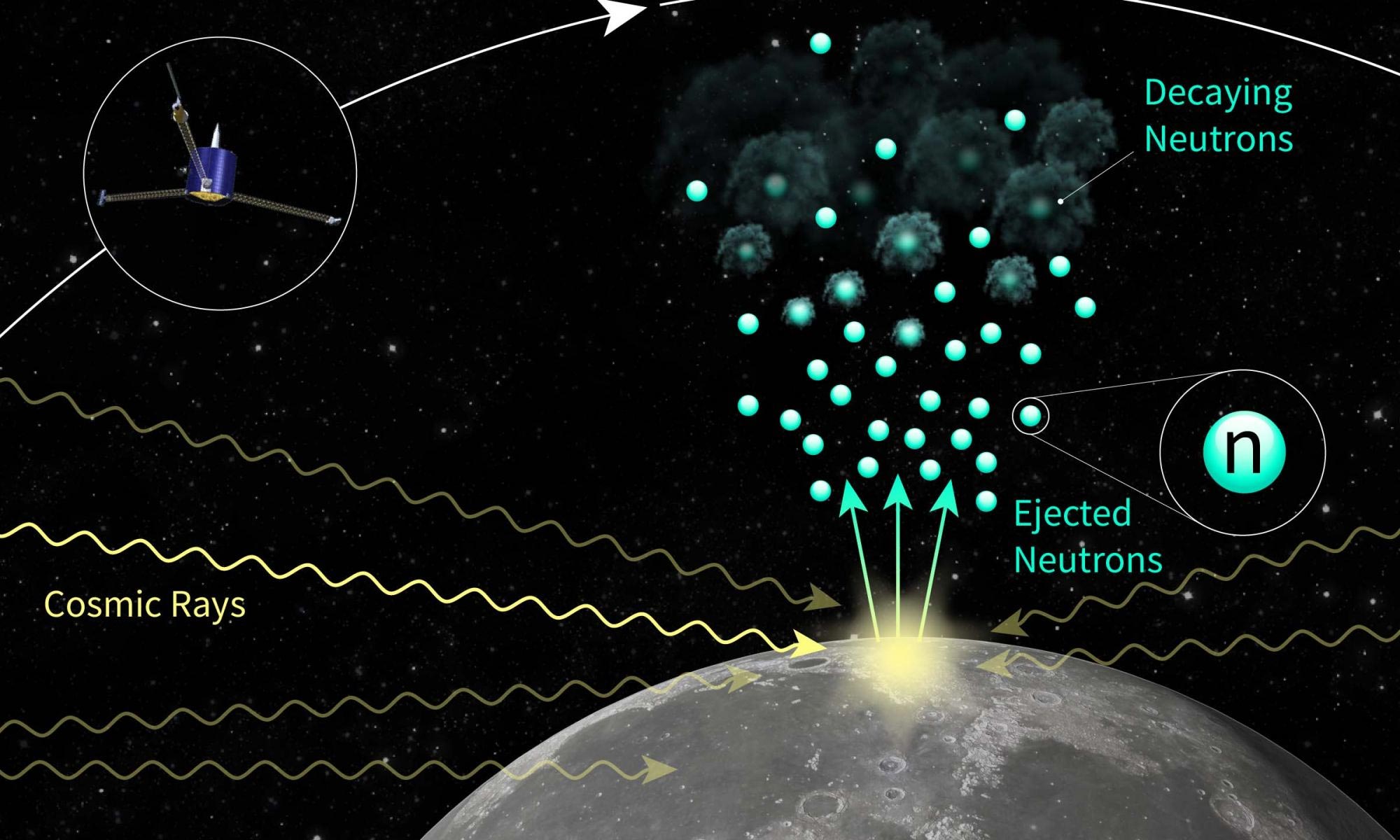
    Lunar Prospector Neutron Lifetime Schematic
    Artist’s schematic of how Lunar Prospector provided data to estimate neutron lifetime. Cosmic rays striking the moon’s surface eject neutrons that gradually fly into space. As neutrons move to higher altitudes, more time passes, and more neutrons radioactively decay. Lunar Prospector counted the number of neutrons at various altitudes, allowing scientists to compare neutron numbers across altitudes. Using models, researchers could then estimate the neutron lifetime. Credit: JHU / APL

    A new experiment used NASA’s Lunar Prospector to measure neutrons kicked off the Moon by cosmic rays, producing a result close to earlier estimates.

    When we look into the night sky, we see the universe as it once was. We know that in the past the universe was once warmer and denser than it is now. When we look deep enough into the sky, we see the microwave remnant of the Big Bang known as the cosmic microwave background. That marks the limit of what we can see. It marks the extent of the observable universe from our vantage point.

    The cosmic background we observe comes from a time when the universe was already about 380,000 years old. We can’t directly observe what happened before that. Much of the earlier period is fairly well understood given what we know about physics, but the earliest moments of the big bang remain a bit of a mystery. According to the standard model, the earliest moments of the universe were so hot and dense that even the fundamental forces of the universe acted differently than they do now. To better understand the Big Bang, we need to better understand these forces.

    One of the more difficult forces to understand is the weak force. Unlike more familiar forces such as gravity and electromagnetism, the weak is mostly seen through its effect of radioactive decay. So we can study the weak force by measuring the rate at which things decay. But there’s a problem when it comes to neutrons.

    Free Neutron Decay
    How free neutrons can decay. Credit: Evan Berkowitz

    Together with protons, neutrons make up the nuclei of the atoms we see around us. Within an atomic nucleus, neutrons can be extremely stable. But when a neutron is on its own, it typically decays in a matter of minutes. The rate of decay for neutrons is typically given in terms of their half-life. That is the time at which a neutron has about a 50/50 chance of having decayed. Technically, they measure a related quantity known as the neutron lifetime, but the idea is the same.

    There are a couple of ways we can measure neutron half-life, such as measuring a beam of neutrons or cooling them down and trapping them in a magnetic bottle, but these different methods give different results for the half-life. The methods should give the same result, but they don’t. The beam method gives a lifetime of 888 seconds, while the bottle method gives 879 seconds. Perhaps there is some systematic error in the methods, but this discrepancy is a problem for fundamental physics. But a new study has measured neutron decay in a third way, by using a spacecraft orbiting the Moon.

    A Lunar Experiment in Neutron Physics

    The airless surface of the moon is constantly bombarded by cosmic rays. Sometimes a cosmic ray will kick a neutron off the lunar surface. As the neutron speeds away from the Moon, it has a chance of decaying. So the team used NASA’s Lunar Prospector satellite to count the number of neutrons at various orbital heights. From this, they calculated the neutron lifetime to be 887 seconds.

    While the result isn’t precise enough to resolve the neutron decay problem, it does show that we can use spacecraft to get very accurate results. Accurate enough that future missions might be able to solve the weakest link of early cosmology.

    Adapted from an article originally published on Universe Today.

    For more on this research, see From the Moon to the Math, Latest Attempts at Breaking CKM Matrix Unitarity—And Discovering New Physics.

    Reference: “Measurement of the free neutron lifetime using the neutron spectrometer on NASA’s Lunar Prospector mission” by Jack T. Wilson, David J. Lawrence, Patrick N. Peplowski, Vincent R. Eke and Jacob A. Kegerreis, 13 October 2021, Physical Review C.
    DOI: 10.1103/PhysRevC.104.045501

    Never miss a breakthrough: Join the SciTechDaily newsletter.
    Follow us on Google and Google News.

    Astronomy Astrophysics Neutrons
    Share. Facebook Twitter Pinterest LinkedIn Email Reddit

    Related Articles

    Crab Nebula Pulsar Abrupt Acceleration is Ultrarelativistic

    Study of X-Shaped Radio Galaxy NGC 326 Shows Outburst History and Active Galactic Nucleus Feedback

    The Bolshoi Simulation: Boxing the Universe

    NASA’s Kepler Mission Discovers 11 New Extrasolar Systems with 26 Exoplanets

    Lasers Mimic Supernova to Explain Cosmic Magnetic Fields

    Baryon Oscillation Spectroscopic Survey Measures the Universe’s Expansion and Dark Energy

    SN Primo Is Farthest Type Ia Supernova Discovered

    Scientists Convene to Take a Picture of the Supermassive Black Hole at the Center of the Milky Way

    Hubble Observes Rare Blue Stars in Andromeda’s Core

    1 Comment

    1. xABBAAA on December 12, 2021 8:04 am

      … like some thing is boiling, but what how, why ….

      Reply
    Leave A Reply Cancel Reply

    • Facebook
    • Twitter
    • Pinterest
    • YouTube

    Don't Miss a Discovery

    Subscribe for the Latest in Science & Tech!

    Trending News

    New Pill Lowers Stubborn Blood Pressure and Protects the Kidneys

    Humans May Have Hidden Regenerative Powers, New Study Suggests

    Scientists Just Solved the Mystery of Why Crabs Walk Sideways

    Doctors Are Surprised by What This Vaccine Is Doing to the Heart

    This Popular Supplement May Boost Your Brain, Not Just Your Muscles

    Scientists Say This Simple Supplement May Actually Reverse Heart Disease

    Warming Oceans Could Trigger a Dangerous Methane Surge

    This Simple Movement Could Be Secretly Cleaning Your Brain

    Follow SciTechDaily
    • Facebook
    • Twitter
    • YouTube
    • Pinterest
    • Newsletter
    • RSS
    SciTech News
    • Biology News
    • Chemistry News
    • Earth News
    • Health News
    • Physics News
    • Science News
    • Space News
    • Technology News
    Recent Posts
    • Study Reveals Dangerous Flaw in AI Symptom Checkers
    • New MRI Breakthrough Captures Stunningly Clear Images of the Eye and Brain
    • Scientists Warn Sitting Too Much Can Harm Your Body in Surprising Ways
    • Your Blood Pressure Reading Could Be Wrong Because of One Simple Mistake
    • Scientists Discover Cheap Material That Kills Deadly Superbugs
    Copyright © 1998 - 2026 SciTechDaily. All Rights Reserved.
    • Science News
    • About
    • Contact
    • Editorial Board
    • Privacy Policy
    • Terms of Use

    Type above and press Enter to search. Press Esc to cancel.