
Close Menu
    Facebook X (Twitter) Instagram
    SciTechDaily
    • Biology
    • Chemistry
    • Earth
    • Health
    • Physics
    • Science
    • Space
    • Technology
    Facebook X (Twitter) Pinterest YouTube RSS
    SciTechDaily
    Home»Physics»From the Moon to the Math, Latest Attempts at Breaking CKM Matrix Unitarity—And Discovering New Physics
    Physics

    From the Moon to the Math, Latest Attempts at Breaking CKM Matrix Unitarity—And Discovering New Physics

    By American Physical SocietyDecember 5, 20211 Comment3 Mins Read
    Facebook Twitter Pinterest Telegram LinkedIn WhatsApp Email Reddit
    Share
    Facebook Twitter LinkedIn Pinterest Telegram Email Reddit
    Lunar Prospector Neutron Lifetime Schematic
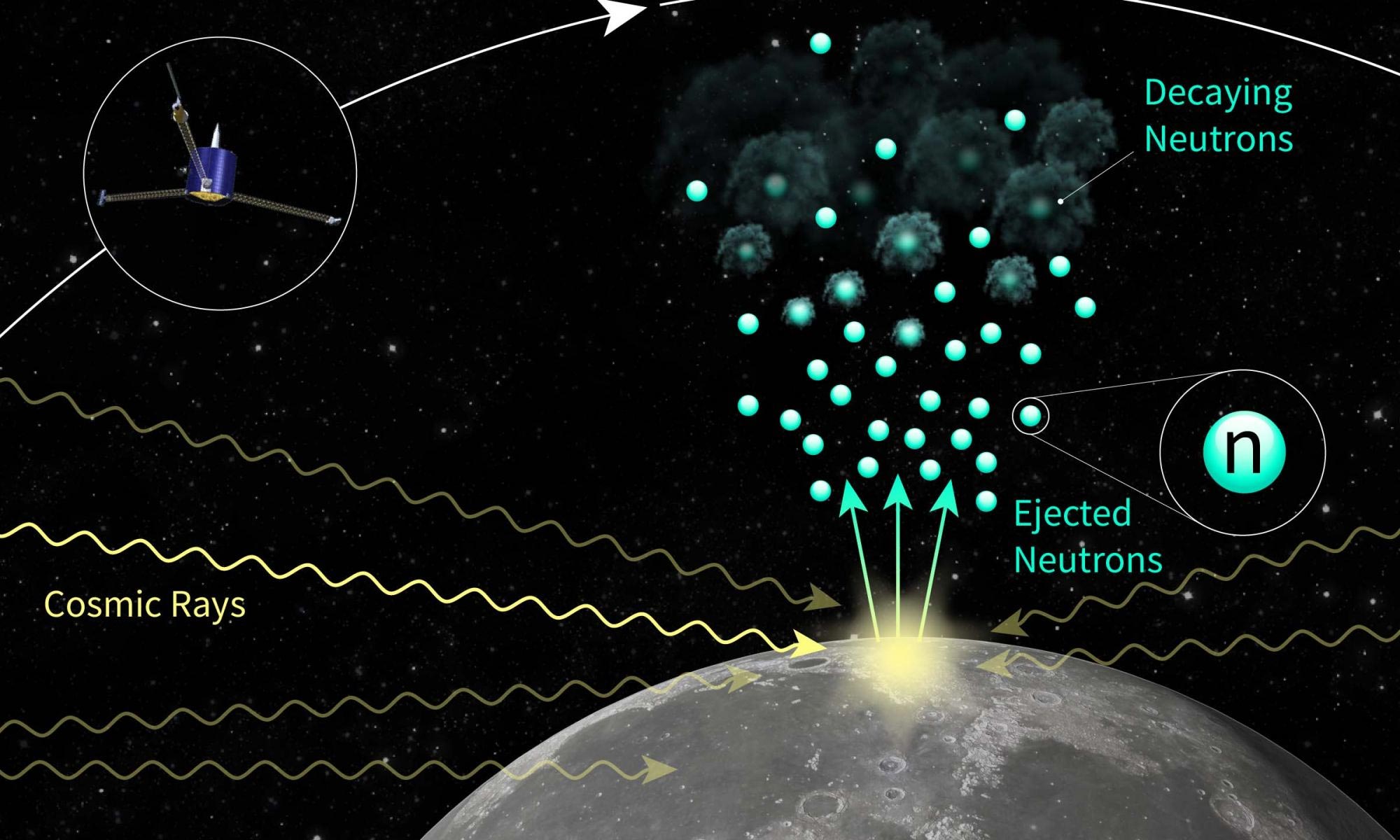
    Artist’s schematic of how Lunar Prospector provided data to estimate neutron lifetime. Cosmic rays striking the moon’s surface eject neutrons that gradually fly into space. As neutrons move to higher altitudes, more time passes, and more neutrons radioactively decay. Lunar Prospector counted the number of neutrons at various altitudes, allowing scientists to compare neutron numbers across altitudes. Using models, researchers could then estimate the neutron lifetime. Credit: JHU / APL

    A 5-Sigma Standard Model Anomaly Is Possible

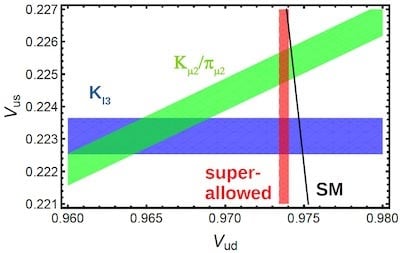
    One of the best chances for proving beyond-the-standard-model physics relies on something called the Cabibbo-Kobayashi-Maskawa (CKM) matrix. The standard model insists that the CKM matrix, which describes the mixing of quarks, should be unitary. But growing evidence suggests that during certain forms of radioactive decay, the unitarity of the CKM matrix might break.

    At the 2021 Fall Meeting of the APS Division of Nuclear Physics, researchers discuss how a NASA lunar mission and major theoretical progress could help snap the standard model.

    The free neutron lifetime plays an important role in testing CKM matrix unitarity. However, two prevailing methods for measuring it conflict severely. So Jack Wilson and a team at The Johns Hopkins Applied Physics Laboratory and Durham University decided to think outside the box—by going to outer space.

    Measuring Neutrons from Space

    Piggybacking on data from NASA’s Lunar Prospector Mission, which sent a spacecraft to orbit the moon, the scientists made the second-ever free neutron lifetime measurement from space. They reduced uncertainty by an order of magnitude.

    “Our result opens up a third way of measuring the neutron lifetime. Using this technique in a dedicated mission could bring to an end a decades-long puzzle in fundamental physics,” said Wilson, who shared the results at the meeting.

    A publication was forthcoming the same day from Physical Review C.
    CKM Matrix Elements Beta Decay Experiments
    The values of the CKM matrix elements Vud and Vus obtained from different beta decay experiments, versus the unitarity requirement from the standard model. Credit: Chien Yeah Seng

    Theoretical Limits and Progress

    Ultimately, breaking the CKM matrix unitarity—and finding physics beyond the standard model—would demand a stronger discrepancy between theory and experiment. The most recent review of the field measured the disagreement at about three sigma.

    “The current significant level of the observed anomalies is not yet sufficient to declare a discovery. The major limiting factor is the precision level of the standard model theory inputs,” said Chien Yeah Seng, a postdoctoral researcher at the University of Bonn.

    At the meeting, Seng will share the story behind the theoretical research that revealed this hint of new physics and will discuss progress in making the theory side more accurate.

    His collaborator Luchang Jin, a professor at the University of Connecticut and one of the theoretical pioneers behind the recent muon g–2 calculations, presents recent research refining a key theoretical component. The study dramatically reduces uncertainties in the low energy constants used for theoretical calculations.

    Path to Discovery

    Seng will lay out the path to finding a five-sigma discrepancy, including Jin’s work on radiative corrections, isospin-breaking corrections, and nuclear structure corrections. He predicts we could see a breakthrough even in the next few years.

    Reference: “Measurement of the free neutron lifetime using the neutron spectrometer on NASA’s Lunar Prospector mission” by Jack T. Wilson, David J. Lawrence, Patrick N. Peplowski, Vincent R. Eke and Jacob A. Kegerreis, 13 October 2021, Physical Review C.
    DOI: 10.1103/PhysRevC.104.045501

    Never miss a breakthrough: Join the SciTechDaily newsletter.
    Follow us on Google and Google News.

    American Physical Society Astrophysics Neutrons Particle Physics
    Share. Facebook Twitter Pinterest LinkedIn Email Reddit

    Related Articles

    Tetra-Neutron Experiment: Understanding of Nuclear Forces Might Have To Be Significantly Changed

    Unexpected Substructures in the Fundamental Components of All Matter

    Matter Without Antimatter? Closing In on Elusive Particles.

    Chameleon Theory Could Change How Scientists Think About Gravity

    Magneto-Gravitational Trap Provides Precise Measurement of Neutron Lifetime

    DarkSide-20k Will Push the Search for WIMP Dark Matter to New Levels

    Physicists Reveal a Neutron Halo Around Neutron-Rich Magnesium Nuclei

    Mathematical Model May Explain What Dark Matter Consists Of

    Black Holes Have Properties That Resemble the Dynamics of Solids and Liquids

    1 Comment

    1. xABBAAA on December 13, 2021 11:49 pm

      … yeah, those black swans and the unicorns and those things …. the one that look angry…

      Reply
    Leave A Reply Cancel Reply

    • Facebook
    • Twitter
    • Pinterest
    • YouTube

    Don't Miss a Discovery

    Subscribe for the Latest in Science & Tech!

    Trending News

    Mezcal “Worm” in a Bottle Mystery: DNA Testing Reveals a Surprise

    New Research Reveals That Your Morning Coffee Activates an Ancient Longevity Switch

    This Is What Makes You Irresistible to Mosquitoes

    Shockingly Powerful Giant Octopuses Ruled the Seas 100 Million Years Ago

    Scientists Stunned by New Organic Molecules Found on Mars

    Rewriting Dinosaur Evolution: Scientists Unearth Remarkable 150-Million-Year-Old Stegosaur Skull

    Omega-3 Supplements Linked to Cognitive Decline in Surprising New Study

    First-of-Its-Kind Discovery: Homer’s Iliad Found Embedded in a 1,600-Year-Old Egyptian Mummy

    Follow SciTechDaily
    • Facebook
    • Twitter
    • YouTube
    • Pinterest
    • Newsletter
    • RSS
    SciTech News
    • Biology News
    • Chemistry News
    • Earth News
    • Health News
    • Physics News
    • Science News
    • Space News
    • Technology News
    Recent Posts
    • New Research Challenges Long-Held Beliefs About How the Brain Makes Decisions
    • Breakthrough Technology Reveals New Treatment Targets for Cancer
    • Scientists Discover New Way To Make Drug-Resistant Cancer Treatable Again
    • This Simple Exercise Trick Builds Muscle With Less Effort, Study Finds
    • Middle Age Is Becoming a Breaking Point in America, Study Reveals
    Copyright © 1998 - 2026 SciTechDaily. All Rights Reserved.
    • Science News
    • About
    • Contact
    • Editorial Board
    • Privacy Policy
    • Terms of Use

    Type above and press Enter to search. Press Esc to cancel.