
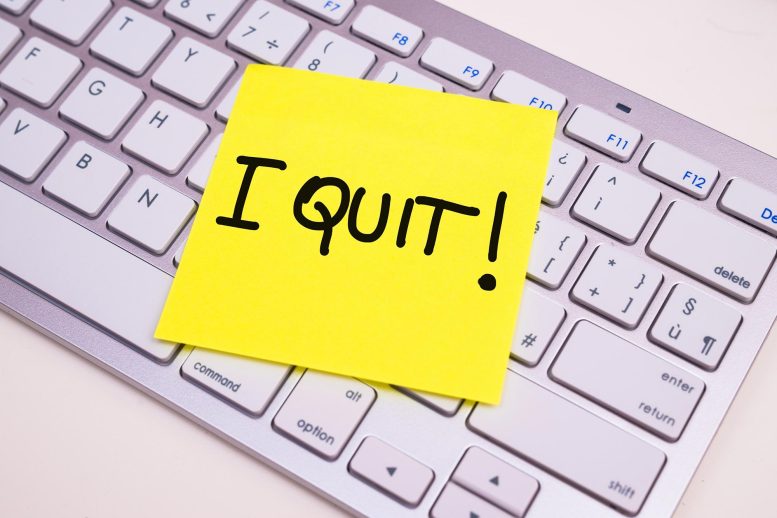
Record numbers of Americans have quit their jobs in recent months, with more than 4.4 million submitting their resignation in September alone. Millions more may be preparing to follow them to the exits – one survey found that around a third of workers wanted to make a career change.
But one of the things I learned over the years as a lawyer and later as a professor specializing in employment law is that timing and preparation matter when it comes to quitting a job. So even if you have another job lined up, it’s worth considering a few factors that might influence whether you quit now or stay in your current role for a few weeks – or months.
1. No unemployment insurance
In general, workers who quit are not eligible for unemployment insurance.
Instead, unemployment insurance is reserved for those who lost their job through no fault of their own, generally as a result of a layoff or other termination.
2. Two weeks’ notice not required
Employers often request that workers provide two weeks’ notice before they quit, but your employer cannot force you to stay in a job you don’t want.
Almost all employment relationships in the United States are terminable at will, meaning the employee can be terminated – or can quit – at any time.
It also means that if you give your employer two weeks’ notice, they might choose to terminate your employment earlier, including immediately upon receiving your notice.
3. Check your vacation balance
If you are eligible for vacation or paid time off, it’s worth checking your vacation balance, as well as your company’s policy regarding vacation payout for workers who quit.
Some state laws require companies to pay out employees’ remaining vacation balance as part of their final paycheck. Other states allow companies to refuse to pay out remaining vacation.
If your company’s policy states that workers forfeit their remaining vacation balance upon termination, you may want to take any vacation days you’ve accumulated before you submit your notice.
4. Consider your need for leave
If you expect to need family or medical leave to take care of a newborn baby, recover from your own health condition or care for a sick family member, now may not be the best time to quit your job.
Although state law varies, you’ll be eligible to take leave under the federal Family and Medical Leave Act only if you have worked for a company for more than a year. The law also applies only to companies with more than 50 employees and workers who have logged at least 1,250 hours at the company in the past 12 months.
Although the leave is unpaid, it allows you to continue your benefits while not working and enables you to return to your job at the end of the period if you so choose.
5. Health care: Plan ahead
Quitting a job also means losing whatever health coverage you receive through your employment. Your termination paperwork should explain how long you will remain covered under the current plan – for example, the last day of the month that your employment ended.
If you have a new job lined up, you’ll want to ask them when you can expect to be covered under their plan. For any gaps in coverage, you can opt to continue under your old employer’s plan through a law called COBRA, but you’ll have to pay your old employer’s share of the premium, which can be pricey.
You may want to comparison-shop on the Affordable Care Act health care exchange, which offers subsidies based on your income.
6. Consider any bonuses on the line
If you are lucky enough to be eligible for a bonus – such as an annual bonus if the company logs a successful year – you’ll want to check its terms and conditions.
It’s not unusual for companies to require workers to be employed on the date the bonus is paid to be eligible to receive the payment. If you happen to quit the week before, you may be out of luck, unless wage laws in your state protect that payment.
If you expect to receive a big bonus this year, you may want to stick around until that bonus check is in your bank account.
7. The final paycheck: Know your rights
State laws will generally impose rules requiring your employer to pay your final paycheck within a certain period after your final day of work. If you’re owed sales commission, there may be separate rules on when that needs to be paid.
State rules also prohibit your employer from making deductions from your paycheck without your permission – such as deductions for equipment or to recoup a signing bonus or relocation expenses. If your final paycheck doesn’t arrive within the legal time frame, or includes unauthorized deductions, you may want to consider hiring a lawyer.
8. Do not take anything from the office (without permission)
If your job involved working on a laptop or in an office, it might be tempting to plug a thumb drive into that computer and download some useful files for future reference – maybe some spreadsheets or a PowerPoint presentation you were especially proud of. Don’t.
Be careful not to take any company information when you leave a job.
All information that you had access to during your job, and even anything you produced while there, belongs to your employer. Downloading information onto a thumb drive is a great way to trigger an expensive lawsuit over whether you have stolen company trade secrets, especially if you are leaving to work for a competitor.
And yes, they will be able to tell that you plugged a thumb drive into the machine.
If you just need to download some personal files or a work sample for your future career, get permission from your boss or human resources to download or copy the files.
After all, departing a job in style isn’t just about sending a sarcastic email on your way out the door. It’s also about leaving with a bonus check in the bank and an empty vacation balance.
Written by Elizabeth C. Tippett, Associate Professor of Law, University of Oregon.
This article was first published in The Conversation.
Never miss a breakthrough: Join the SciTechDaily newsletter.
Follow us on Google and Google News.
1 Comment
I’m thinking about quitting my job. I don’t have the best relationship with my boss, and it really depresses me