
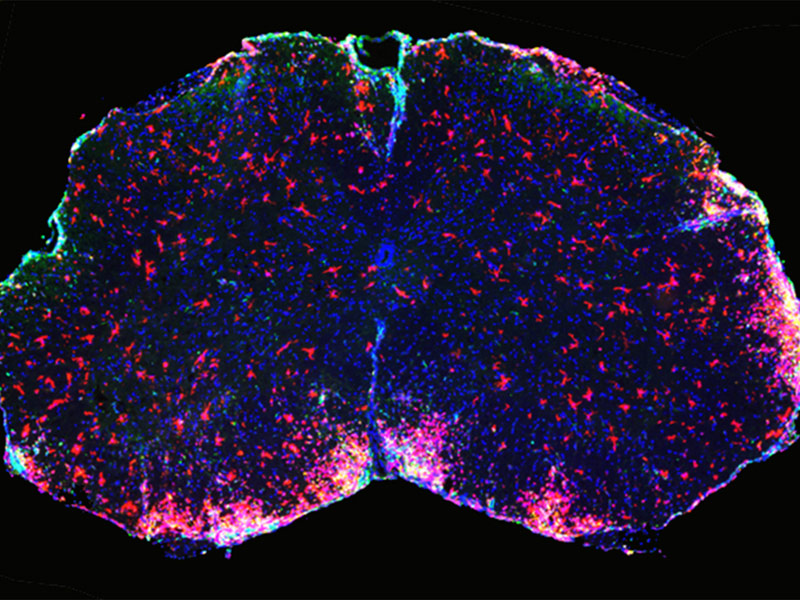
Scientists from the Max Planck Institute and the University of Lübeck have uncovered the mode of action for dimethyl fumarate, a drug that was recently approved in Europe as a basic therapy for multiple sclerosis.
Just a few short weeks ago, dimethyl fumarate was approved in Europe as a basic therapy for multiple sclerosis. Although its efficacy has been established in clinical studies, its underlying mode of action was still unknown, but scientists from Bad Nauheim’s Max Planck Institute for Heart and Lung Research and the University of Lübeck have now managed to decode it. They hope that this knowledge will help them develop more effective therapeutic agents.
Multiple sclerosis (MS) is a chronic inflammatory disease of the central nervous system that affects nerve fibers in the brain and spinal cord by damaging their protective myelin sheath. The cause of multiple sclerosis is unknown and the disease has no cure to date, but a range of treatments are available that can have a positive influence on its course.
Basic MS therapy to date generally involved beta interferons or the active substance glatiramer acetate. In both cases, the drug was administered by injections under the skin or into the muscle, which is a cause of considerable discomfort and annoyance to many patients.
By contrast, the active substance dimethyl fumarate (DMF), approved in Europe for MS treatment only a few weeks ago, brings a ray of hope to those affected since it can be taken in tablet form. The efficacy of DMF in clinical studies was at least comparable to that of the more established substances, while its side effects were moderate by comparison.
DMF has been in use for some twenty years as a successful treatment for psoriasis, but little was known about how it influences immune function. Scientists from Nina Wettschureck’s research groups at the Max Planck Institute for Heart and Lung Research in Bad Nauheim and Markus Schwaninger from the Institute of Experimental and Clinical Pharmacology and Toxicology at the University of Lübeck have explained significant aspects of how DMF works.
In their study, the researchers used a standardized mouse model of multiple sclerosis, whereby drugs trigger an autoimmune response, leading to characteristic reactions within days. In this way, they induced neurological deficits comparable to those observed in MS. “In the group we treated with DMF, the problems with motor function were considerably lower than in the control group,” says Wettschureck.
The researchers uncovered the mode of action by treating genetically modified mice in the same way. “In mice that don’t have the gene for the receptor called HCA2, DMF was unable to prevent the signs of paralysis,” explains Schwaninger. This means that the HCA2 receptor must mediate the therapeutic effect of DMF.
HCA2 is a so-called G protein-coupled membrane receptor which occurs, among other places, on a certain type of white blood cells, neutrophil granulocytes. “In animals treated with DMF, the number of granulocytes that infiltrated the nervous system was much lower than in untreated animals. In animals without the HCA2 receptor, the number of invasive granulocytes remained equally high despite treatment with DMF,” stated Wettschureck.
In other experiments involving cell cultures, the scientists found that activation of the HCA2 receptor is responsible for infiltration of the central nervous system by white blood cells. DMF blocks this infiltration, thereby preventing the associated inflammation. “Our study has enabled us to provide the first evidence that DMF’s protective effect is due to the HCA2 receptor. However, we are not ruling out the possibility that there may also be other mechanisms,” observed Wettschureck.
As a next step, the scientists want to find out why patients respond differently to treatment with DMF. “It may be that individual genetic differences influence the efficacy of DMF,” states Schwaninger. Consequently, future therapies could be specifically designed for individual patients, an approach known as personalized medicine.
The researchers also intend to search for additional substances that bind to the HCA2 receptor. “Ideally, we would find a substance of comparable or even greater efficacy, but with fewer side effects,” says Wettschureck. The colleagues in Bad Nauheim and Lübeck hope this will lead to the development of novel therapeutic agents for MS with an improved profile in terms of efficacy and adverse effects.
Reference: “Hydroxycarboxylic acid receptor 2 mediates dimethyl fumarate’s protective effect in EAE” by Hui Chen, Julian C. Assmann, Antje Krenz, Mahbubur Rahman, Myriam Grimm, Christian M. Karsten, Jörg Köhl, Stefan Offermanns, Nina Wettschureck and Markus Schwaninger, 1 April 2014, The Journal of Clinical Investigation.
doi:10.1172/JCI72151
Never miss a breakthrough: Join the SciTechDaily newsletter.
Follow us on Google and Google News.