
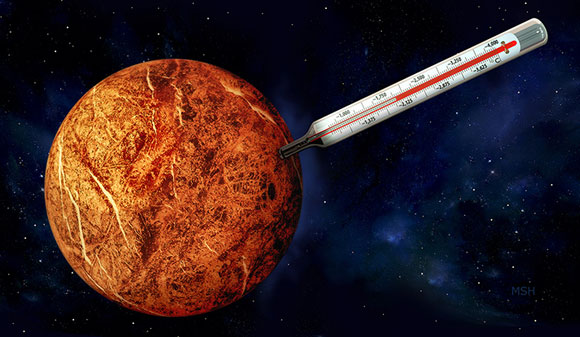
New research from Yale University suggests that simply being in the habitable zone isn’t sufficient to support life. A planet also must start with an internal temperature that is just right.
The search for habitable, alien worlds needs to make room for a second “Goldilocks,” according to a Yale University researcher.
For decades, it has been thought that the key factor in determining whether a planet can support life was its distance from its sun. In our solar system, for instance, Venus is too close to the sun and Mars is too far, but Earth is just right. That distance is what scientists refer to as the “habitable zone,” or the “Goldilocks zone.”
It also was thought that planets were able to self-regulate their internal temperature via mantle convection — the underground shifting of rocks caused by internal heating and cooling. A planet might start out too cold or too hot, but it would eventually settle into the right temperature.
“If you assemble all kinds of scientific data on how Earth has evolved in the past few billion years and try to make sense out of them, you eventually realize that mantle convection is rather indifferent to the internal temperature,” said Jun Korenaga, author of the study and professor of geology and geophysics at Yale. Korenaga presents a general theoretical framework that explains the degree of self-regulation expected for mantle convection and suggests that self-regulation is unlikely for Earth-like planets.
“The lack of the self-regulating mechanism has enormous implications for planetary habitability,” Korenaga said. “Studies on planetary formation suggest that planets like Earth form by multiple giant impacts, and the outcome of this highly random process is known to be very diverse.”
Such diversity of size and internal temperature would not hamper planetary evolution if there was self-regulating mantle convection, Korenaga said. “What we take for granted on this planet, such as oceans and continents, would not exist if the internal temperature of Earth had not been in a certain range, and this means that the beginning of Earth’s history cannot be too hot or too cold.”
The NASA Astrobiology Institute supported the research. Korenaga is a co-investigator of the NASA “Alternative Earths” team, which is organized around the principle of understanding how the Earth has maintained a persistent biosphere through most of its history, how the biosphere manifests in “biosignatures” on a planetary scale, and how reconstructing this history can inform the search for life within and beyond the solar system.
Reference: “Can mantle convection be self-regulated?” by Jun Korenaga, 19 August 2016, Science Advances.
DOI: 10.1126/sciadv.1601168
Never miss a breakthrough: Join the SciTechDaily newsletter.
Follow us on Google and Google News.
2 Comments
I am sure these chaps are very smart but all this is still based on 1 sample! Earth! Surely all these theories are a waste of time until we have at least one other example and even then that would not be sufficient to generalize.
Actually, we have several examples: Mercury, Venus, Mars, and assorted large moons.
We know a good deal about Earth’s tectonics, and enough about the afore-mentioned bodies to know that our world is not like them internally.
Earth has what I term a thin-crust horizontal form of tectonics. Plate movement, largely in flat planes, that also recycles minerals and destroys/recycles organic compounds as well as water. All that helps to lubricate the tectonic motion, and produce volcanoes, which then return minerals to the surface.
Without this wonderful balance,even a good Goldilocks candidate would be at best a largely barren and probably toxic world.