
Close Menu
    Facebook X (Twitter) Instagram
    SciTechDaily
    • Biology
    • Chemistry
    • Earth
    • Health
    • Physics
    • Science
    • Space
    • Technology
    Facebook X (Twitter) Pinterest YouTube RSS
    SciTechDaily
    Home»Space»NASA’s Image of the Day Shows Saturnian Moons Prometheus and Pan
    Space

    NASA’s Image of the Day Shows Saturnian Moons Prometheus and Pan

    By NASAJanuary 24, 2013No Comments2 Mins Read
    Facebook Twitter Pinterest Telegram LinkedIn WhatsApp Email Reddit
    Share
    Facebook Twitter LinkedIn Pinterest Telegram Email Reddit
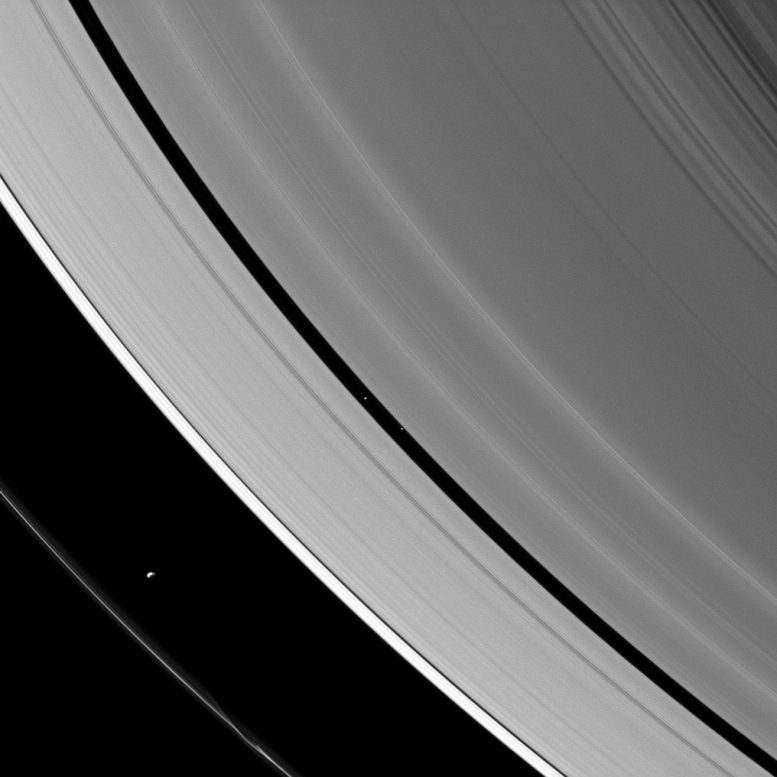
    The Ring Region and the Saturnian Moons Prometheus and Pan
    The Cassini spacecraft’s narrow-angle camera captured Saturn’s moons Prometheus and Pan as they passed through the planet’s rings, illuminated in visible violet light. Credit: NASA/JPL-Caltech/Space Science Institute

    This NASA image of the day shows Saturn’s moons Prometheus and Pan through Saturn’s rings captured in visible violet light by the Cassini spacecraft narrow-angle camera.

    The ring-region Saturnian moons Prometheus and Pan are both caught “herding” their respective rings in this image. Through their gravitational disturbances of nearby ring particles, one moon maintains a gap in the outer A ring and the other helps keep a ring narrowly confined.

    Prometheus (53 miles, or 86 kilometers across), together with Pandora (not seen in this image), maintains the narrow F ring seen at the bottom left in this image. Pan (17 miles, or 28 kilometers across) holds open the Encke gap in which it finds itself embedded in the center. The bright dot near the inner edge of the Encke gap is a background star.

    This view looks toward the unilluminated side of the rings from about 29 degrees below the ringplane. The image was taken in visible violet light with the Cassini spacecraft narrow-angle camera on September 18, 2012.

    The view was acquired at a distance of approximately 1.4 million miles (2.3 million kilometers) from Pan and at a Sun-Pan-spacecraft, or phase, angle of 98 degrees. The image scale is 9 miles (14 kilometers) per pixel.

    The Cassini-Huygens mission is a cooperative project of NASA, the European Space Agency, and the Italian Space Agency. The Jet Propulsion Laboratory, a division of the California Institute of Technology in Pasadena, manages the mission for NASA’s Science Mission Directorate, Washington, D.C. The Cassini orbiter and its two onboard cameras were designed, developed, and assembled at JPL. The imaging operations center is based at the Space Science Institute in Boulder, Colorado.

    Never miss a breakthrough: Join the SciTechDaily newsletter.
    Follow us on Google and Google News.

    Astronomy Cassini-Huygens Mission NASA Saturn
    Share. Facebook Twitter Pinterest LinkedIn Email Reddit

    Related Articles

    Cassini Data Suggests Saturn’s Moons and Rings Are More Than 4 Billion Years Old

    Cassini Views Saturn’s North Polar Hexagon

    Storm Spawns the Largest Tropospheric Vortex Ever Seen on Saturn

    New Cassini Image of Saturn and Its Rings

    Natural Color View of Saturn and Titan

    NASA’s Cassini Spots Lightning in Saturn’s Northern Hemisphere

    Cassini Changes Orbit, Saturn’s Rings Visible Again

    Cassini Data Reveals Likely Subsurface Ocean on Titan

    Heat from Within the Planet Powers Saturn’s Jet Streams

    Leave A Reply Cancel Reply

    • Facebook
    • Twitter
    • Pinterest
    • YouTube

    Don't Miss a Discovery

    Subscribe for the Latest in Science & Tech!

    Trending News

    Long COVID Brain Scans Reveal Damage to Dopamine Neurons

    Scientists Warn a Silent Oxygen Crisis Is Spreading Through Earth’s Waters

    James Webb Telescope Discovers Hidden Giant Planet in Famous Star System

    Scientists Build the First 3D Cloak That Makes Objects Invisible To Heat

    Common Food Additive Linked To Gut Inflammation

    Black Hole Collisions May Follow a Surprisingly Simple Rule

    The Eye Has a Hidden Cleanup System and Scientists Just Discovered It

    The Truth About Vikings Is More Complicated Than Museums Admit

    Follow SciTechDaily
    • Facebook
    • Twitter
    • YouTube
    • Pinterest
    • Newsletter
    • RSS
    SciTech News
    • Biology News
    • Chemistry News
    • Earth News
    • Health News
    • Physics News
    • Science News
    • Space News
    • Technology News
    Recent Posts
    • Rare 8,000-Year-Old Rock Shelter Captures a Turning Point in Human History
    • The Lost “Golden Age” of Human Language
    • Scientists Say Love Follows Mathematical Patterns
    • Long-Term Money Problems May Accelerate Brain Aging
    • The Surprising Brain Chemistry That Turns Ants Into Caregivers
    Copyright © 1998 - 2026 SciTechDaily. All Rights Reserved.
    • Science News
    • About
    • Contact
    • Editorial Board
    • Privacy Policy
    • Terms of Use

    Type above and press Enter to search. Press Esc to cancel.