
Close Menu
    Facebook X (Twitter) Instagram
    SciTechDaily
    • Biology
    • Chemistry
    • Earth
    • Health
    • Physics
    • Science
    • Space
    • Technology
    Facebook X (Twitter) Pinterest YouTube RSS
    SciTechDaily
    Home»Space»Cassini Changes Orbit, Saturn’s Rings Visible Again
    Space

    Cassini Changes Orbit, Saturn’s Rings Visible Again

    By Jia-Rui Cook, Jet Propulsion LaboratoryJuly 10, 2012No Comments2 Mins Read
    Facebook Twitter Pinterest Telegram LinkedIn WhatsApp Email Reddit
    Share
    Facebook Twitter LinkedIn Pinterest Telegram Email Reddit
    NASA Casini Saturn Rings
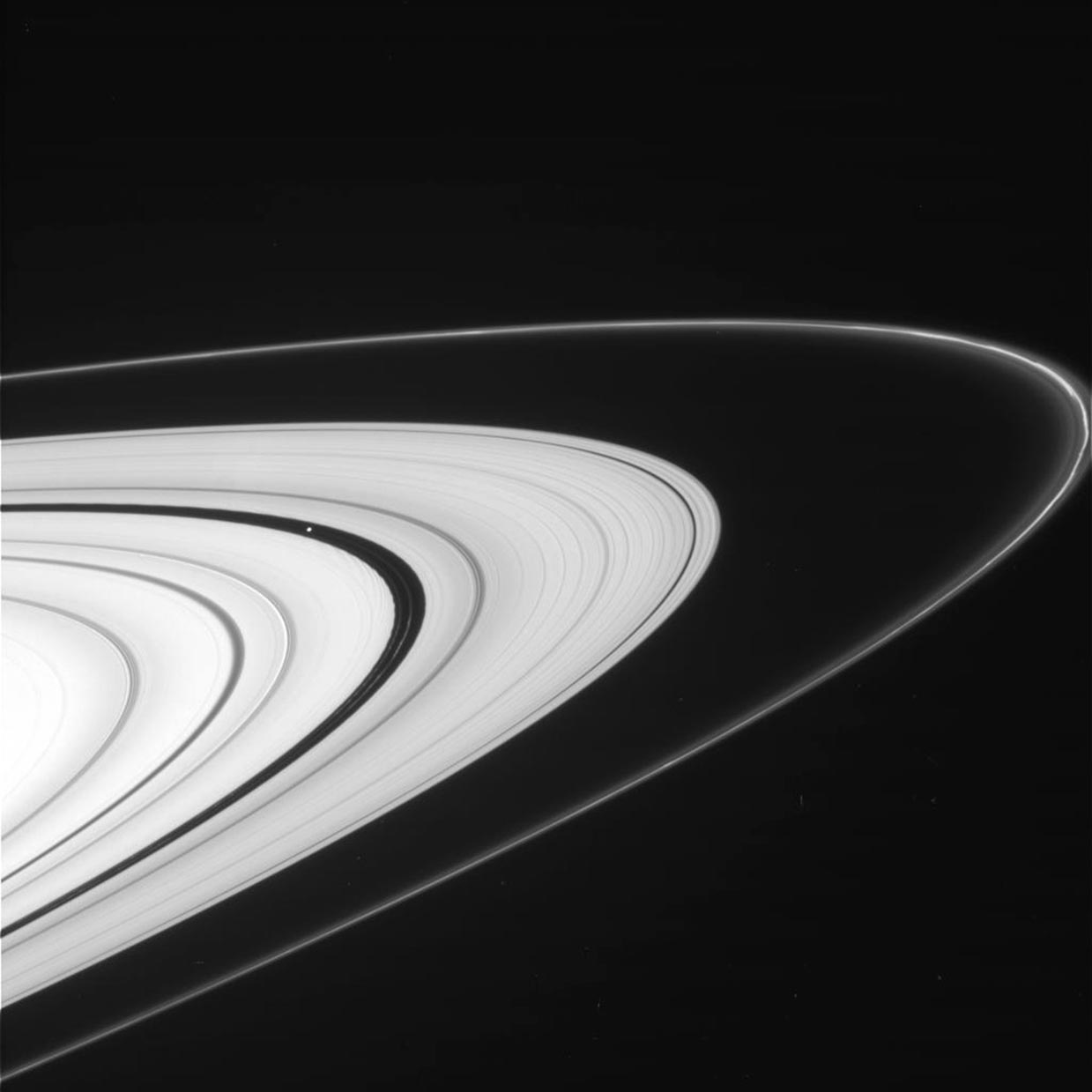
    NASA’s Cassini spacecraft has recently resumed the kind of orbits that allow for spectacular views of Saturn’s rings. This view, from Cassini’s imaging camera, shows the outer A ring and the F ring. The wide gap in the image is the Encke gap, where you see not only the embedded moon Pan but also several kinky, dusty ringlets. A wavy pattern on the inner edge of the Encke gap downstream from Pan and a spiral pattern moving inwards from that edge show Pan’s gravitational influence. The narrow gap close to the outer edge is the Keeler gap. Credit: NASA/JPL-Caltech/SSI

    Cassini’s orbit took the spacecraft out of Saturn’s equatorial plane in the spring of 2012, making face-on views of the rings possible again and allowing scientists to view the poles and atmosphere of Saturn and its “propeller” moons.

    It’s been nearly two years since NASA’s Cassini spacecraft has had views like these of Saturn’s glorious rings. These views are possible again because Cassini has changed the angle at which it orbits Saturn and regularly passes above and below Saturn’s equatorial plane. Steeply inclined orbits around the Saturn system also allow scientists to get better views of the poles and atmosphere of Saturn and its moons.
    Cassini Saturn A Ring
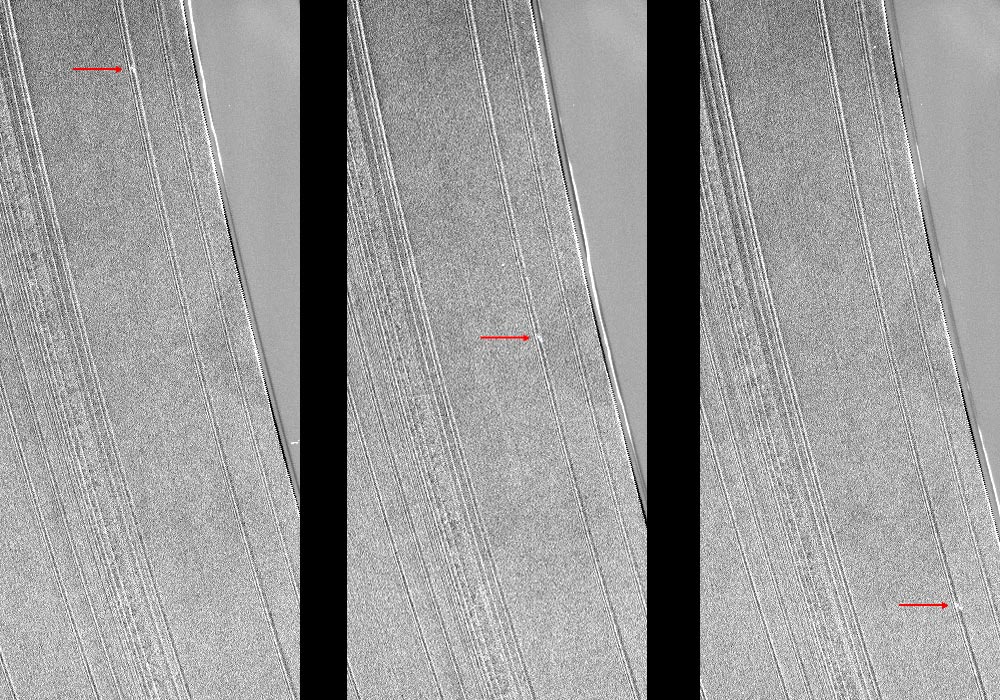
    These three Cassini images show a propeller-shaped structure created by an unseen moon in Saturn’s A ring. Credit: NASA/JPL-Caltech/SSI/Cornell

    Cassini’s recent return of ring images has started to pay off. A group of scientists has restarted the team’s studies of propeller-shaped gaps. These gaps are cleared out by objects that are smaller than known moons but larger than typical ring particles. Cassini scientists haven’t seen propellers in two years. Matt Tiscareno, a Cassini imaging team associate at Cornell University, Ithaca, N.Y., and colleagues have been following these objects for several years. Because some of the propellers are exactly where models predicted they would be, scientists believe they are seeing some old friends again.

    Scientists are eagerly waiting for the other data that will come from this change in perspective. What’s the secret to getting Cassini to orbit at such high angles? Cassini’s lead navigator, Duane Roth, explains in a JPL blog post.

    Never miss a breakthrough: Join the SciTechDaily newsletter.
    Follow us on Google and Google News.

    Astronomy Cassini-Huygens Mission NASA Saturn
    Share. Facebook Twitter Pinterest LinkedIn Email Reddit

    Related Articles

    Cassini Data Suggests Saturn’s Moons and Rings Are More Than 4 Billion Years Old

    Cassini Views Saturn’s North Polar Hexagon

    Storm Spawns the Largest Tropospheric Vortex Ever Seen on Saturn

    NASA’s Image of the Day Shows Saturnian Moons Prometheus and Pan

    New Cassini Image of Saturn and Its Rings

    Natural Color View of Saturn and Titan

    NASA’s Cassini Spots Lightning in Saturn’s Northern Hemisphere

    Cassini Data Reveals Likely Subsurface Ocean on Titan

    Heat from Within the Planet Powers Saturn’s Jet Streams

    Leave A Reply Cancel Reply

    • Facebook
    • Twitter
    • Pinterest
    • YouTube

    Don't Miss a Discovery

    Subscribe for the Latest in Science & Tech!

    Trending News

    Scientists May Have Found the Key to Jupiter and Saturn’s Moon Mystery

    Scientists Uncover Brain Changes That Link Pain to Depression

    Saunas May Do More Than Raise Body Temperature – They Activate Your Immune System

    Exercise in a Pill? Metformin Shows Surprising Effects in Cancer Patients

    Hidden Oceans of Magma Could Be Protecting Alien Life

    New Study Challenges Alzheimer’s Theories: It’s Not Just About Plaques

    Artificial Sweeteners May Harm Future Generations, Study Suggests

    Splashdown! NASA Artemis II Returns From Record-Breaking Moon Mission

    Follow SciTechDaily
    • Facebook
    • Twitter
    • YouTube
    • Pinterest
    • Newsletter
    • RSS
    SciTech News
    • Biology News
    • Chemistry News
    • Earth News
    • Health News
    • Physics News
    • Science News
    • Space News
    • Technology News
    Recent Posts
    • This Strange Material Can Turn Superconductivity on and off Like a Switch
    • Scientists Discover Game-Changing New Way To Treat High Cholesterol
    • Breakthrough Drug Delays Rheumatoid Arthritis for Years After Treatment Ends
    • This Small Change to Your Exercise Routine Could Be the Secret to Living Longer
    • Physicists Discover a Strange New Kind of One-Dimensional Particle
    Copyright © 1998 - 2026 SciTechDaily. All Rights Reserved.
    • Science News
    • About
    • Contact
    • Editorial Board
    • Privacy Policy
    • Terms of Use

    Type above and press Enter to search. Press Esc to cancel.