
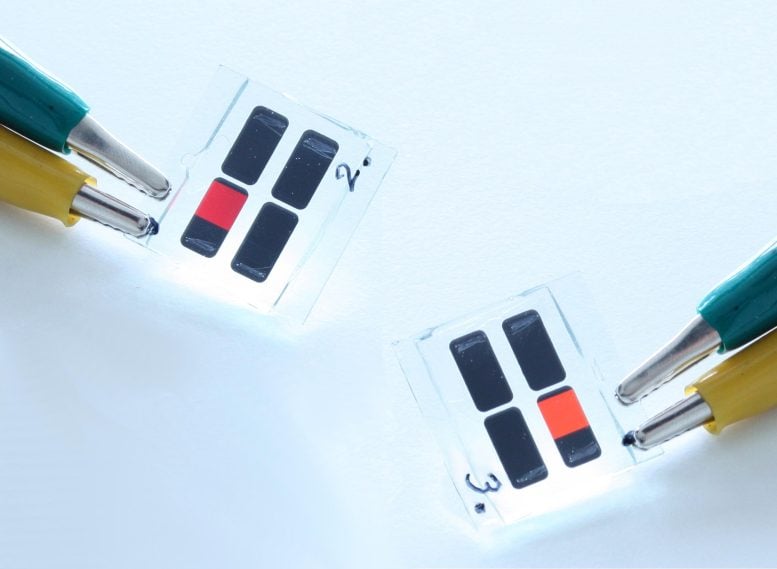
Researchers have developed silicon-based light-emitting diodes (SiLEDs) that have the ability to change color from the deep red down to the yellow-orange spectral region by using nanoparticles.
Silicon nanocrystals have a size of a few nanometers and possess a high luminous potential. Scientists of KIT and the University of Toronto/Canada have now succeeded in manufacturing silicon-based light-emitting diodes (SiLEDs). They are free of heavy metals and can emit light in various colors. The team of chemists, materials researchers, nanoscientists, and opto-electronic experts presents its development in the Nano Letters journal.
Silicon dominates in the microelectronics and photovoltaics industries, but has been considered unsuitable for light-emitting diodes for a long time. However, this is not true for nanoscopic dimensions: Minute silicon nanocrystals can produce light. These nanocrystals consist of a few hundred to thousand atoms and have a considerable potential as highly efficient light emitters, as was demonstrated by the team of Professor Uli Lemmer and Professor Annie K. Powell from KIT as well as Professor Geoffrey A. Ozin from the University of Toronto. In a joint project, the scientists have now succeeded in manufacturing highly efficient light-emitting diodes from the silicon nanocrystals.
So far, the manufacture of silicon light-emitting diodes has been limited to the red visible spectral range and the near-infrared. As regards the efficiency of silicon diodes emitting red light, researchers from Karlsruhe are already top in the world. “Controlled manufacture of diodes emitting multicolor light, however, is an absolutely novelty,” explains Florian Maier-Flaig, scientist of the Light Technology Institute (LTI) of KIT and doctoral student of the Karlsruhe School of Optics and Photonics (KSOP). KIT scientists specifically adjust the color of the light emitted by the diodes by separating nanoparticles depending on their size. “Moreover, our light-emitting diodes have a surprising long-term stability that has not been reached before,” Maier-Flaig reports. The increased service life of the components in operation is due to the use of nanoparticles of one size only. This enhances the stability of the sensitive thin-film components. Short circuits due to oversized particles are excluded.
The development made by the researchers from Karlsruhe and Toronto is also characterized by an impressing homogeneity of the luminous areas. The KIT researchers are among the few teams in the world that know how to manufacture such devices. “With the liquid-processed silicon LEDs that may potentially be produced on large areas as well as at low costs, the nanoparticle community enters new territory, the associated potentials of which can hardly be estimated today. But presumably, textbooks about semiconductor components have to be rewritten,” says Geoffrey A. Ozin, who is presently working as a KIT distinguished research fellow at KIT’s Center for Functional Nanostructures (CFN).
The SiLEDs also have the advantage that they do not contain any heavy metals. In contrast to cadmium selenide, cadmium sulfide, or lead sulfide used by other groups of researchers, the silicon used by this group for the light-emitting nanoparticles is not toxic. Moreover, it is available at low costs and highly abundant on Earth. Due to their many advantages, the SiLEDs will be developed further in cooperation with other partners.
Reference: “Multicolor Silicon Light-Emitting Diodes (SiLEDs)” by Florian Maier-Flaig, Julia Rinck, Moritz Stephan, Tobias Bocksrocker, Michael Bruns, Christian Kübel, Annie K. Powell, Geoffrey A. Ozin and Uli Lemmer, 15 January 2013, Nano Letters.
DOI: 10.1021/nl3038689
Never miss a breakthrough: Join the SciTechDaily newsletter.
Follow us on Google and Google News.