
Close Menu
    Facebook X (Twitter) Instagram
    SciTechDaily
    • Biology
    • Chemistry
    • Earth
    • Health
    • Physics
    • Science
    • Space
    • Technology
    Facebook X (Twitter) Pinterest YouTube RSS
    SciTechDaily
    Home»Technology»New “Gold Nanocluster” Technology Improves Solar Cell Performance
    Technology

    New “Gold Nanocluster” Technology Improves Solar Cell Performance

    By Western UniversitySeptember 26, 2014No Comments4 Mins Read
    Facebook Twitter Pinterest Telegram LinkedIn WhatsApp Email Reddit
    Share
    Facebook Twitter LinkedIn Pinterest Telegram Email Reddit
    Scientists Addvance Solar Power with New Gold Nanocluster Technology
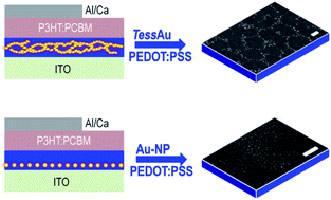
    We report for the first time the fabrication of nanocomposite hole-blocking layers consisting of poly-3,4-ethylene-dioxythiophene:poly-styrene-sulfonate (PEDOT:PSS) thin films incorporating networks of gold nanoparticles assembled from Au144(SCH2CH2Ph)60, a molecular gold precursor. These thin films can be prepared reproducibly on indium tin oxide by spinning on it Au144(SCH2CH2Ph)60 solutions in chlorobenzene, annealing the resulting thin film at 400 °C, and subsequently spinning PEDOT:PSS on top. The use of our nanocomposite hole-blocking layers for enhancing the photoconversion efficiency of bulk heterojunction organic solar cells is demonstrated. By varying the concentration of Au144(SCH2CH2Ph)60 in the starting solution and the annealing time, different gold nanostructures were obtained ranging from individual gold nanoparticles (AuNPs) to tessellated networks of gold nanostructures (Tess-AuNPs). Improvement in organic solar cell efficiencies up to 10% relative to a reference cell is demonstrated with Tess-AuNPs embedded in PEDOT:PSS. Credit: Nanoscale, 2014,6, 7570-7575; DOI: 10.1039/C4NR01821D

    Using approximately 10,000 times less gold than in previous studies, researchers from Western University improve solar power performance with new “gold nanocluster” technology.

    Scientists at Western University have discovered that a small molecule created with just 144 atoms of gold can increase solar cell performance by more than 10 percent. These findings, published recently by the high-impact journal Nanoscale, represent a game-changing innovation that holds the potential to take solar power mainstream and dramatically decrease the world’s dependence on traditional, resource-based sources of energy, says Giovanni Fanchini from Western’s Faculty of Science.

    Fanchini, the Canada Research Chair in Carbon-based Nanomaterials and Nano-optoelectronics, says the new technology could easily be fast-tracked and integrated into prototypes of solar panels in one to two years and solar-powered phones in as little as five years.

    “Every time you recharge your cell phone, you have to plug it in,” says Fanchini, an assistant professor in Western’s Department of Physics and Astronomy. “What if you could charge mobile devices like phones, tablets, or laptops on the go? Not only would it be convenient, but the potential energy savings would be significant.”

    The Western researchers have already started working with manufacturers of solar components to integrate their findings into existing solar cell technology and are excited about the potential.

    “The Canadian business industry already has tremendous know-how in solar manufacturing,” says Fanchini. “Our invention is modular, an add-on to the existing production process, so we anticipate a working prototype very quickly.”

    Making nanoplasmonic enhancements, Fanchini and his team use “gold nanoclusters” as building blocks to create a flexible network of antennae on more traditional solar panels to attract an increase of light. While nanotechnology is the science of creating functional systems at the molecular level, nanoplasmonics investigates the interaction of light with and within these systems.

    “Picture an extremely delicate fishnet of gold,” explains Fanchini explains, noting that the antennae are so miniscule they are unseen even with a conventional optical microscope. “The fishnet catches the light emitted by the sun and draws it into the active region of the solar cell.”

    According to Fanchini, the spectrum of light reflected by gold is centered on the yellow color and matches the light spectrum of the sun making it superior for such antennae as it greatly amplifies the amount of sunlight going directly into the device.

    “Gold is very robust, resilient to oxidization, and not easily damaged, making it the perfect material for long-term use,” says Fanchini. “And gold can also be recycled.”

    It has been known for some time that larger gold nanoparticles enhance solar cell performance, but the Western team is getting results with “a ridiculously small amount” – approximately 10,000 times less than previous studies, which is 10,000 times less expensive too.

    Reference:  “Tessellated gold nanostructures from Au144(SCH2CH2Ph)60 molecular precursors and their use in organic solar cell enhancement” by Reg Bauld, Mahdi Hesari, Mark S. Workentinac and Giovanni Fanchini, 6 May 2014, Nanoscale.
    DOI: 10.1039/C4NR01821D


    Never miss a breakthrough: Join the SciTechDaily newsletter.
    Follow us on Google and Google News.

    Gold Materials Science Nanotechnology Photovoltaics Solar Cells Western University
    Share. Facebook Twitter Pinterest LinkedIn Email Reddit

    Related Articles

    18 Times More Power: MIT Researchers Have Developed Ultrathin Lightweight Solar Cells

    Engineers Develop New System to Harness the Full Spectrum of Available Solar Radiation

    New Type of CNT Solar Cell is Twice as Efficient as Its Predecessors

    Aluminum Studs Improve Solar Panel Efficiency

    Scientists Change the Color of Gold

    First All Carbon Solar Cell Made From Nanotubes and Buckyballs

    Highly Transparent Polymer Solar Cell Produces Energy by Absorbing Near-Infrared Light

    Nano-Sandwich Design Results in Slimmer Solar Cells With Decreased Costs

    All-Carbon Photovoltaic Cell to Harness Infrared Light

    Leave A Reply Cancel Reply

    • Facebook
    • Twitter
    • Pinterest
    • YouTube

    Don't Miss a Discovery

    Subscribe for the Latest in Science & Tech!

    Trending News

    Your Blood Pressure Reading Could Be Wrong Because of One Simple Mistake

    Astronomers Stunned by Ancient Galaxy With No Spin

    Physicists May Be on the Verge of Discovering “New Physics” at CERN

    Scientists Solve 320-Million-Year Mystery of Reptile Skin Armor

    Scientists Say This Daily Walking Habit May Be the Secret to Keeping Weight Off After Dieting

    New Therapy Rewires the Brain To Restore Joy in Depression Patients

    Giant Squid Detected off Western Australia in Stunning Deep-Sea Discovery

    Popular Sugar-Free Sweetener Linked to Liver Disease, Study Warns

    Follow SciTechDaily
    • Facebook
    • Twitter
    • YouTube
    • Pinterest
    • Newsletter
    • RSS
    SciTech News
    • Biology News
    • Chemistry News
    • Earth News
    • Health News
    • Physics News
    • Science News
    • Space News
    • Technology News
    Recent Posts
    • Common Blood Pressure Drug Supercharges Cancer Treatment in Surprising New Study
    • Key Magic Mushroom Ingredient Increases Laziness and Reduces Aggression
    • Researchers Solve 15-Year Mystery Behind Cancer-Causing Gut Toxin
    • One of the World’s Most Popular Weedkillers May Be Fueling Deadly Superbugs
    • Scientists Create Laser “Whirlpools” That Spin Tiny Cells Without Touching Them
    Copyright © 1998 - 2026 SciTechDaily. All Rights Reserved.
    • Science News
    • About
    • Contact
    • Editorial Board
    • Privacy Policy
    • Terms of Use

    Type above and press Enter to search. Press Esc to cancel.