
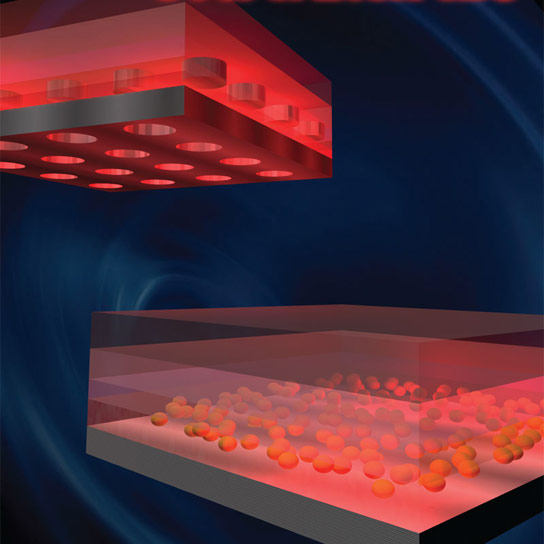
Researchers at the University at Buffalo are working on the development of organic photovoltaics that use polymers and small molecules that are carbon-based and can be applied in liquid form over large areas, reducing the cost and possibly becoming as inexpensive as paint.
Most Americans want the U.S. to place more emphasis on developing solar power, recent polls suggest.
A major impediment, however, is the cost to manufacture, install and maintain solar panels. Simply put, most people and businesses cannot afford to place them on their rooftops.
Fortunately, that is changing because researchers such as Qiaoqiang Gan, University at Buffalo assistant professor of electrical engineering, are helping develop a new generation of photovoltaic cells that produce more power and cost less to manufacture than what’s available today.
One of the more promising efforts, which Gan is working on, involves the use of plasmonic-enhanced organic photovoltaic materials. These devices don’t match traditional solar cells in terms of energy production but they are less expensive and – because they are made (or processed) in liquid form – can be applied to a greater variety of surfaces.
Gan detailed the progress of plasmonic-enhanced organic photovoltaic materials in the May 7 edition of the journal Advanced Materials. Co-authors include Filbert J. Bartoli, professor of electrical and computer engineering at Lehigh University, and Zakya Kafafi of the National Science Foundation.
The paper, which included an image of a plasmonic-enhanced organic photovoltaic device on the journal’s front page, is available online.
Currently, solar power is produced with either thick polycrystalline silicon wafers or thin-film solar cells made up of inorganic materials such as amorphous silicon or cadmium telluride. Both are expensive to manufacture, Gan said.
His research involves thin-film solar cells, too, but unlike what’s on the market he is using organic materials such as polymers and small molecules that are carbon-based and less expensive.
“Compared with their inorganic counterparts, organic photovoltaics can be fabricated over large areas on rigid or flexible substrates potentially becoming as inexpensive as paint,” Gan said.
The reference to paint does not include a price point but rather the idea that photovoltaic cells could one day be applied to surfaces as easily as paint is to walls, he said.
There are drawbacks to organic photovoltaic cells. They have to be thin due to their relatively poor electronic conductive properties. Because they are thin and, thus, without sufficient material to absorb light, it limits their optical absorption and leads to insufficient power conversion efficiency.
Their power conversion efficiency needs to be 10 percent or more to compete in the market, Gan said.
To achieve that benchmark, Gan and other researchers are incorporating metal nanoparticles and/or patterned plasmonic nanostructures into organic photovoltaic cells. Plasmons are electromagnetic waves and free electrons that can be used to oscillate back and forth across the interface of metals and semiconductors.
Recent material studies suggest they are succeeding, he said. Gan and the paper’s co-authors argue that, because of these breakthroughs, there should be a renewed focus on how nanomaterials and plasmonic strategies can create more efficient and affordable thin-film organic solar cells.
Gan is continuing his research by collaborating with several researchers at UB including: Alexander N. Cartwright, professor of electrical engineering and biomedical engineering and UB vice president for research and economic development; Mark T. Swihart, UB professor of chemical and biological engineering and director of the university’s Strategic Strength in Integrated Nanostructured Systems; and Hao Zeng, associate professor of physics.
Gan is a member of UB’s electrical engineering optics and photonics research group, which includes Cartwright, professors Edward Furlani and Pao-Lo Liu, and Natalia Litchinitser, associate professor.
The group carries out research in nanophotonics, biophotonics, hybrid inorganic/organic materials and devices, nonlinear and fiber optics, metamaterials, nanoplasmonics, optofluidics, microelectromechanical systems (MEMS), biomedical microelectromechanical systems (BioMEMs), biosensing and quantum information processing.
Reference: “Plasmonic-Enhanced Organic Photovoltaics: Breaking the 10% Efficiency Barrier” by Qiaoqiang Gan, Filbert J. Bartoli and Zakya H. Kafafi, 18 February 2013, Advanced Materials.
DOI: 10.1002/adma.201203323
Never miss a breakthrough: Join the SciTechDaily newsletter.
Follow us on Google and Google News.