
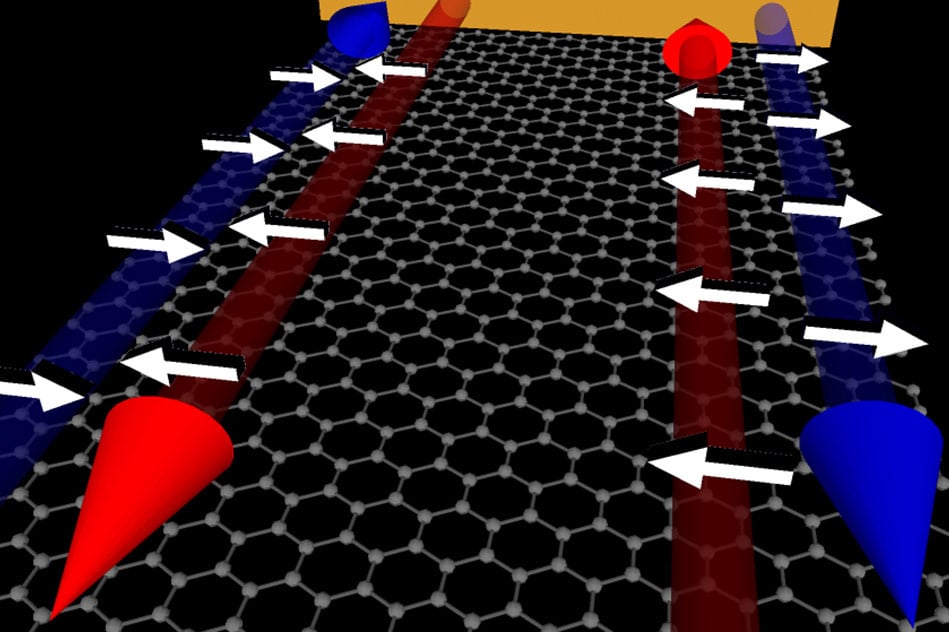
New research from MIT shows that graphene can effectively filter electrons according to the direction of their spin, something that cannot be done by any conventional electronic system.
Graphene has become an all-purpose wonder material, spurring armies of researchers to explore new possibilities for this two-dimensional lattice of pure carbon. But new research at MIT has found additional potential for the material by uncovering unexpected features that show up under some extreme conditions — features that could render graphene suitable for exotic uses such as quantum computing.
The research is published this week in the journal Nature, in a paper by professors Pablo Jarillo-Herrero and Ray Ashoori, postdocs Andrea Young and Ben Hunt, graduate student Javier Sanchez-Yamaguchi, and three others. Under an extremely powerful magnetic field and at extremely low temperature, the researchers found, graphene can effectively filter electrons according to the direction of their spin, something that cannot be done by any conventional electronic system.
Under typical conditions, sheets of graphene behave as normal conductors: Apply a voltage, and current flows throughout the two-dimensional flake. If you turn on a magnetic field perpendicular to the graphene flake, however, the behavior changes: Current flows only along the edge, while the bulk remains insulating. Moreover, this current flows only in one direction — clockwise or counterclockwise, depending on the orientation of the magnetic field — in a phenomenon known as the quantum Hall effect.
In the new work, the researchers found that if they applied a second powerful magnetic field — this time in the same plane as the graphene flake — the material’s behavior changes yet again: Electrons can move around the conducting edge in either direction, with electrons that have one kind of spin moving clockwise while those with the opposite spin move counterclockwise.
“We created an unusual kind of conductor along the edge,” says Young, a Pappalardo Postdoctoral Fellow in MIT’s physics department and the paper’s lead author, “virtually a one-dimensional wire.” The segregation of electrons according to spin is “a normal feature of topological insulators,” he says, “but graphene is not normally a topological insulator. We’re getting the same effect in a very different material system.”
What’s more, by varying the magnetic field, “we can turn these edge states on and off,” Young says. That switching capability means that, in principle, “we can make circuits and transistors out of these,” he says, which has not been realized before in conventional topological insulators.
There is another benefit of this spin selectivity, Young says: It prevents a phenomenon called “backscattering,” which could disrupt the motion of the electrons. As a result, imperfections that would ordinarily ruin the electronic properties of the material have little effect. “Even if the edges are ‘dirty,’ electrons are transmitted along this edge nearly perfectly,” he says.
Jarillo-Herrero, the Mitsui Career Development Associate Professor of Physics at MIT, says the behavior seen in these graphene flakes was predicted, but never seen before. This work, he says, is the first time such spin-selective behavior has been demonstrated in a single sheet of graphene, and also the first time anyone has demonstrated the ability “to transition between these two regimes.”
That could ultimately lead to a novel way of making a kind of quantum computer, Jarillo-Herrero says, something that researchers have tried to do, without success, for decades. But because of the extreme conditions required, Young says, “this would be a very specialized machine” used only for high-priority computational tasks, such as in national laboratories.
Ashoori, a professor of physics, points out that the newly discovered edge states have a number of surprising properties. For example, although gold is an exceptionally good electrical conductor, when dabs of gold are added to the edge of the graphene flakes, they cause the electrical resistance to increase. The gold dabs allow the electrons to backscatter into the oppositely traveling state by mixing the electron spins; the more gold is added, the more the resistance goes up.
This research represents “a new direction” in topological insulators, Young says. “We don’t really know what it might lead to, but it opens our thinking about the kind of electrical devices we can make.”
The experiments required the use of a magnetic field with a strength of 35 tesla — “about 10 times more than in an MRI machine,” Jarillo-Herrero says — and a temperature of just 0.3 degrees Celsius above absolute zero. However, the team is already pursuing ways of observing a similar effect at magnetic fields of just one tesla — similar to a strong kitchen magnet — and at higher temperatures.
Philip Kim, a professor of physics at Columbia University who was not involved in this work, says, “The authors here have beautifully demonstrated excellent quantization of the conductance,” as predicted by theory. He adds, “This is very nice work that may connect topological insulator physics to the physics of graphene with interactions. This work is a good example of how the two most popular topics in condensed matter physics are connected to each other.”
Reference: “Tunable symmetry breaking and helical edge transport in a graphene quantum spin Hall state” by A. F. Young, J. D. Sanchez-Yamagishi, B. Hunt, S. H. Choi, K. Watanabe, T. Taniguchi, R. C. Ashoori and P. Jarillo-Herrero, 22 December 2013, Nature.
DOI: 10.1038/nature12800
The team also included MIT junior Sang Hyun Choi and Kenji Watanabe and Takashi Taniguchi of the National Institute for Materials Science in Tsukuba, Japan. The work was supported by grants from the U.S. Department of Energy, the Gordon and Betty Moore Foundation, and the National Science Foundation, and used facilities at the National High Magnetic Field Laboratory in Florida.
Never miss a breakthrough: Join the SciTechDaily newsletter.
Follow us on Google and Google News.
1 Comment
What kind of kitchen do you live in where you have a 1 Tesla kitchen magnet??????????
Totally totally inaccurate