
Close Menu
    Facebook X (Twitter) Instagram
    SciTechDaily
    • Biology
    • Chemistry
    • Earth
    • Health
    • Physics
    • Science
    • Space
    • Technology
    Facebook X (Twitter) Pinterest YouTube RSS
    SciTechDaily
    Home»Technology»A Simple Sponge Has Improved How Robots Grasp
    Technology

    A Simple Sponge Has Improved How Robots Grasp

    By University of BristolJuly 6, 2023No Comments3 Mins Read
    Facebook Twitter Pinterest Telegram LinkedIn WhatsApp Email Reddit
    Share
    Facebook Twitter LinkedIn Pinterest Telegram Email Reddit
    Robot Sponge
    Robot sponge. Credit: Tianqi Yue

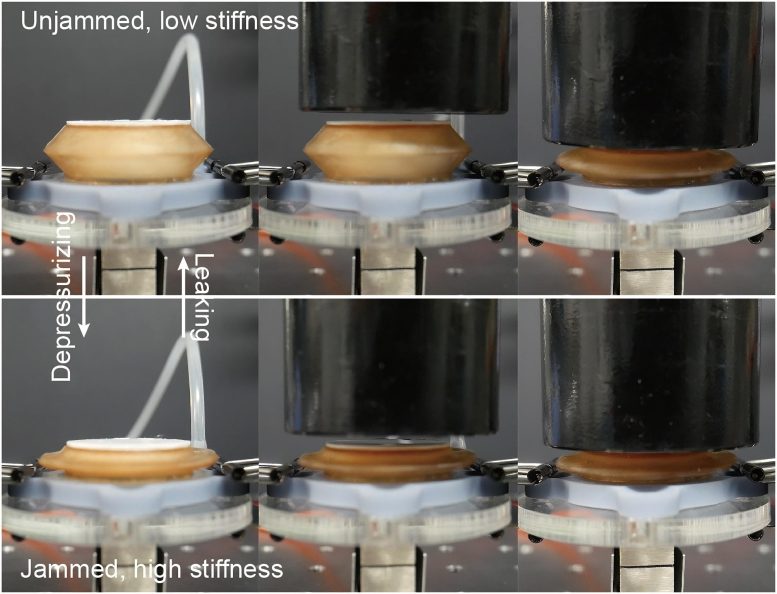
    Researchers have created a simple, low-cost silicone sponge device that improves robotic grasping by providing variable stiffness, enabling safer handling of delicate objects in various industries.

    Scientists at the University of Bristol have discovered that a simple sponge can enhance the way robots grasp objects.

    This easy-to-make sponge-jamming device can assist stiff robots handle delicate items carefully by mimicking the nuanced touch, or variable stiffness, of a human.

    Robots can skip, jump and do somersaults, but they’re too rigid to hold an egg easily. Variable-stiffness devices are potential solutions for contact compliance on hard robots to reduce damage, or for improving the load capacity of soft robots.

    This study, published at the IEEE International Conference on Robotics and Automation (ICRA) 2023, shows that variable stiffness can be achieved by a silicone sponge.

    Lead author Tianqi Yue from Bristol’s Department of Engineering Mathematics explained: “Stiffness, also known as softness, is important in contact scenarios.

    “Robotic arms are too rigid so they cannot make such a soft human-like grasp on delicate objects, for example, an egg.

    “What makes humans different from robotic arms is that we have soft tissues enclosing rigid bones, which act as a natural mitigating mechanism.

    “In this paper, we managed to develop a soft device with variable stiffness, to be mounted on the end robotic arm for making the robot-object contact safe.”


    Robot sponge in action. Credit: Tianqi Yue

    Silicone sponge is a cheap and easy-to-fabricate material. It is a porous elastomer just like the cleaning sponge used in everyday tasks.

    By squeezing the sponge, the sponge stiffens which is why it can be transformed into a variable-stiffness device.

    This device could be used in industrial robots in scenarios including gripping jellies, eggs, and other fragile substances. It can also be used in service robots to make human-robot interaction safer.

    Mr. Yue added: “We managed to use a sponge to make a cheap and nimble but effective device that can help robots achieve soft contact with objects. The great potential comes from its low cost and lightweight.

    “We believe this silicone-sponge-based variable-stiffness device will provide a novel solution in industry and healthcare, for example, tunable-stiffness requirement on robotic polishing and ultrasound imaging.”

    The team will now look at making the device achieve variable stiffness in multiple directions, including rotation.

    Reference: “A Silicone-sponge-based Variable-stiffness Device” by Tianqi Yue, Tsam Lung You, Hemma Philamore, Hermes Bloomfield-Gadêlha and Jonathan Rossiter, 29 May 2023 – 02 June 2023, 2023 IEEE International Conference on Robotics and Automation (ICRA).
    DOI: 10.1109/ICRA48891.2023.10160915

    Never miss a breakthrough: Join the SciTechDaily newsletter.
    Follow us on Google and Google News.

    Robotics University of Bristol
    Share. Facebook Twitter Pinterest LinkedIn Email Reddit

    Related Articles

    Mantis: Affordable and Accessible Haptic Force Feedback [Video]

    DARPA’s Legged Squad Support System (LS3) To Ease Physical Load on Troops

    Researchers Study Butterfly Flight Dynamics to Create Small Airborne Robots

    Leaping Lizards Influence Robot Design at UC Berkeley

    Babyloid Robot Aims to Combat Depression in the Elderly

    Qbo Robot Looks In The Mirror, Recognizes Itself

    Harvard Scientists Develop $5 Rubber Robot

    Korea Developing Robot Prison Guards

    Yaskawa Electric’s SmartPal VII Operated Using Kinect

    Leave A Reply Cancel Reply

    • Facebook
    • Twitter
    • Pinterest
    • YouTube

    Don't Miss a Discovery

    Subscribe for the Latest in Science & Tech!

    Trending News

    JWST Finds a “Star” 100 Billion Times Brighter Than Any Star Should Be

    Scientists Find a Hidden Biological Link Across Different Forms of Autism

    Astronomers Discover a Ghostly River of Stars That Could Reveal Dark Matter

    Why Is Colorectal Cancer Rising in People Under 50? New Clues Point to the Environment

    Quantum Fluctuations Break a Crystal’s Symmetry Rules

    Why Does an Irregular Heartbeat Strike 40 Years Early in Some People?

    Scientists Reveal How ADHD Could Fuel Creative Thinking

    Scientists Find Just 3 Minutes of Sprinting Can Transform Blood Chemistry

    Follow SciTechDaily
    • Facebook
    • Twitter
    • YouTube
    • Pinterest
    • Newsletter
    • RSS
    SciTech News
    • Biology News
    • Chemistry News
    • Earth News
    • Health News
    • Physics News
    • Science News
    • Space News
    • Technology News
    Recent Posts
    • Common Plant Chemical Linked to Widespread Organ Damage in Aquatic Animals
    • Scientists Discover a Hidden Baobab Species in Madagascar
    • Dogs and Humans May Share a Surprising Biological Secret to Longevity
    • A 150-Million-Year-Old Dinosaur Flight Mystery May Finally Have an Answer
    • Giant Crocodylians Ruled South America’s Ancient Food Chain
    Copyright © 1998 - 2026 SciTechDaily. All Rights Reserved.
    • Science News
    • About
    • Contact
    • Editorial Board
    • Privacy Policy
    • Terms of Use

    Type above and press Enter to search. Press Esc to cancel.