
Close Menu
    Facebook X (Twitter) Instagram
    SciTechDaily
    • Biology
    • Chemistry
    • Earth
    • Health
    • Physics
    • Science
    • Space
    • Technology
    Facebook X (Twitter) Pinterest YouTube RSS
    SciTechDaily
    Home»Technology»Harvard Scientists Develop $5 Rubber Robot
    Technology

    Harvard Scientists Develop $5 Rubber Robot

    By SciTechDailyNovember 29, 20111 Comment2 Mins Read
    Facebook Twitter Pinterest Telegram LinkedIn WhatsApp Email Reddit
    Share
    Facebook Twitter LinkedIn Pinterest Telegram Email Reddit
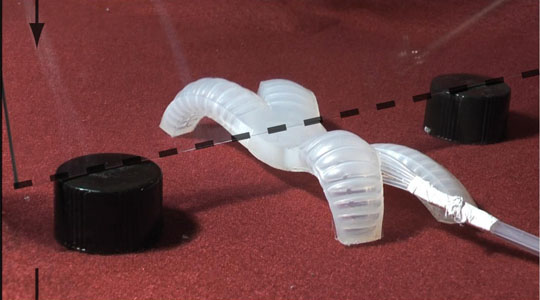
    Harvard Develops Felxible Robot of the Future
    Harvard Develops flexible robot of the future

    This may not look like the future of robots that we were promised in movies like Star Wars and Star Trek, but according to scientists at Harvard University and other leading researchers in the robotics field, flexible robots are the future.

    They offer the ability to adapt to situations and go places that a standard model would be unable to navigate based on size restrictions. According to Matthew Walter, a roboticist at the Massachusetts Institute of Technology, “The unique ability for soft robots to deform allows them to go places that traditional rigid-body robots cannot.”

    This “unique ability” is what inspired the Harvard team, led by chemist George M. Whitesides, to create a robot based on movements borrowed from squids, starfish, and other animals without hard skeletons that lead to a soft robot with a material cost of about $5, according to Robert Shepherd, a Harvard research team member and idea co-creator.

    Besides from being relatively inexpensive, these soft robots offer endless possibilities for use in a variety of fields like exploration and rescue. Since the motion is controlled by compressed air flowing into the soft robot, it has some limitations, but I expect those to diminish as research goes on.

    “They’ve used a clever system of chambers and shapes, and when you apply pressure, you get the robot to move in predictable ways,” says Barry Trimmer, who’s developing soft robotics at Tufts University.

    While this model is small at only 5 inches long and is limited by the air being compressed into its limbs, larger and more advanced models can be expected in the future. Especially since the Harvard project was funded by the Defense Advanced Research Projects Agency, the Pentagon’s research think tank.

    Look for future models to be independent and autonomous. “Usually, if you want to build a device to do something useful, you don’t want it to be tethered,” Trimmer says. “If you want it to travel somewhere, you don’t want it to be trailing wires or tubes.”

    I think we can expect to see a lot more of these rubber robots in the future.

    Never miss a breakthrough: Join the SciTechDaily newsletter.
    Follow us on Google and Google News.

    Development Exploration Popular Robotics
    Share. Facebook Twitter Pinterest LinkedIn Email Reddit

    Related Articles

    Engineers Create 3D-Printed Smart Gel That Walks Underwater, Moves Objects

    New Inexpensive Robots Find Leaks from Inside Pipes

    MIT Develops a System That Can 3D Print the Basic Structure of an Entire Building

    Engineers Develop Micro-tentacles So Tiny Robots Can Handle Delicate Objects

    Cancer-Fighting DNA Nanorobots Could Target Specific Cells for Repair

    Sandia’s Robot Hand Can Replace Battery in Flashlight

    DARPA & Harvard’s Soft, Self-Camouflaging Robot

    Robonaut 2: A Robotic Space Station Crew Member

    Researchers Use Robot Fish to Lead Golden Shiner School

    1 Comment

    1. Julie on September 14, 2012 7:52 am

      Video of the robot in action
      https://www.youtube.com/watch?v=Z19OZUQV20E

      Reply
    Leave A Reply Cancel Reply

    • Facebook
    • Twitter
    • Pinterest
    • YouTube

    Don't Miss a Discovery

    Subscribe for the Latest in Science & Tech!

    Trending News

    One of the Universe’s Largest Stars May Be Getting Ready To Explode

    Scientists Discover Enzyme That Could Supercharge Ozempic-Like Weight Loss Drugs

    Popular Sweetener Linked to DNA Damage – “It’s Something You Should Not Be Eating”

    Ancient “Rock” Microbes May Reveal How Complex Life Began

    Researchers Capture Quantum Interference in One of Nature’s Rarest Atoms

    “A Plague Is Upon Us”: The Mass Death That Changed an Ancient City Forever

    Scientists Discover Game-Changing New Way To Treat High Cholesterol

    This Small Change to Your Exercise Routine Could Be the Secret to Living Longer

    Follow SciTechDaily
    • Facebook
    • Twitter
    • YouTube
    • Pinterest
    • Newsletter
    • RSS
    SciTech News
    • Biology News
    • Chemistry News
    • Earth News
    • Health News
    • Physics News
    • Science News
    • Space News
    • Technology News
    Recent Posts
    • Scientists Prove There Are Just Six Degrees of Separation in a Social Network
    • Bee Bacteria Could Fix a Major Flaw in Plant-Based Milk
    • Scientists Discover a Surprising Way To Make Bread Healthier and More Nutritious
    • Natural Compounds Boost Bone Implant Success While Killing Bacteria and Cancer Cells
    • After 60 Years, Scientists Uncover Unexpected Brain Effects of Popular Diabetes Drug Metformin
    Copyright © 1998 - 2026 SciTechDaily. All Rights Reserved.
    • Science News
    • About
    • Contact
    • Editorial Board
    • Privacy Policy
    • Terms of Use

    Type above and press Enter to search. Press Esc to cancel.