
“It’s a useful planet because it may be like an early Earth”
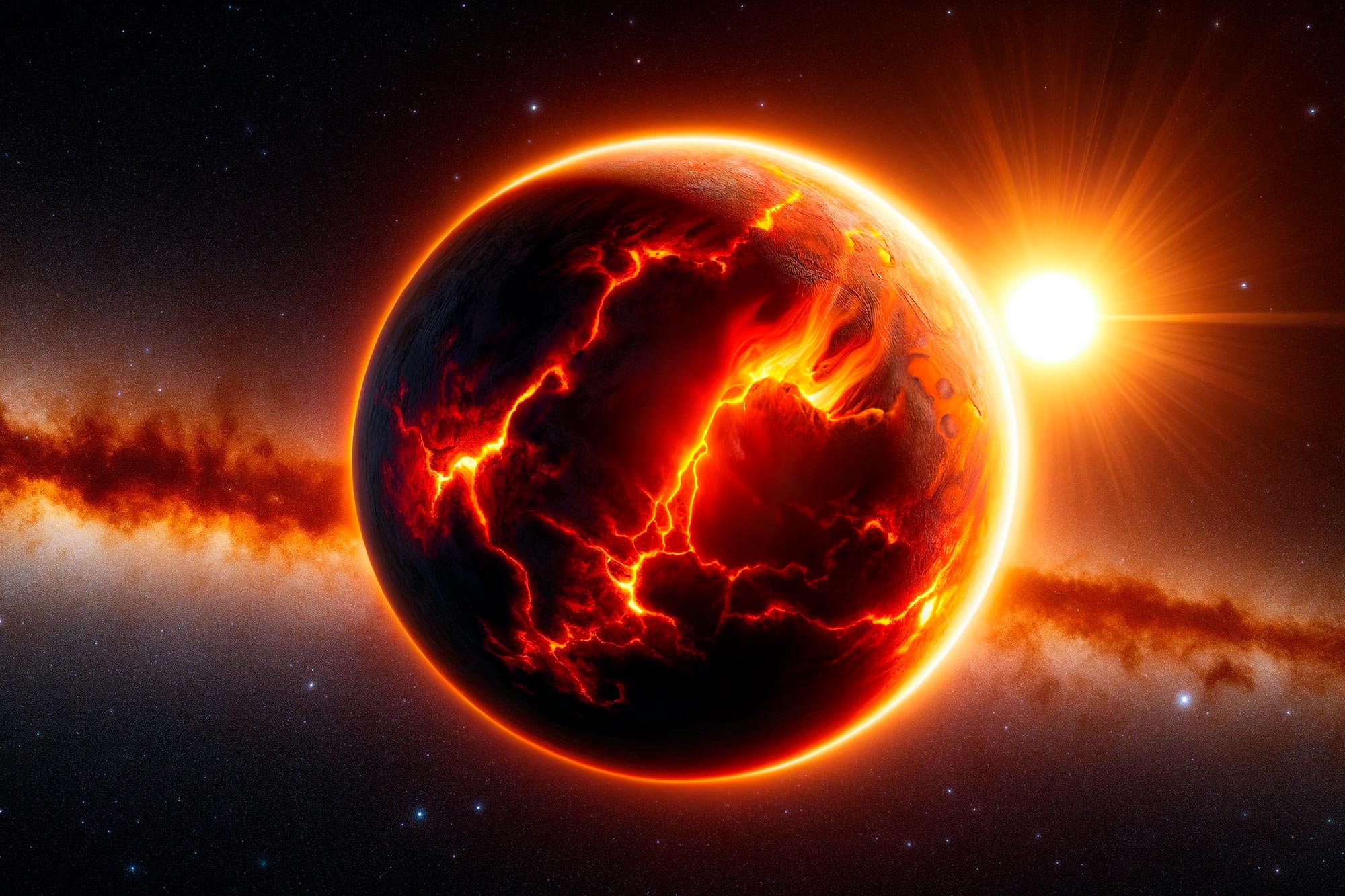
HD 63433d, a new Earth-sized planet discovered by astronomers, offers a rare glimpse into the early stages of planet evolution, given its close orbit around a young sun-like star.
A team of astronomers has discovered a planet closer and younger than any other Earth-sized world yet identified. It’s a remarkably hot world whose proximity to our own planet and to a star like our sun mark it as a unique opportunity to study how planets evolve.
The new planet was described in a new study published recently by The Astronomical Journal. Melinda Soares-Furtado, a NASA Hubble Fellow at the University of Wisconsin–Madison who will begin work as an astronomy professor at the university in the fall, and recent UW–Madison graduate Benjamin Capistrant, now a graduate student at the University of Florida, co-led the study with co-authors from around the world.
“It’s a useful planet because it may be like an early Earth,” says Soares-Furtado.
Here is what scientists know about the planet:
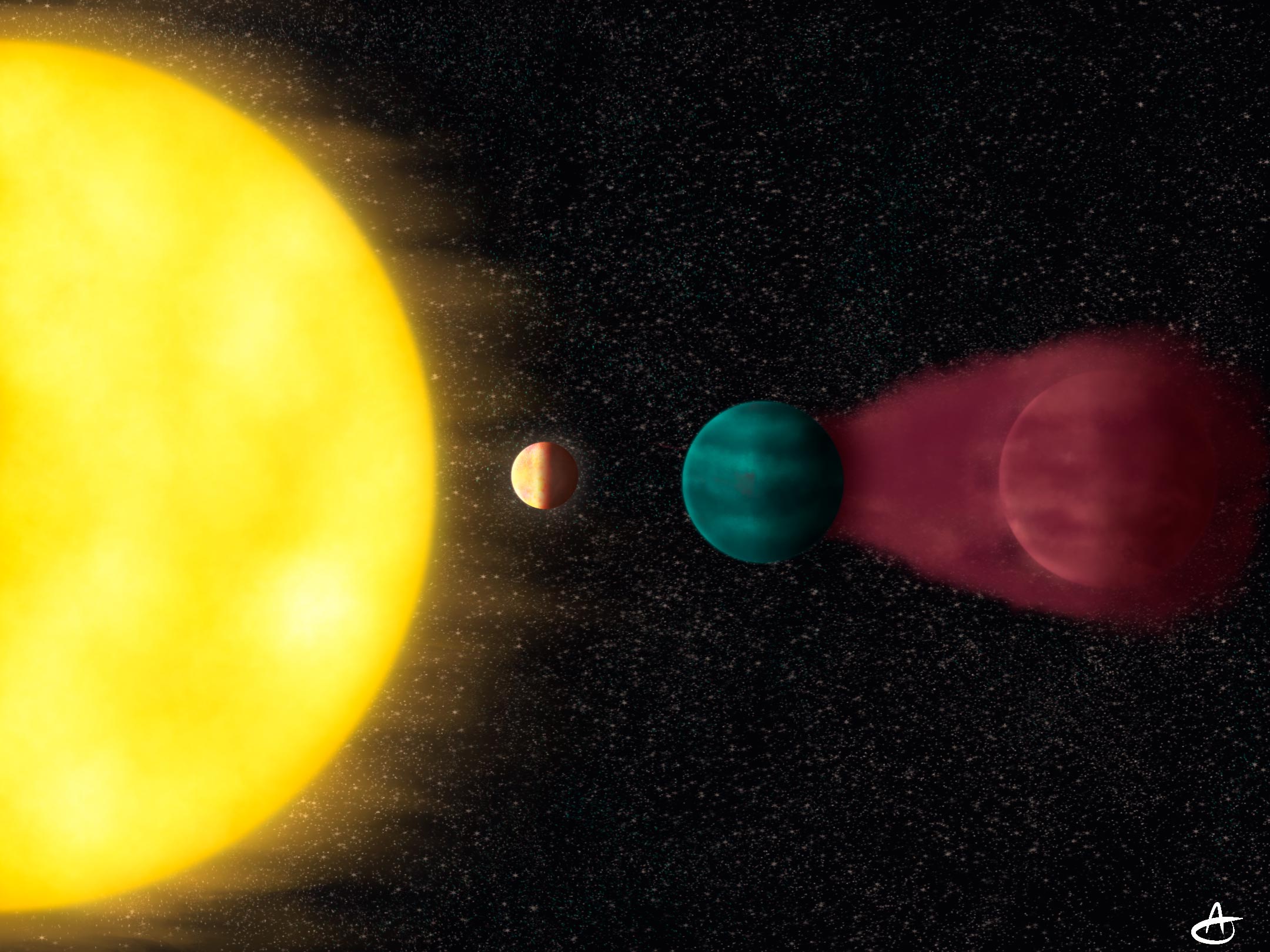
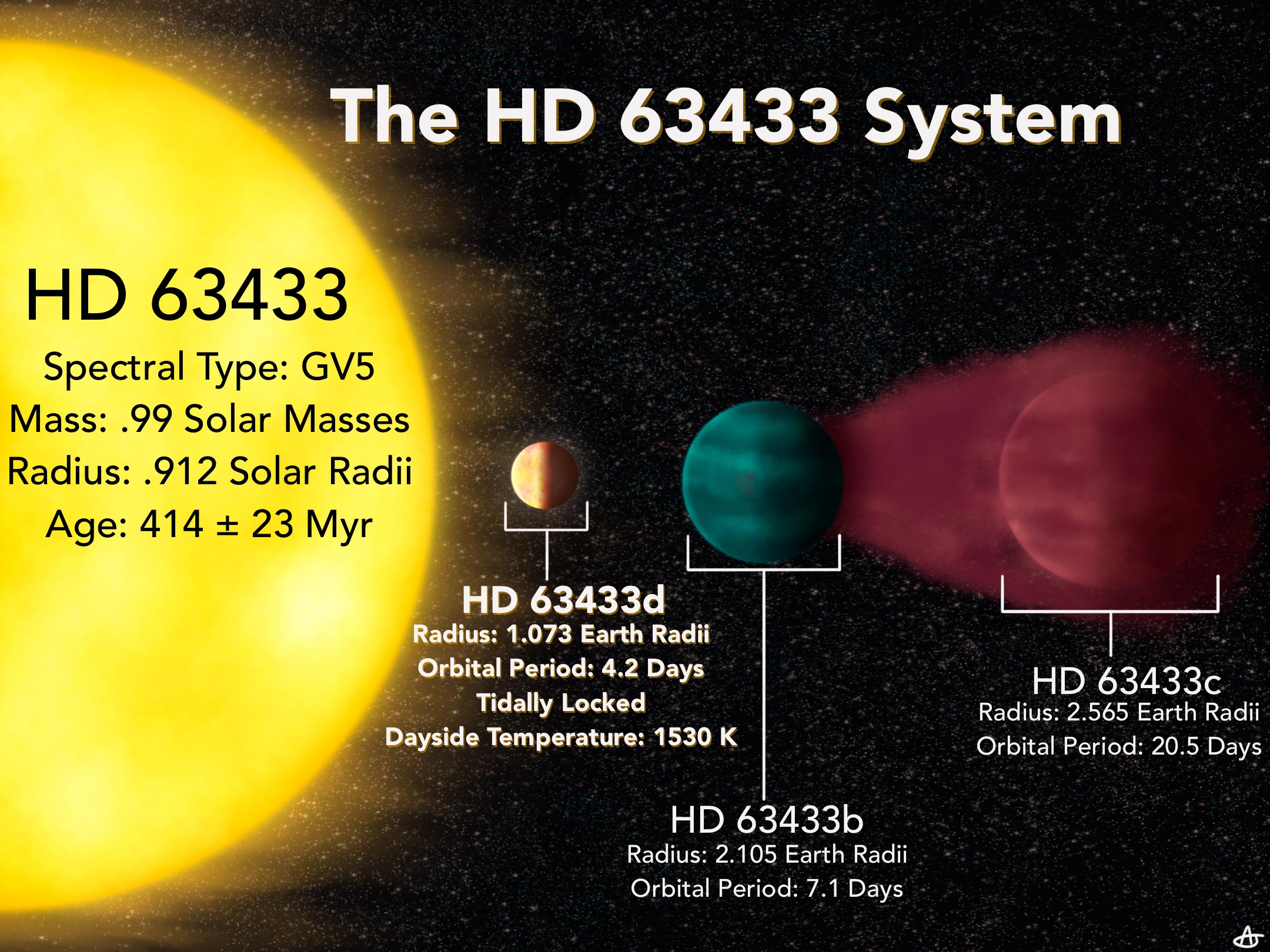
- The planet is known as HD 63433d and it’s the third planet found in orbit around a star called HD 63433.
- HD 63433d is so close to its star, it completes a trip all the way around every 4.2 days.
- “Even though it’s really close-orbiting, we can use follow-up data to search for evidence of outgassing and atmospheric loss that could be important constraints on how terrestrial worlds evolve,” Soares-Furtado says. “But that’s where the similarities end — and end dramatically.”
- Based on its orbit, the astronomers are relatively certain HD 63433d is tidally locked, which means one side is perpetually facing its star.
- That side can reach a brutal 2,300 degrees Fahrenheit and may flow with lava, while the opposite side is forever dark.
What you should know about the planet’s star:
- HD 63433 is roughly the same size and star type as our sun, but (at about 400 million years old) it’s not even one-tenth our sun’s age.
- The star is about 73 light years away from our own sun and part of the group of stars moving together that make up the constellation Ursa Major, which includes the Big Dipper.
- “On a dark night in Madison,” Soares-Furtado says, “you could see [HD 63433] through a good pair of binoculars.”
How the scientists found the planet:
- The study’s authors are collaborating on a planet-hunting project called THYME. In 2020, they used data from NASA’s Transiting Exoplanet Survey Satellite to identify two mini-Neptune-sized planets orbiting HD 63433.
- Since then, TESS took four more looks at the star, compiling enough data for the researchers to detect HD 63433d crossing between the star and the satellite.
What comes next:
- The researchers, including UW–Madison study co-authors graduate student Andrew C. Nine, undergraduate Alyssa Jankowski and Juliette Becker, a UW–Madison astronomy professor, think there is plenty to learn from HD 63433d.
- The planet is uniquely situated for further study. Its peppy young star is visible from both the Northern and Southern hemispheres, increasing the number of instruments, like the South African Large Telescope or WIYN Observatory in Arizona (both of which UW–Madison helped design and build) that can be trained on the system.
- And the star is orders of magnitude closer than many Soares-Furtado has studied, possibly affording opportunities to develop new methods to study gasses escaping from the planet’s interior or measure its magnetic field.
“This is our solar backyard, and that’s kind of exciting,” Soares-Furtado says. “What sort of information can a star this close, with such a crowded system around it, give away? How will it help us as we move on to look for planets among the maybe 100 other, similar stars in this young group it’s part of?”
Reference: “TESS Hunt for Young and Maturing Exoplanets (THYME). XI. An Earth-sized Planet Orbiting a Nearby, Solar-like Host in the 400 Myr Ursa Major Moving Group” by Benjamin K. Capistrant, Melinda Soares-Furtado, Andrew Vanderburg, Alyssa Jankowski, Andrew W. Mann, Gabrielle Ross, Gregor Srdoc, Natalie R. Hinkel, Juliette Becker, Christian Magliano, Mary Anne Limbach, Alexander P. Stephan, Andrew C. Nine, Benjamin M. Tofflemire, Adam L. Kraus, Steven Giacalone, Joshua N. Winn, Allyson Bieryla, Luke G. Bouma, David R. Ciardi, Karen A. Collins, Giovanni Covone, Zoë L. de Beurs, Chelsea X. Huang, Jon M. Jenkins, Laura Kreidberg, David W. Latham, Samuel N. Quinn, Sara Seager, Avi Shporer, Joseph D. Twicken, Bill Wohler, Roland K. Vanderspek, Ricardo Yarza and Carl Ziegler, 10 January 2024, The Astronomical Journal.
DOI: 10.3847/1538-3881/ad1039
This research was supported in part by grants from NASA (HST-HF2-51493.001-A, 21-ASTRO21-0068 and XRP 80NSSC21K0393) and the National Science Foundation (AST-2143763, PHY-2210452 and 1745302).
Never miss a breakthrough: Join the SciTechDaily newsletter.
Follow us on Google and Google News.
1 Comment
How big is our “solar backyard”?