
Close Menu
    Facebook X (Twitter) Instagram
    SciTechDaily
    • Biology
    • Chemistry
    • Earth
    • Health
    • Physics
    • Science
    • Space
    • Technology
    Facebook X (Twitter) Pinterest YouTube RSS
    SciTechDaily
    Home»Space»WASP-12 b, A Planet Being Consumed By Its Own Sun
    Space

    WASP-12 b, A Planet Being Consumed By Its Own Sun

    By The Open UniversityNovember 22, 2012No Comments2 Mins Read
    Facebook Twitter Pinterest Telegram LinkedIn WhatsApp Email Reddit
    Share
    Facebook Twitter LinkedIn Pinterest Telegram Email Reddit
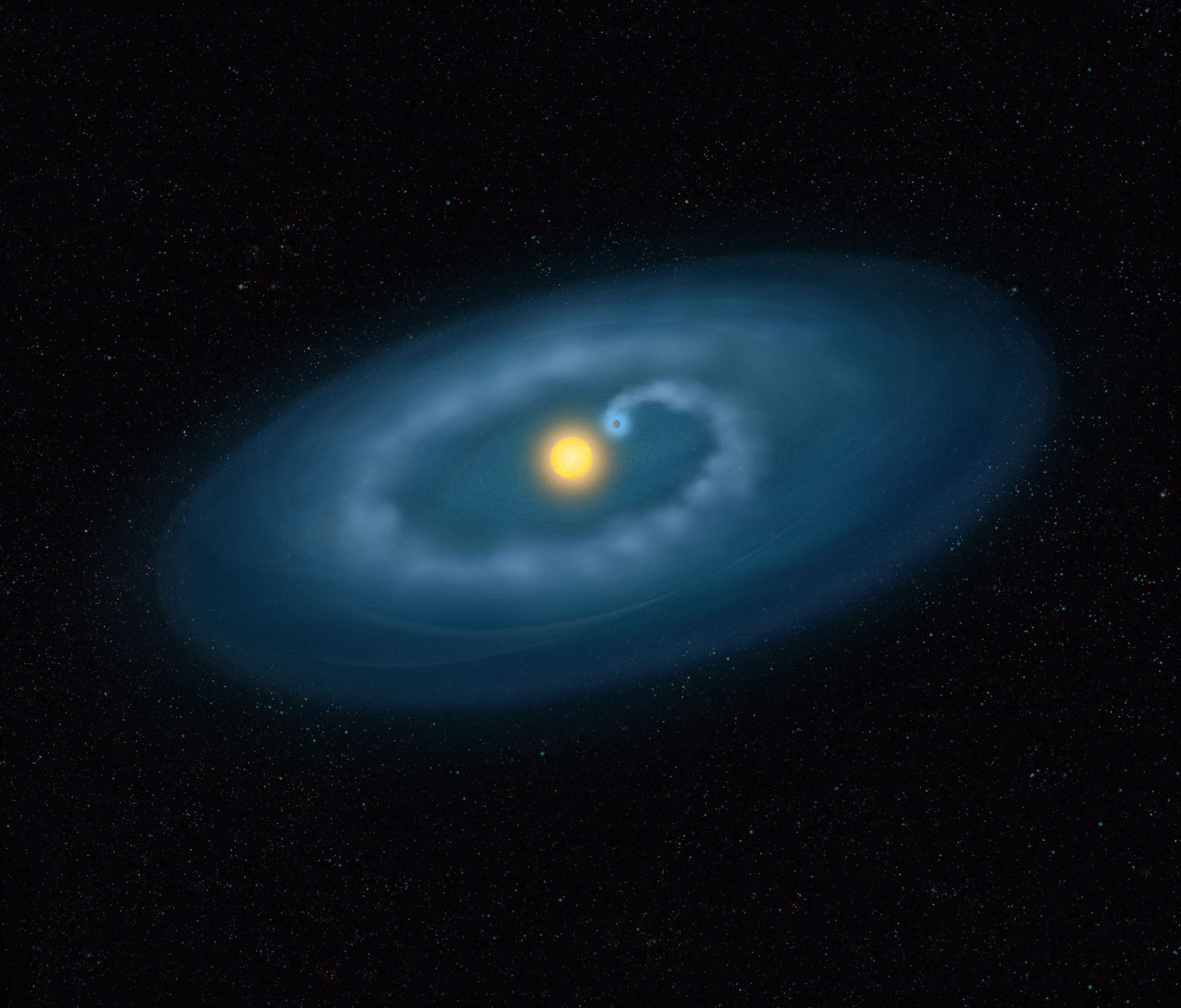
    WASP-12 b
    Artist’s illustration of WASP-12 b, an exoplanet that is being consumed by its own star. Credit: Ann Feild, NASA/STScI

    A newly published study takes a closer look at WASP-12 b, a planet that is being consumed by its own star.

    A planet roughly 1.4 times the size of Jupiter is being consumed by its own star behind a shroud thanks to a magnesium veil absorbing all of certain light wavelengths, according to new observations by the Hubble Space Telescope (HST).

    WASP-12 b, originally spotted in 2008, is a gas giant planet orbiting extremely close to its parent star. The distance between the star and planet is so small that the planet completes an orbit of its star in just over one Earth day. This proximity has “boiled off” a superheated gas cloud roughly three times the radius of Jupiter which feeds the star. However, some of this gas is moving out towards interstellar space, creating a shroud around the star.

    The gas shroud is thin, and barely noticeable in optical light, but the new observations were made with HST using near-UV light. The team discovered that one element in the cloud is magnesium, which is extremely efficient at absorbing near-UV light. These wavelengths are extremely sensitive to the presence of tenuous gas, and in them the star can appear completely invisible.

    The study was made by researchers from the UK’s Wide Angle Search for Planets (WASP) consortium, who originally found the planet in 2008, as well experts on the Cosmic Origins Spectrograph aboard the HST, stellar activity, and interstellar absorption from the Center for Astrophysics and Space Astronomy at the University of Colorado.

    Senior Lecturer in Astronomy at The Open University Dr Carole Haswell, who led the study, said that a structure like this had never before been observed around a star, adding: “It’s as though a veil has been drawn over the planet’s demise.”

    Reference: “Near-UV Absorption, Chromospheric Activity, and Star-Planet Interactions in the WASP-12 system” by C. A. Haswell, L. Fossati, T. Ayres, K. France, C. S. Froning, S. Holmes, U. C. Kolb, R. Busuttil, R. A. Street, L. Hebb, A. Collier Cameron, B. Enoch, V. Burwitz, J. Rodriguez, R. G. West, D. Pollacco, P. J. Wheatley and A. Carter, 6 November 2012, The Astrophysical Journal.
    DOI: 10.1088/0004-637X/760/1/79

    Never miss a breakthrough: Join the SciTechDaily newsletter.
    Follow us on Google and Google News.

    Astronomy Astrophysics Exoplanet Hubble Space Telescope Planets Popular
    Share. Facebook Twitter Pinterest LinkedIn Email Reddit

    Related Articles

    Cyclones in Space? See How Hubble Uncovered Extreme Weather on a Distant Planet

    Raining Vaporized Rock: Hubble Probes Bizarre Weather Conditions on Sizzling Worlds

    Gigantic, Scorching-Hot Planet May Be Orbiting Vega, One of the Brightest Stars in the Night Sky

    Planetary Scientists Discover There May Be Many Planets With Water-Rich Atmospheres

    On the Quest for Other Earths in the Search for Extraterrestrial Life

    Hubble Finds Earth-Sized Planet That May Be on Its Second Atmosphere

    Earth Has a Hot New Neighbor – And It Could Change How We Look for Life in the Universe

    Astronomers Detect Possible Radio Emission From Exoplanet for the First Time

    Hubble Discovers a Strange Exoplanet That Resembles the Long-Sought “Planet Nine”

    Leave A Reply Cancel Reply

    • Facebook
    • Twitter
    • Pinterest
    • YouTube

    Don't Miss a Discovery

    Subscribe for the Latest in Science & Tech!

    Trending News

    Mezcal “Worm” in a Bottle Mystery: DNA Testing Reveals a Surprise

    New Research Reveals That Your Morning Coffee Activates an Ancient Longevity Switch

    This Is What Makes You Irresistible to Mosquitoes

    Shockingly Powerful Giant Octopuses Ruled the Seas 100 Million Years Ago

    Scientists Stunned by New Organic Molecules Found on Mars

    Rewriting Dinosaur Evolution: Scientists Unearth Remarkable 150-Million-Year-Old Stegosaur Skull

    Omega-3 Supplements Linked to Cognitive Decline in Surprising New Study

    First-of-Its-Kind Discovery: Homer’s Iliad Found Embedded in a 1,600-Year-Old Egyptian Mummy

    Follow SciTechDaily
    • Facebook
    • Twitter
    • YouTube
    • Pinterest
    • Newsletter
    • RSS
    SciTech News
    • Biology News
    • Chemistry News
    • Earth News
    • Health News
    • Physics News
    • Science News
    • Space News
    • Technology News
    Recent Posts
    • Scientists Map Thousands of Brain Connections With RNA Barcodes
    • This Gene Tweak Turns Strawberries Into Healthier, Tastier Superfruit
    • This New Chip Could Make GPUs Far More Efficient
    • This Tiny World in the Outer Solar System Should Be Airless, but It Has an Atmosphere
    • NASA’s Webb Space Telescope Reveals a Dark Airless Super-Earth That Looks Like Mercury
    Copyright © 1998 - 2026 SciTechDaily. All Rights Reserved.
    • Science News
    • About
    • Contact
    • Editorial Board
    • Privacy Policy
    • Terms of Use

    Type above and press Enter to search. Press Esc to cancel.