

Unusual white dwarf star is made of hydrogen on one side and helium on the other.
In a first for white dwarfs, the burnt-out cores of dead stars, astronomers have discovered that at least one member of this cosmic family is two-faced. One side of the white dwarf is composed of hydrogen, while the other is made up of helium.
“The surface of the white dwarf completely changes from one side to the other,” says Ilaria Caiazzo, a postdoctoral scholar at Caltech who leads a new study on the findings in the journal Nature. “When I show the observations to people, they are blown away.”
White dwarfs are the scalding remains of stars that were once like our sun. As the stars age, they puff up into red giants; eventually, their outer fluffy material is blown away and their cores contract into dense, fiery-hot white dwarfs. Our sun will evolve into a white dwarf in about 5 billion years.
Illaria Caiazzo, a postdoctoral scholar research associate in Astronomy, explains how her team used ZTF to discover a very unusual “two-faced” white dwarf – one side is all helium and the other side, hydrogen. Credit: Caltech
The newfound white dwarf, nicknamed Janus after the two-faced Roman god of transition, was initially discovered by the Zwicky Transient Facility (ZTF), an instrument that scans the skies every night from Caltech’s Palomar Observatory near San Diego. Caiazzo had been searching for highly magnetized white dwarfs, such as the object known as ZTF J1901+1458, which she and her team found previously using ZTF. One candidate object stood out for its rapid changes in brightness, so Caiazzo decided to investigate further with the CHIMERA instrument at Palomar, as well as HiPERCAM on the Gran Telescopio Canarias in Spain’s Canary Islands. Those data confirmed that Janus is rotating on its axis every 15 minutes.
Subsequent observations made with the W. M. Keck Observatory atop Maunakea in Hawaiʻi revealed the dramatic double-faced nature of the white dwarf. The team used an instrument called a spectrometer to spread the light of the white dwarf into a rainbow of wavelengths that contain chemical fingerprints. The data revealed the presence hydrogen when one side of the object was in view (with no signs of helium), and only helium when the other side swung into view.

What would cause a white dwarf floating alone in space to have such drastically different faces? The team acknowledges they are baffled but have come up with some possible theories. One idea is that we may be witnessing Janus undergoing a rare phase of white dwarf evolution.
“Not all, but some white dwarfs transition from being hydrogen- to helium-dominated on their surface,” Caiazzo explains. “We might have possibly caught one such white dwarf in the act.”
After white dwarfs are formed, their heavier elements sink to their cores and their lighter elements—hydrogen being the lightest of all—float to the top. But over time, as the white dwarfs cool, the materials are thought to mix together. In some cases, the hydrogen is mixed into the interior and diluted such that helium becomes more prevalent. Janus may embody this transition phase, but one pressing question is: why is the transition happening in such a disjointed way, with one side evolving before the other?
The answer, according to the science team, may lie in magnetic fields.
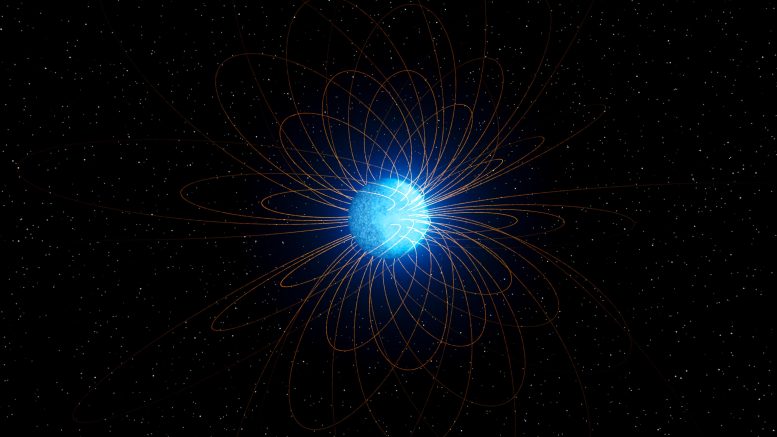
“Magnetic fields around cosmic bodies tend to be asymmetric, or stronger on one side,” Caiazzo explains. “Magnetic fields can prevent the mixing of materials. So, if the magnetic field is stronger on one side, then that side would have less mixing and thus more hydrogen.”
Another theory proposed by the team to explain the two faces also depends on magnetic fields. But in this scenario, the fields are thought to change the pressure and density of the atmospheric gases.
“The magnetic fields may lead to lower gas pressures in the atmosphere, and this may allow a hydrogen ‘ocean’ to form where the magnetic fields are strongest,” says co-author James Fuller, professor of theoretical astrophysics at Caltech. “We don’t know which of these theories are correct, but we can’t think of any other way to explain the asymmetric sides without magnetic fields.”
To help solve the mystery, the team hopes to find more Janus-like white dwarfs with ZTF’s sky survey. “ZTF is very good at finding strange objects,” Caiazzo says. Future surveys, such as those to be performed by the Vera C. Rubin Observatory in Chile, she says, should make finding variable white dwarfs even easier.
Reference: “A rotating white dwarf shows different compositions on its opposite faces” by Ilaria Caiazzo, Kevin B. Burdge, Pier-Emmanuel Tremblay, James Fuller, Lilia Ferrario, Boris T. Gänsicke, J. J. Hermes, Jeremy Heyl, Adela Kawka, S. R. Kulkarni, Thomas R. Marsh, Przemek Mróz, Thomas A. Prince, Harvey B. Richer, Antonio C. Rodriguez, Jan van Roestel, Zachary P. Vanderbosch, Stéphane Vennes, Dayal Wickramasinghe, Vikram S. Dhillon, Stuart P. Littlefair, James Munday, Ingrid Pelisoli, Daniel Perley, Eric C. Bellm, Elmé Breedt, Alex J. Brown, Richard Dekany, Andrew Drake, Martin J. Dyer, Matthew J. Graham, Matthew J. Green, Russ R. Laher, Paul Kerry, Steven G. Parsons, Reed L. Riddle, Ben Rusholme and Dave I. Sahman, 19 July 2023, Nature.
DOI: 10.1038/s41586-023-06171-9
The study was funded by Caltech’s Walter Burke Institute for Theoretical Physics, the European Research Council, The Leverhulme Trust, and the United Kingdom’s Science and Technology Facilities Council.
Observations from NASA’s Neils Gehrels Swift Observatory—renamed after Gehrels, a Caltech alumnus (PhD ’82) who passed away in 2017—were also used in the study to help narrow down the temperature of the object to a searing 35,000 Kelvin (roughly 35,000 degrees Celsius).
Caltech’s ZTF is funded by the National Science Foundation and an international collaboration of partners. Additional support comes from the Heising–Simons Foundation and from Caltech. ZTF data are processed and archived by IPAC, a science and data center for astronomy at Caltech. NASA supports ZTF’s search for near-Earth objects through the Near-Earth Object Observations program.
Never miss a breakthrough: Join the SciTechDaily newsletter.
Follow us on Google and Google News.