
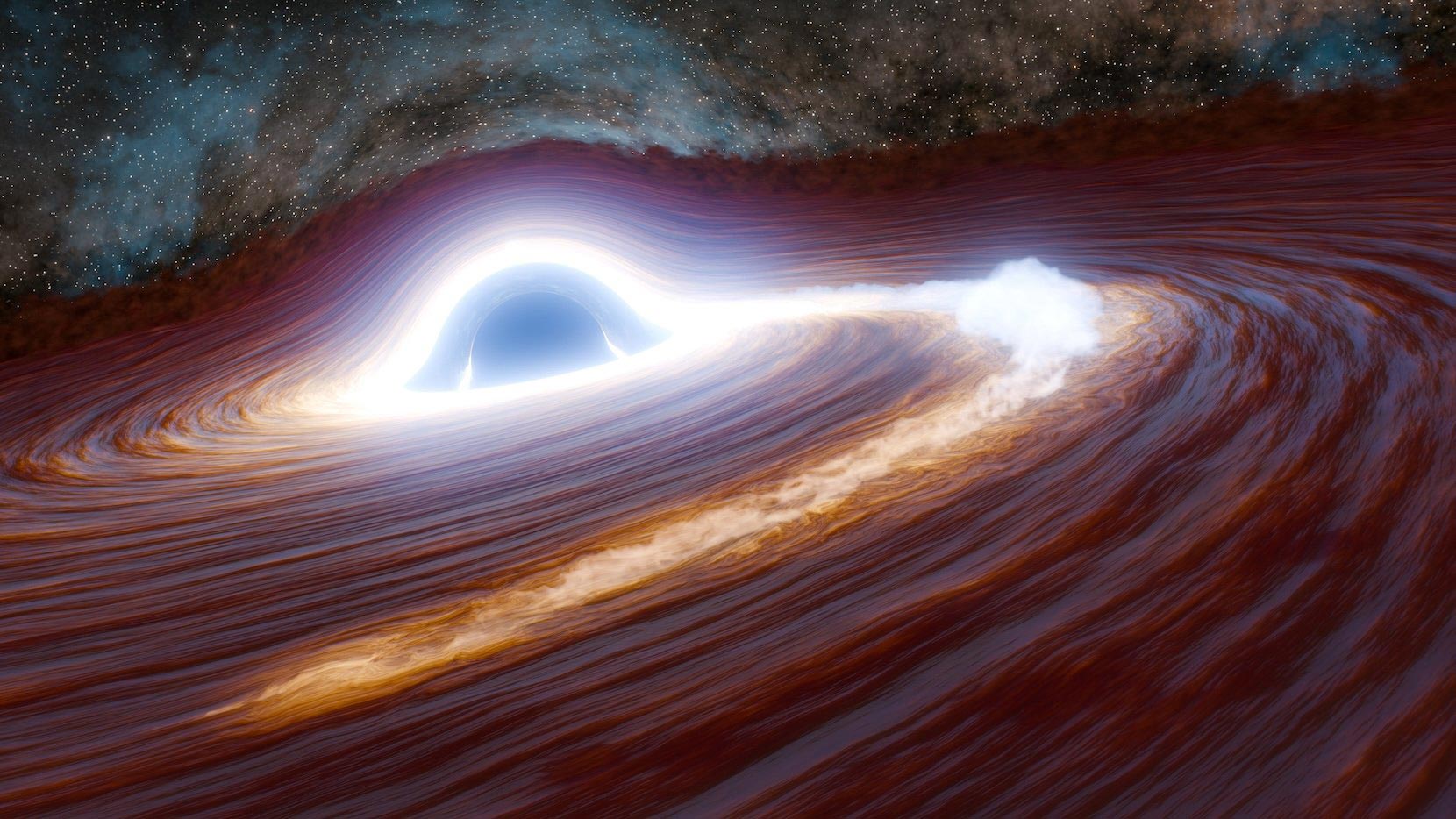
A colossal star met an unexpected fate when it drifted too close to a supermassive black hole 10 billion light-years away.
Instead of exploding as a supernova, the star was torn apart, creating the brightest and most distant black hole flare ever recorded—shining with the power of 10 trillion suns.
Star Meets Its Doom in a Cosmic Twist
The largest stars in the cosmos typically end their lives in spectacular fashion, exploding as supernova before collapsing into black holes. One enormous star, however, seems to have met a very different end. Instead of finishing its lifecycle with a brilliant blast, it drifted too close to a colossal black hole that tore it apart and consumed it piece by piece.
Researchers describe this scenario in a new Nature Astronomy study that details the most powerful and most distant flare of energy ever detected from a supermassive black hole. The outburst was first spotted in 2018 by the Zwicky Transient Facility (ZTF), a sky survey funded by the US National Science Foundation (NSF) and located at Caltech’s Palomar Observatory. The Caltech-led Catalina Real-Time Transient Survey, also supported by NSF, recorded it as well. The flare brightened dramatically, increasing its brightness by a factor of 40 within months, and ultimately became 30 times more luminous than any black hole flare previously seen. At its peak, it radiated the equivalent light of 10 trillion suns.
Peering Into the Distant Universe
The source of this powerful flash is an active galactic nucleus (AGN), a type of supermassive black hole that actively draws in surrounding material. Known as J2245+3743, it is estimated to have a mass 500 million times greater than the Sun and sits about 10 billion light-years from Earth. Because light takes time to travel across such vast distances, astronomers are viewing the event as it occurred billions of years ago, during an early era of the universe.
“The energetics show this object is very far away and very bright,” says study lead author Matthew Graham, research professor of astronomy at Caltech, as well as the project scientist for ZTF, and a co-principal investigator of the project. “This is unlike any AGN we’ve ever seen.”

Time Dilation and a Cosmic Slow-Motion Show
Although the flare is gradually fading, astronomers continue to observe it closely. The extreme distance affects not only how far back in time they are looking but also the rate at which the event appears to unfold. Time progresses more slowly at the black hole’s location relative to Earth.
Graham explains, “It’s a phenomenon called cosmological time dilation due to stretching of space and time. As the light travels across expanding space to reach us, its wavelength stretches as does time itself.”
This effect is one reason long-term sky surveys like ZTF and Catalina are so valuable. In this case, Graham notes that “seven years here is two years there. We are watching the event play back at quarter speed.”
A Star Torn Apart — The Tidal Disruption Event
To determine what could cause such a dramatic burst of light in the cosmos, the researchers thoroughly examined a list of possibilities, concluding that the most likely culprit is a tidal disruption event (TDE). This phenomenon occurs when a supermassive black hole’s gravity shears a star that comes too close, slowly consuming the star over time as it spirals into the black hole. The fact that the black hole flare J2245+3743 is still going indicates that we are witnessing a star not yet fully devoured but rather like “a fish only halfway down the whale’s gullet,” Graham says.
If the flare is from a TDE, the scientists estimate that the supermassive black hole gobbled a star with a mass at least 30 times greater than that of our Sun. The previous record holder for the largest candidate TDE, an event nicknamed Scary Barbie after its initial ZTF classification as ZTF20abrbeie, was not nearly as intense. That TDE, which is also thought to have originated from an AGN, was 30 times weaker than that of J2245+3743, and its doomed star is estimated to have been between three and 10 solar masses.
Stellar Snack Within a Black Hole’s Disk
Most of the roughly 100 TDEs seen to date do not take place around AGN—massive structures that consist of supermassive black holes surrounded by large, swirling disks of material that feed the central black hole. The AGN burble along, flaring up with their own feeding activity, which can mask TDE bursts and makes them harder to find. The recent jumbo flare J2245+3743, on the other hand, was so large that it was easier to see.
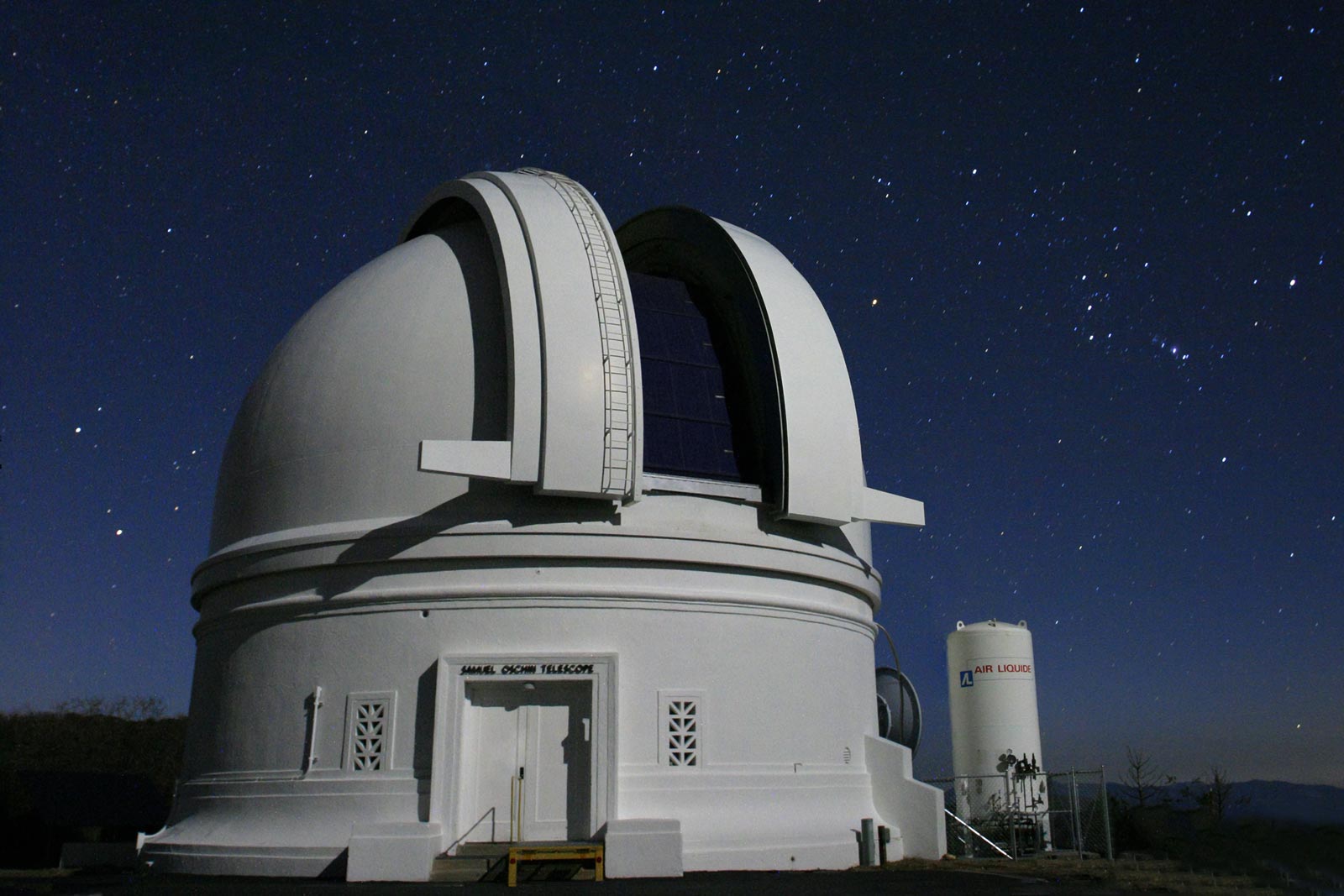
However, at first, J2245+3743 did not seem to be anything special. In 2018, after the object was first spotted, the researchers used the 200-inch Hale Telescope at Caltech’s Palomar Observatory to obtain a spectrum of the object’s light, but it did not reveal anything unusual. In 2023, the team noticed the flare was decaying slower than expected, so they obtained another spectrum from the W. M. Keck Observatory in Hawai‘i, which indicated the extreme brightness of this particular AGN.
Confirming the Unthinkable: A Star Devoured
“At first, it was important to establish that this extreme object was truly this bright,” explains co-author K. E. Saavik Ford, a professor at the City University of New York (CUNY) Graduate Center and Borough of Manhattan Community College and American Museum of Natural History (AMNH). It was possible, she says, that the object could have been beaming the light toward us rather than glowing in all directions, but data from NASA’s former Wide-field Infrared Survey Explorer (WISE) mission helped rule that out. In the end, after other scenarios were also ruled out, the researchers concluded that J2245+3743 was indeed the brightest black hole flare ever recorded.
“If you convert our entire Sun to energy, using Albert Einstein’s famous formula E = mc2, that’s how much energy has been pouring out from this flare since we began observing it,” Ford says.
Beyond Supernovae — A Rare Celestial Catastrophe
After confirming that the flare’s brightness surpassed anything previously recorded, the researchers turned to the question of what could create such an extreme burst of energy. One idea was a supernova, but that explanation was quickly dismissed.
“Supernovae are not bright enough to account for this,” Ford says. The team instead concluded that the most convincing cause is a supermassive black hole gradually tearing apart an enormous star.
“Stars this massive are rare,” Ford says, “but we think stars within the disk of an AGN can grow larger. The matter from the disk is dumped onto stars, causing them to grow in mass.”
A Window Into the Cosmic Past
Discovering a star this large being consumed by a black hole suggests that similar dramatic events may be happening elsewhere throughout the universe. The team plans to examine additional data from ZTF to search for more examples, and future observations from the NSF and Department of Energy’s Vera C. Rubin Observatory may reveal even larger tidal disruption events.
“We never would have found this rare event in the first place if it weren’t for ZTF,” Graham says. “We’ve been observing the sky with ZTF for seven years now, so when we see anything flare or change, we can see what it has done in the past and how it will evolve.”
Reference: “An extremely luminous flare recorded from a supermassive black hole” by Matthew J. Graham, Barry McKernan, K. E. Saavik Ford, Daniel Stern, Matteo Cantiello, Andrew J. Drake, Yuanze Ding, Mansi Kasliwal, Mike Koss, Raffaella Margutti, Sam Rose, Jean Somalwar, Phil Wiseman, S. G. Djorgovski, Patrik M. Veres, Eric C. Bellm, Tracy X. Chen, Steven L. Groom, Shrinivas R. Kulkarni and Ashish Mahabal, 4 November 2025, Nature Astronomy.
DOI: 10.1038/s41550-025-02699-0
The Nature Astronomy paper, titled “An Extremely Luminous Flare Recorded from a Supermassive Black Hole,” received support from the NSF, the Simons Foundation, NASA, and the German Research Foundation. The research team includes Caltech contributors Andrew Drake, Yuanze Ding (MS ’25), Mansi Kasliwal (PhD ’11), Sam Rose, Jean Somalwar (now a postdoc at UC Berkeley), George Djorgovski, Shri Kulkarni, and Ashish Mahabal. Tracy Chen and Steven Groom from Caltech’s IPAC astronomy center also took part, along with Daniel Stern of NASA’s Jet Propulsion Laboratory (which is managed by Caltech).
Additional collaborators include Barry McKernan of CUNY Graduate Center, Borough of Manhattan Community College, and AMNH; Matteo Cantiello of the Simons Foundation’s Flatiron Institute and Princeton University; Mike Koss of Eureka Scientific; Raffaella Margutti of UC Berkeley; Phil Wiseman of the University of Southampton, UK; Patrik Veres of Ruhr University in Bochum, Germany; and Eric Bellm of the University of Washington.
Caltech’s Zwicky Transient Facility (ZTF) is supported by the NSF and an international group of partners, with further funding from the Heising-Simons Foundation and Caltech. Data from ZTF are processed and stored by Caltech’s IPAC, and NASA contributes support for ZTF’s hunt for near-Earth objects through the Near-Earth Object Observations program.
Never miss a breakthrough: Join the SciTechDaily newsletter.
Follow us on Google and Google News.
1 Comment
Memo 2511240347_ Source 1. Reinterpretation Storytelling 【】
Source 1.
https://scitechdaily.com/supermassive-black-hole-shreds-a-huge-star-in-record-flare/
1.
Supermassive Black Hole Shreds a Huge Star in Record Flare
_This artist’s concept depicts a supermassive black hole shredding a massive star at least 30 times the mass of the Sun. Scientists believe this phenomenon likely occurred around a distant black hole called J2245+3743.
^This black hole brightened dramatically in 2018, generating the brightest black hole flare in history, shining with the light of 10 trillion suns.
This remarkable flare was detected by the Zwicky Observatory (ZTF) at the California Institute of Technology Palomar Observatory and the Catalina Real-Time Transient Survey, led by Caltech.
1-1. Stars Meet Their Ends in a Cosmic Twist
The most massive stars in the universe typically meet their spectacular end, collapsing into black holes after a supernova explosion.
But one massive star appears to have met a very different fate. Instead of ending its life in a spectacular explosion, it flew too close to a massive black hole, shattering and devouring it.
Researchers describe this scenario in a new study published in Nature Astronomy, detailing the most powerful and distant energetic flare ever observed from a supermassive black hole.
^This explosion was first observed in 2018 by the Zwicky Astronomical Facility (ZTF) at the California Institute of Technology (Caltech) Palomar Observatory, funded by the National Science Foundation (NSF).
^The explosion was also observed by the NSF-funded Catalina Real-Time Transient Survey, a Caltech-led observation. The flare brightened dramatically, increasing in brightness 40-fold within a few months and ultimately becoming 30 times brighter than any previously observed black hole flare.
^At its peak, it emitted the equivalent of 10 trillion suns.
1-2. Looking into the Distant Universe
_The source of this powerful flash is an active galactic nucleus (AGN). An AGN is a type of supermassive black hole that actively attracts material from its surroundings.
This black hole, known as J2245+3743, is estimated to be 500 million times the mass of the Sun and is located approximately 10 billion light-years from Earth.
Because it takes time for light to travel such a great distance, astronomers are observing this event, which occurred billions of years ago, in the early days of the universe.
“Energetically, this object is very distant and very bright,” said Matthew Graham, a research professor of astronomy at Caltech, ZTF project scientist, and co-principal investigator on the project. “It’s unlike any AGN we’ve ever seen.”
1-3. Time Dilation and the Cosmic Slow-Motion Show
The flare is fading, but astronomers continue to closely monitor it. This great distance affects not only the temporal distance observed by observers, but also the speed at which the event unfolds. Time passes more slowly at the black hole’s location relative to Earth.
1-2. Graham explains, “This is a phenomenon called cosmological time dilation, caused by the expansion of space and time. As light travels through expanding space to reach us, its wavelength expands, just like time itself.”
【Astronomy is literally a discipline that relies on observational evidence. I’m trying to interpret the subject from a different, non-observational (my msbase.qpeoms theoretical) perspective.
】
This effect is one of the reasons why long-term astronomical observations like ZTF and Catalina are so valuable. In this case, Graham says, “Seven years here equals two years there. We’re watching an event that’s replaying at a quarter of its speed.”
1-3. A Star Torn Apart – Tidal Disruption Events
To determine the cause of these dramatic bursts of light in space, researchers carefully considered several possibilities and concluded that the most likely cause was a tidal disruption event (TDE).
This phenomenon occurs when the gravity of a supermassive black hole rips apart a star that gets too close, slowly swallowing it over time as it spirals into the black hole.
Graham says the fact that J2245+3743’s black hole flares are still ongoing suggests we’re witnessing a star that hasn’t been completely swallowed yet, more like a “fish halfway down a whale’s esophagus.”
2.
^If this flare originated from a tectonic event (TDE), scientists estimate that the supermassive black hole swallowed a star at least 30 times the mass of the Sun.
2-1. A Star’s Snack in a Black Hole’s Disk
2-2. Confirming the Unthinkable: A Swallowed Star
“It was important to confirm that this extreme object was actually this bright in the first place.” After ruling out other scenarios, the researchers concluded that J2245+3743 was the brightest black hole flare in history.
2-3.
Ford states, “If we convert the entire Sun into energy using Albert Einstein’s famous formula E=mc², that’s the amount of energy released by this flare since we began observing it.”
【The total energy released by a destroyed star’s flare can also be calculated using Albert Einstein’s famous formula E=mc², but according to my sample1 formula,
>Since a star is equivalent to a single neutron star vixxa.nk, its mass can be calculated as its dissipative energy qpeoms.sample1.
>If the star’s mass is 100 and the flare’s energy is 100, then the sample1. energy is also a phenomenon resulting from the instantaneous overlapping and separation of 100 systems. If you look at it in a book, 100 pages is like one book. Oh my.
】
3. Beyond a Supernova – A Rare Celestial Disaster
After confirming that the flare was brighter than anything previously recorded, researchers questioned what could cause such an intense burst of energy. A supernova theory was also proposed, but that explanation was quickly dismissed.
“A supernova alone doesn’t explain this,” Ford said. Instead, the team concluded that the most plausible cause is a supermassive black hole slowly tearing apart a massive star.
【Massive stars are nk2stars. Every msbase.galaxy has vixers.black_holes. The sample1.qpeoms protogalaxy contains six types of black holes and about 30 neutron stars, vixxa.
>Black holes destroy or create stars. The sample1.galaxy is an inner galaxy of the msbase galaxy, and the system that controls the black holes is different. The Andromeda galaxies we know only appear when the black hole grows in size. Hmm.
>If the black hole in Andromeda is massive, it’s the result of sample1.vixer gaining massive mass, and its accretion disk is made up of neutron star clusters, vixxas.
>So, if a massive star were destroyed by a black hole, the arrangement and movement of the msbase would change slightly. Hmm.
>Of course, the resulting mass of the destroyed flare is ultimately recorded in sample1.oms.vix.ain, detailing the entire process, from the moments before and after the explosion to the hundreds of millions of light-years afterward. Ugh.
]
“Such massive stars are rare,” Ford said. “But I think stars within AGN disks can grow even larger. Material from the disk rains down on the star, increasing its mass.”
3-1. A Window into the Universe’s Past
_The discovery of such a massive star being swallowed by a black hole suggests that similar dramatic events are occurring elsewhere in the universe.