
Close Menu
    Facebook X (Twitter) Instagram
    SciTechDaily
    • Biology
    • Chemistry
    • Earth
    • Health
    • Physics
    • Science
    • Space
    • Technology
    Facebook X (Twitter) Pinterest YouTube RSS
    SciTechDaily
    Home»Biology»Ancient Bacteria Turned a DNA System Into a Cell Skeleton
    Biology

    Ancient Bacteria Turned a DNA System Into a Cell Skeleton

    By Institute of Science and Technology AustriaApril 27, 20262 Comments7 Mins Read
    Facebook Twitter Pinterest Telegram LinkedIn WhatsApp Email Reddit
    Share
    Facebook Twitter LinkedIn Pinterest Telegram Email Reddit
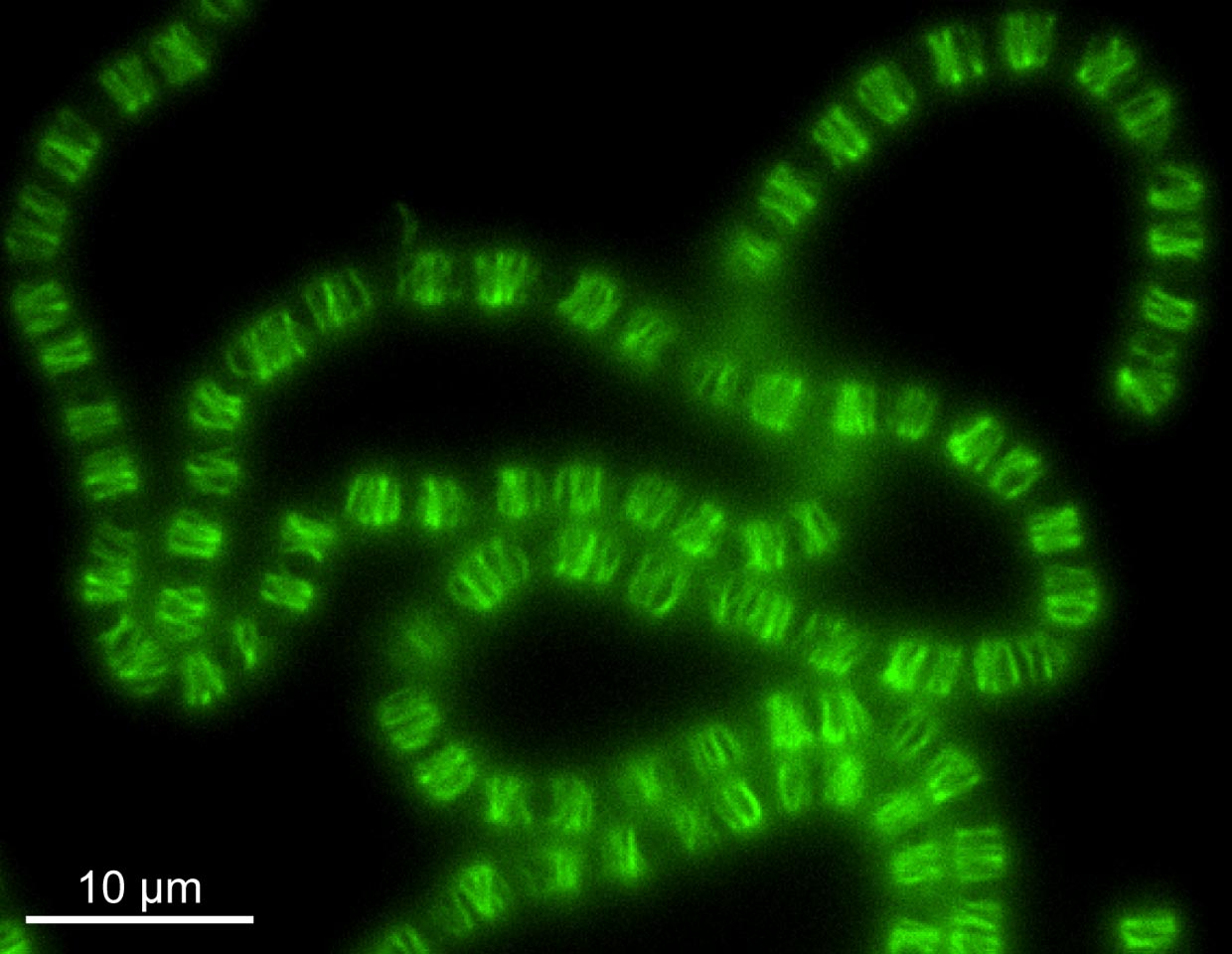
    Fluorescent Anabaena
    Fluorescently labeled CorM filaments inside Anabaena. These represent a newly discovered cytoskeleton in multicellular cyanobacteria. Credit: © Loose group | ISTA

    A system once tied to DNA organization in cyanobacteria has evolved into a structure that shapes the cell itself. This shift reveals how evolution can turn old biological tools into entirely new functions.

    Photosynthetic bacteria played a crucial role in shaping our planet. Among them, cyanobacteria stand out for producing the oxygen that filled Earth’s atmosphere and enabled complex life to evolve. Now, scientists at the Institute of Science and Technology Austria (ISTA) have uncovered an unexpected twist in how these organisms function. A system long believed to separate DNA has instead taken on a completely different job, helping determine the shape of cyanobacterial cells. The study, published in Science, provides new clues about how protein systems evolve and how multicellular life arose in these environmentally important bacteria.

    “Cyanobacteria are essentially pioneers of oxygenic photosynthesis,” says Benjamin Springstein, a postdoc in the Loose group at the Institute of Science and Technology Austria (ISTA).

    “They are responsible for the Great Oxygenation Event about 2.5 billion years ago, when oxygen accumulated in the atmosphere and made aerobic life possible. Without them, it’s safe to say that none of us would be here today.”

    Even now, cyanobacteria remain vital to Earth’s ecosystems. They contribute significantly to global biomass and play key roles in carbon and nitrogen cycling. These organisms are remarkably adaptable, thriving in extreme environments ranging from hot springs to the Arctic, as well as on surfaces such as roofs and walls in cities. One well-studied species, Anabaena sp. PCC 7120 (or simply Anabaena), has been a model organism for more than 30 years.
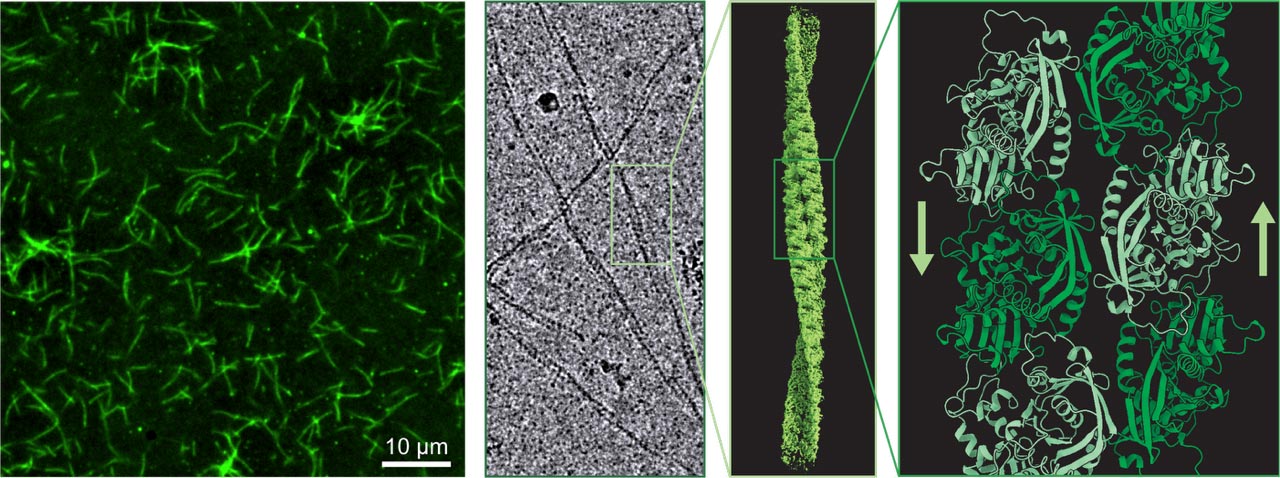
    CorM Filaments Core
    Down to the core. From left to right: When rebuilt outside of living cells, CorM forms dynamic filaments. Cryo-electron microscopy (cryo-EM) image of purified CorM filaments. Successive zoom-ins show the reconstructed 3D electron density map of the CorM filament, followed by the corresponding atomic model, illustrating the filaments’ assembly into a bipolar double-stranded filament. Credit: © Springstein et al. / Science

    Evolution Repurposes a DNA System Into a Cell-Shaping Structure

    Springstein worked in the group of Professor Martin Loose alongside collaborators from ISTA, the Institut Pasteur de Montevideo (Uruguay), Kiel University (Germany), and the University of Zürich (Switzerland). Their research shows that Anabaena, and likely many other multicellular cyanobacteria, have undergone a major evolutionary change. An ancient system once used to separate DNA has been transformed into a cytoskeleton-like structure that helps control cell shape.
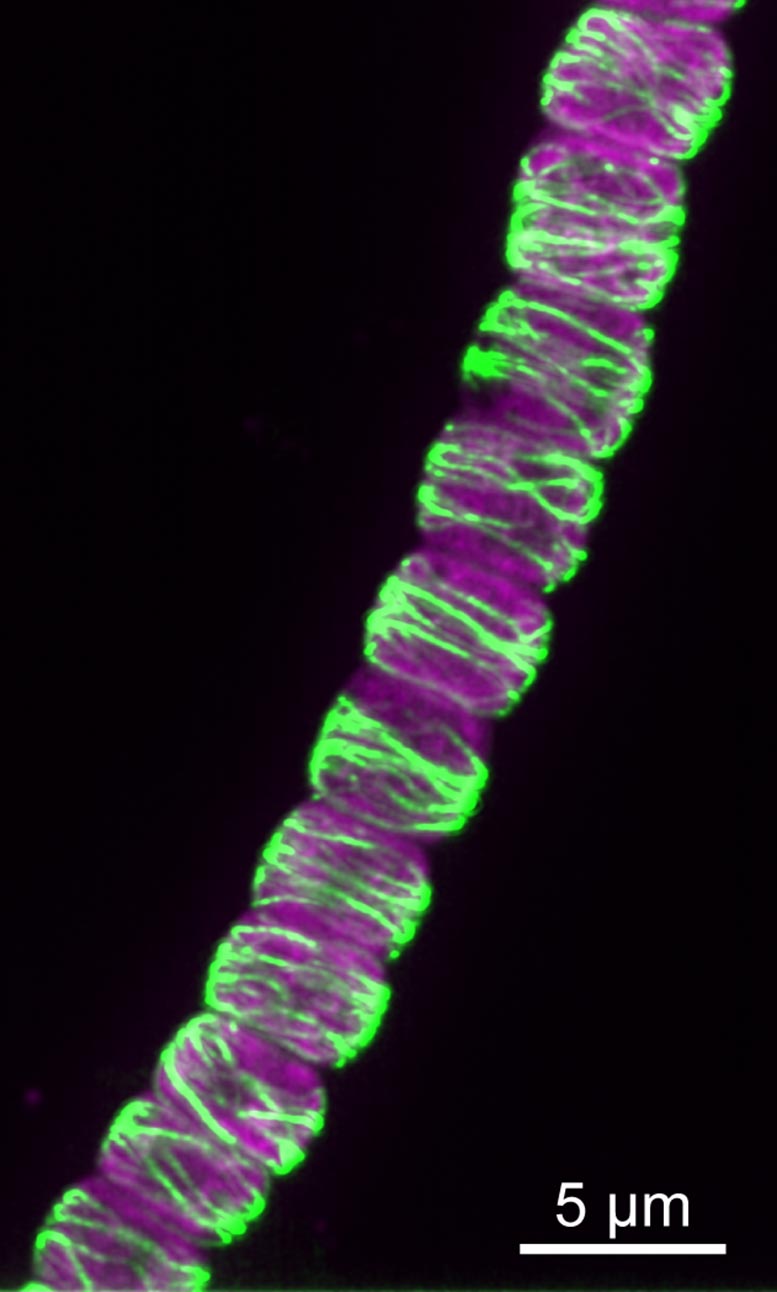
    CorM Filaments in Anabaena
    High-resolution image of CorM filaments in Anabaena. Green corresponds to CorM filaments while purple shows cyanobacterial photosynthetic pigments. Credit: © Springstein et al. / Science

    DNA in Bacteria: A Brief Primer

    Like all bacteria, Anabaena reproduce through cell division. This process requires accurate copying and distribution of DNA so that each new cell receives the genetic material it needs. DNA is tightly packed into chromosomes, similar to thread wound around a spool, and is often present in multiple copies that must be reliably passed on during division.

    Bacterial DNA exists in two main forms. Chromosomes carry genes essential for survival, while plasmids contain additional genes that are often not required. Plasmids are highly mobile and can move between bacteria, allowing traits to spread quickly and enabling rapid adaptation.

    Benjamin Springstein
    First author Benjamin Springstein. The ISTA postdoc uses high-resolution microscopes to examine cyanobacteria known as Anabaena. Credit: © ISTA

    A DNA Segregation System Finds a New Role

    Springstein has been studying Anabaena since 2014, focusing on its evolutionary and molecular features. During the COVID-19 pandemic, when laboratory work paused, he reviewed scientific literature and noticed something unusual.

    “I made a serendipitous observation,” he recalls.

    He found that Anabaena and some related cyanobacteria contain a system called ParMR encoded on their chromosomes. This system is typically linked to plasmid segregation and had previously only been observed on plasmids, which act as mobile gene storage units. This unusual placement led him to suspect that the system might have adapted to separate chromosomes instead.

    After joining ISTA as an IST-Bridge Fellow, Springstein tested this idea experimentally. The results revealed a different function. One component, ParR, no longer binds to DNA. Instead, it attaches to lipid membranes, particularly the inner cell membrane. Meanwhile, ParM does not form structures in the cytoplasm to move DNA. Instead, it builds filament networks just beneath the inner membrane, creating an array of protein polymers that resembles a cell cortex.

    Rather than forming spindle-like structures inside the cell, as expected for DNA segregation, the system appears to organize itself at the membrane and contribute to cell structure.
    Anabaena Researchers Loose and Schur Groups at ISTA
    Collaboration between the Loose and the Schur groups at the Insitute of Science and Technology Austria (ISTA). In the back, from left to right: Roman Hajdu, Martin Loose, Florian Schur. In the front, from left to right: Manjunath Javoor, Benjamin Springstein, Bettina Zens. Credit: © ISTA

    Filament Dynamics Reveal Cytoskeleton-Like Behavior

    To better understand this system, the researchers reconstructed it outside living cells using purified components. In these in vitro reconstitution experiments, they observed that the filaments exhibit dynamic instability. They grow and then rapidly collapse, a pattern also seen in microtubules in more complex cells.

    To examine their structure in detail, the team collaborated with ISTA Professor Florian Schur and his PhD student Manjunath Javoor. Using cryo-electron microscopy, which allows scientists to visualize molecular structures at very high resolution, they analyzed the architecture of the filaments. They found that, unlike similar systems in other bacteria that form polar filaments, the filaments in Anabaena are bipolar, meaning they can grow and shrink from both ends.

    Loss of the System Changes Cell Shape

    The system’s true role became clear when it was removed from living cells.

    “Cells lacking the system lost their normal rectangular-like cell shape and instead became round and swollen,” Springstein explains.

    Such changes are commonly observed when genes responsible for maintaining cell shape are disrupted in other bacteria. This strongly suggests that the system’s primary function is to control cell morphology rather than manage DNA distribution.

    Given its newly identified role and its position near the cell membrane, the researchers renamed the system “CorMR.”

    Stepwise Evolution of a New Cellular Function

    Multicellular cyanobacteria evolved from single-celled ancestors through gradual increases in complexity. Bioinformatic analysis by collaborator Daniela Megrian from the Institut Pasteur in Montevideo, Uruguay, helped clarify how the CorMR system developed.

    The transition likely occurred in several stages rather than all at once. First, the system moved from a plasmid to the chromosome. Next, its components changed in size and structure. Then, it gained the ability to bind to cell membranes. Finally, it came under the control of an additional protein system.

    Together, these steps transformed an ancient DNA segregation system into one that shapes the cell itself, highlighting how evolution can repurpose existing biological machinery to create entirely new functions.

    Reference: “Repurposing of a DNA segregation machinery into a cytoskeletal system controlling cell shape” by Benjamin L. Springstein, Manjunath G. Javoor, Daniela Megrian, Roman Hajdu, Dustin M. Hanke, Bettina Zens, Gregor L. Weiss, Florian K. M. Schur and Martin Loose, 16 April 2026, Science.
    DOI: 10.1126/science.aea6343

    Never miss a breakthrough: Join the SciTechDaily newsletter.
    Follow us on Google and Google News.

    Bacteria Cyanobacteria DNA Evolution
    Share. Facebook Twitter Pinterest LinkedIn Email Reddit

    Related Articles

    Rapid Evolution of Deadly Pathogen: Cholera Bacterium Can Steal Up to 150 Genes in One Go

    Prolific Changes in the Human Genome in the Past 5,000 Years

    DNA Could Predate Existence of Life As We Know It

    Improved Estimates of DNA’s Mutation Rate Paint Clearer Picture of Human Prehistory

    Understanding Antibiotics and Their Role in Killing Bacteria

    DNA Jumps Directly From the Cell’s Chloroplasts Into Its Nucleus

    Rare Example of Bacterial Gene Transfer Providing Evolutionary Benefit

    Human Y-Chromosome Has Enough Genes to Stay for Millions of Years

    Viruses Use Bacteria for Reproduction

    2 Comments

    1. kamir bouchareb st on April 27, 2026 1:49 pm

      thanks for this

      Reply
    2. AGEAZIT EMBAYE on April 27, 2026 2:31 pm

      “THE NEW TYPTICAL KINDS REALITY IN THE SOLAR-SYSTEMS ARE DESCRIPTIONS MIGHTS INCLUDES ALL S(BIO-WORLDS)THE THEORY FOCUSED YET IMPROVERISED INTO ALL CONNECTIONS ARE”THESIS’-ISSUES ARE DUE TO ALL COMBINATIONS THESE NEVER AREAS OF OPPOISITE INALL TO (BIO-REALITY)/ (BIO-GENETICS) [{TRI-PHISPOSHY}]: (#1)ASIANS (#2) SPANISH(#3)BIO-AFRCIANS ARE STATED TO FIND ALL THEIR ANCESTORY THESE (WHITES-RACE)FOR SLAVERY THEORTICAL CONNECTION SIN THE MATHAEMATICAL-COMPUTATIONS ARE DUE TO INCLUDES (ALL-GENES) UNITY -OF -THE HUMAN ISSUES OF REALITY INTO REMAINS A RESULTS OF ALL INCREASED TRULY BLESSED RACES ARE SIMPLE INCREASED INTO ALL AREAS DEFINTIONS” ARE NOTED NOT DEVISED IN TE FIRST-PLACE ONTO THESE FOLLOWING AREAS OF CONNECTED/COMPLETED/CALUCATED THE THREE (C.C.C)INTO THESE INTO THESE ISSUES ARE VALUED BY EACH NOTEES OF REVISED RESULTS: “A WORLDFOR HUMANITY OF ALL SYSTEMS:(BIO-TECHNOLOGY)/(BIO-THEOLOGY)/BIO-PHYSOPHY OF THE HUMAN-RACE IS ALL DESCRIPTIONS SERIES ARE DEFINTIONS MEASURES A SIMPLE FACOTRS OF ALL REALITY IS ALL SERIES ARE DESCRIPTIONS MEASURES A SIMPLE FACTORS ARE ‘NOTHING’ ACCOMPLISHED BY SERIES IN THE AREAS IN THESE QUESTIONS ARE NOT THEORIES MEASUREMENTS OF DEVELOPED FOUNDATIONS NOT REVISED NOT DEVISED & ALL SIMPLE ISSUES INTO THESE AREAS OF REALITY NEVER ALL KINDS OF RESOURCES
      ARE (NEVER) DEVISED BUT REMINDS NOT ONLY THESE THREE (R.R..R)REALITY/RESPONDES(CONNECTIONS OF PAST-PRESENT (R)PRE-THEORIES OF REASONING NOTES BECAUSE ALL INTO THEORTICAL VIRTUES AS SIMPLE ARE EQUALS (WORLD-PEACE) AS ASSUMPTIONS ARE REALITY ARE THESE QUESTIONS COMPLETES A SOURCE OF VALID ENERGY-VIRTUES NOT REALITY WIRHOUT HUMANITY FORMS THESE WORLD-NEEDS PEACE-INTO THESE RESULTS AOUNT STO ALL DESCRIPTIONS:A WORLD FILLED WIETHOUT LOVE IS ITS OWN INHUMANITY OPPOSITES OF ALL PEOPLE NOT ONLY COMPLETES ARE RAPIDLY ASSUMPTIONS INTO THESE QUESTIONS OF REMAINS A SYSTEMS ARE RESOURCES INTO THESE QUESTIONS DECREASED.THE FEATURES ARE VALIDS A SOURCES ARE DESCRIPTIONS ARE EVERYTHING BUT AREAS OFTEN DESCRIPTIONS ARE THE (BIO-THEOLOGY) BIO(ASIAN-ETHICS)WITH SPANISH & AFRICANS PEACE TREATIES OFTEN DESCRIPITONS ARE DESCRIPTIONS ARE COMPROMISED AND INCREASED VALUES OF HUMAN-ITY (WORLD-WIDE) EVEN FORMS OF LOVE FOR HUMANS IN ALL PAST-PRESENT-FUTURES THESE ARE ALL WORLDS (GOD’S LOVE IS ALL) JESUS SAID LOVE MY PEOPLE BUT BUDDAH LOVE ALL FOR WORLD (PRESENT IS NOW & LOVE YOUR NEHBOR & GODS WORLD ON EARTH FOR HEAVEN IS THE FUTURE INTO EVEN ISSUES ARE REPEATS PEACE TO PRAY/MEDITIATE/AND THATS TRUE HEAVEN UNTIL GOD COMES THEN WE CAN BECOME ISSUES OF LOVE FOR EACH OTHER (HUAMNITY IS ONE BUT GODS ALL(EARTH/MOON/SUN)BUDAHH IS THE SUN (ON EARTH)MOHAMMAD WILL RETURN UPON MOON WORLD)AND THE INTERRACIAL WILL GUIDANCE FOR WORLD PEACE(GOD LOVES ALL OF US BUT DO WE LOVE HIM TO RETURN TO A WORLD WITHOUT LOVE FOR(TRI-HUMANITY)WHITES /BLACKS/AND NOW THE
      INTERRACIAL ISSUES OF THESE QUESTIONS GOD NOT EACH OTHER.THE LOVE FOR ALL IS EVERYTHING IN GODS EYES(HIGHT THAN EARTH BUT LESS THAN(BIO-BUDDHAISM IS THESE COLLECTIONS ARE DESCRIPTIONS ARE ALWAYS ARE DESCRIPTIONS ANNOUNCES ALL HEALTH/PHISOLOPHY/PEACE(GODS TRUE EYES.THANK YOU &UNTIL LATER.

      Reply
    Leave A Reply Cancel Reply

    • Facebook
    • Twitter
    • Pinterest
    • YouTube

    Don't Miss a Discovery

    Subscribe for the Latest in Science & Tech!

    Trending News

    Why Popular Diabetes Drugs Like Ozempic Don’t Work for Everyone: The “Genetic Glitch”

    Scientists Stunned After Finding Plant Thought Extinct for 60 Years

    Scientists Discover Tiny New Spider That Hunts Prey 6x Its Size

    Natural Component From Licorice Shows Promise for Treating Inflammatory Bowel Disease

    Scientists Warn: Popular Sweetener Linked to Dangerous Metabolic Effects

    Monster Storms on Jupiter Unleash Lightning Beyond Anything on Earth

    Scientists Create “Liquid Gears” That Spin Without Touching

    The Simple Habit That Could Help Prevent Cancer

    Follow SciTechDaily
    • Facebook
    • Twitter
    • YouTube
    • Pinterest
    • Newsletter
    • RSS
    SciTech News
    • Biology News
    • Chemistry News
    • Earth News
    • Health News
    • Physics News
    • Science News
    • Space News
    • Technology News
    Recent Posts
    • Ancient Bacteria Turned a DNA System Into a Cell Skeleton
    • Researchers Finally Solve 50-Year-Old Blood Group Mystery
    • Scientists Discover “Molecular Switch” That Fuels Alzheimer’s Brain Inflammation
    • Hidden Ocean Currents Revealed in Stunning Detail by AI
    • Trees Emit Tiny Lightning Flashes During Storms and Scientists Finally Prove It
    Copyright © 1998 - 2026 SciTechDaily. All Rights Reserved.
    • Science News
    • About
    • Contact
    • Editorial Board
    • Privacy Policy
    • Terms of Use

    Type above and press Enter to search. Press Esc to cancel.