
Close Menu
    Facebook X (Twitter) Instagram
    SciTechDaily
    • Biology
    • Chemistry
    • Earth
    • Health
    • Physics
    • Science
    • Space
    • Technology
    Facebook X (Twitter) Pinterest YouTube RSS
    SciTechDaily
    Home»Biology»Prolific Changes in the Human Genome in the Past 5,000 Years
    Biology

    Prolific Changes in the Human Genome in the Past 5,000 Years

    By SciTechDailyNovember 29, 20122 Comments3 Mins Read
    Facebook Twitter Pinterest Telegram LinkedIn WhatsApp Email Reddit
    Share
    Facebook Twitter LinkedIn Pinterest Telegram Email Reddit
    human-chromosomes
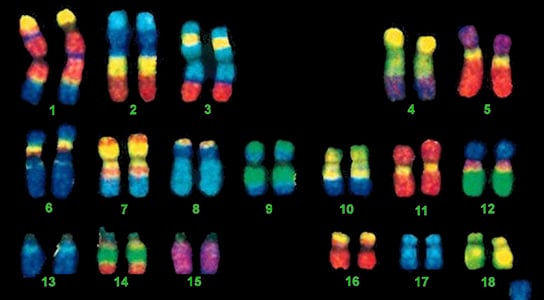
    Fluorescent In-Situ Hybridization (FISH) identification of human chromosomes. Credit: Image by Steven M. Carr, after original by Genetix

    Human populations have grown exponentially in the past 5,000 years, and new genetic mutations arise in each new generation. Humans have a vast abundance of rare genetic variants in the protein-encoding sections of the genome. A new study tries to clarify when many of these rare variants arose.

    The scientists published their findings in the journal Nature. Researchers used deep sequencing to locate and date more than one million single nucleotide variants. These are locations where a single letter of the DNA sequence is different from other individuals. The genomes of 6,500 African and European Americans were analyzed. The findings confirm that the majority of variants were picked up in the past 5,000 to 10,000 years. The scientists also saw the markers of the diverging migratory history of the two groups.

    The sample size, 4,298 North Americans of European descent and 2,217 African Americans, has allowed researchers to mine down into the human genome. They were able to dig out genetic variants occurring in less than 0.1% of the sample population, which is a resolution a full order magnitude finer than was achieved in previous studies.

    Of the 1.15 million single nucleotide variants among the more than 15,000 protein-encoding genes, 73% arose in the past 5,000 years. On average, 14% of the variants were harmful. Of that 14%, 86% arose in the past 5,000 years.

    The scientists discovered that European Americans had a larger proportion of potentially harmful variants, which is probably an effect of their original migration out of Africa. The first group that left Africa experienced a sudden drop in genetic diversity, a sort of bottleneck, due to the smaller pool of possible mating partners. In the rapid expansion that followed, selection was slow to catch up and weed out potentially harmful variants.

    The results indicate that humans are carrying around a larger number of deleterious mutations than they did a few thousand years ago, suggesting that most diseases are caused by more than one variant and that diseases could operate through different genetic pathways and mechanisms in different people.

    Reference: “Analysis of 6,515 exomes reveals the recent origin of most human protein-coding variants” by Wenqing Fu, Timothy D. O’Connor, Goo Jun, Hyun Min Kang, Goncalo Abecasis, Suzanne M. Leal, Stacey Gabriel, Mark J. Rieder, David Altshuler, Jay Shendure, Deborah A. Nickerson, Michael J. Bamshad, NHLBI Exome Sequencing Project and Joshua M. Akey, 28 November 2012, Nature.
    DOI: 10.1038/nature11690

    Never miss a breakthrough: Join the SciTechDaily newsletter.
    Follow us on Google and Google News.

    DNA Evolution Genetics Genome Genomics Popular
    Share. Facebook Twitter Pinterest LinkedIn Email Reddit

    Related Articles

    Discovery of 119-Million-Year-Old “Selfish” Genes Casts Doubt on Established Evolution Beliefs

    Shocking Research Finds DNA From an Ancient, Unidentified Ancestor Was Passed Down to Humans Living Today

    DNA Shows Plants Are Extraordinary Chemists – Making Love and War

    Scientists Extract Complete Human Genome From 5,700-Year-Old “Chewing Gum” – Here’s What They Found

    DNA Study Reveals Clues about Primate Evolution

    Improved Estimates of DNA’s Mutation Rate Paint Clearer Picture of Human Prehistory

    Stickleback Fish Used Pre-Existing Genes to Go from Saltwater to Freshwater Environments

    3-D Image Shows How DNA Packs Itself into a “Fractal Globule”

    Researchers Complete Genome Sequence of a Denisovan Human Finger Bone

    2 Comments

    1. Les Childs on November 29, 2012 8:44 am

      Great article, great site. Looking around, I don’t see any way to “Share” article. You’ll get a lot more exposure & a lot more subscribers if your webmaster can set up a Share function for the various social media tools we use, (Twitter, Facebook, Reddit, etc.).

      Reply
      • Staff on November 29, 2012 9:10 am

        At the bottom of every article you can find the social media tools.

        Reply
    Leave A Reply Cancel Reply

    • Facebook
    • Twitter
    • Pinterest
    • YouTube

    Don't Miss a Discovery

    Subscribe for the Latest in Science & Tech!

    Trending News

    What Causes Chronic Pain? Scientists Identify Key Culprit in the Brain

    Semaglutide Shows Surprising Mental Health Benefits in Massive 100,000-Person Study

    This Liquid Snapped Instead of Flowing and Scientists Were Shocked

    Breakthrough Alzheimer’s Drug Rewires the Brain Instead of Just Clearing Plaques

    Scientists Discover Hidden “Footprint of Death” That Could Transform How We Fight Disease

    A Simple Nose Swab Could Detect Alzheimer’s Years Before Symptoms Appear

    Scientists Just Rewrote the Timeline of Complex Life on Earth

    Teenager’s Fossil Find Leads to Discovery of Shark Teeth in 5 Million-Year-Old Whale Skull

    Follow SciTechDaily
    • Facebook
    • Twitter
    • YouTube
    • Pinterest
    • Newsletter
    • RSS
    SciTech News
    • Biology News
    • Chemistry News
    • Earth News
    • Health News
    • Physics News
    • Science News
    • Space News
    • Technology News
    Recent Posts
    • Even “Failed” Diets May Deliver Long-Term Health Gains, Study Finds
    • Childhood Junk Food May Rewire the Brain for Life
    • NIH Scientists Discover Powerful New Opioid That Relieves Pain Without Dangerous Side Effects
    • Breakthrough Study Reveals Why Damaged Nerves Struggle To Heal
    • 20-Year Study Reveals Cholera’s Surprising Weakness
    Copyright © 1998 - 2026 SciTechDaily. All Rights Reserved.
    • Science News
    • About
    • Contact
    • Editorial Board
    • Privacy Policy
    • Terms of Use

    Type above and press Enter to search. Press Esc to cancel.