
Close Menu
    Facebook X (Twitter) Instagram
    SciTechDaily
    • Biology
    • Chemistry
    • Earth
    • Health
    • Physics
    • Science
    • Space
    • Technology
    Facebook X (Twitter) Pinterest YouTube RSS
    SciTechDaily
    Home»Space»Hinode Mission to Observe Annular Solar Eclipse This Weekend
    Space

    Hinode Mission to Observe Annular Solar Eclipse This Weekend

    By Karen C. Fox, NASA's Goddard Space Flight CenterMay 18, 20122 Comments2 Mins Read
    Facebook Twitter Pinterest Telegram LinkedIn WhatsApp Email Reddit
    Share
    Facebook Twitter LinkedIn Pinterest Telegram Email Reddit
    solar eclipse
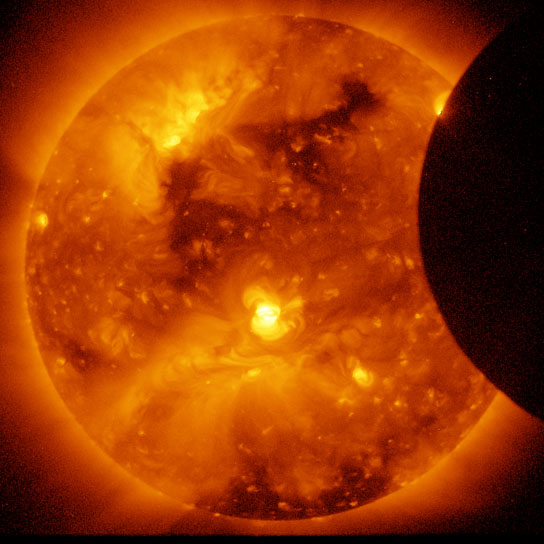
    Hinode captured this image of the January 6, 2011 solar eclipse. Credit: Hinode

    This coming weekend, May 20-21, 2012 will provide us with a view of an annular eclipse of the Sun, which NASA plans to observe and take images of as part of the joint JAXA/NASA Hinode mission.

    On May 20-21, 2012 an annular eclipse of the Sun will be visible from within a narrow corridor along Earth’s northern Hemisphere — beginning in eastern Asia, crossing the North Pacific Ocean, and ending in the western United States. A partial eclipse will be visible from a much larger region covering East Asia, North Pacific, North America, and Greenland.

    During an annular eclipse the moon does not block the entirety of the sun, but leaves a bright ring of light visible at the edges. For the May eclipse, the moon will be at the furthest distance from Earth that it ever achieves – meaning that it will block the smallest possible portion of the sun, and leave the largest possible bright ring around the outside.

    The joint JAXA/NASA Hinode mission will observe the eclipse and provide images and movies that will be available on the NASA website at http://www.nasa.gov/sunearth. Due to Hinode’s orbit around the Earth, Hinode will actually observe 4 separate partial eclipses.” Scientists often use an eclipse to help calibrate the instruments on the telescope by focusing in on the edge of the moon as it crosses the sun and measuring how sharp it appears in the images. An added bonus: Hinode’s X-ray Telescope will be able to provide images of the peaks and valleys of the lunar surface.

    The orbits for NASA’s Solar Dynamics Observatory (SDO), NASA’s Solar Terrestrial Relations Observatory (STEREO), and the joint ESA/NASA mission the Solar Heliospheric Observatory will not provide them with a view of the eclipse.

    The next solar eclipse will be the total solar eclipse on November 13, 2012.

    Never miss a breakthrough: Join the SciTechDaily newsletter.
    Follow us on Google and Google News.

    Eclipse NASA Sun
    Share. Facebook Twitter Pinterest LinkedIn Email Reddit

    Related Articles

    NASA Needs You: Contribute to Research on Eclipse Day – and Every Day

    An Unparalleled View: The Annular Solar Eclipse From the International Space Station

    A “Ring of Fire” in the Sky: The Solar Eclipse Experience

    Five NASA Tips for Photographing the “Ring of Fire” Solar Eclipse

    Don’t Miss: A “Ring of Fire” in the Sky

    Don’t Miss Eclipses: NASA Releases New Map of Upcoming Solar Eclipses

    NASA’s ACE Mission: Total Solar Eclipses Shine a Light on the Solar Wind

    Solar Dynamics Observatory Measures Magnetic Fields on Sun’s Surface

    Comet Survives after Close Brush With the Sun

    2 Comments

    1. Nicola on May 19, 2012 2:23 am

      You forgot to write that If you look directly in the sun you can damage your eyes.
      Do not look at the sun during the eclipse with the naked eye or even with sunglasses, use an approved solar filter, solar glasses, or solar projection system.

      Attempts to use a binoculars, telescope, or other optical viewing device without a proper filter will likely result in instant and permanent eye damage!

      Reply
    2. Etienne on May 19, 2012 7:00 pm

      I’m in Mexico, I hope I’ll be able to see it well enough. Are you planning on watching the solar eclipse? Take my quick poll http://knockoutsurveys.com/will-you-watch-the-solar-eclipse.html

      Reply
    Leave A Reply Cancel Reply

    • Facebook
    • Twitter
    • Pinterest
    • YouTube

    Don't Miss a Discovery

    Subscribe for the Latest in Science & Tech!

    Trending News

    Mezcal “Worm” in a Bottle Mystery: DNA Testing Reveals a Surprise

    New Research Reveals That Your Morning Coffee Activates an Ancient Longevity Switch

    This Is What Makes You Irresistible to Mosquitoes

    Shockingly Powerful Giant Octopuses Ruled the Seas 100 Million Years Ago

    Scientists Stunned by New Organic Molecules Found on Mars

    Rewriting Dinosaur Evolution: Scientists Unearth Remarkable 150-Million-Year-Old Stegosaur Skull

    Omega-3 Supplements Linked to Cognitive Decline in Surprising New Study

    First-of-Its-Kind Discovery: Homer’s Iliad Found Embedded in a 1,600-Year-Old Egyptian Mummy

    Follow SciTechDaily
    • Facebook
    • Twitter
    • YouTube
    • Pinterest
    • Newsletter
    • RSS
    SciTech News
    • Biology News
    • Chemistry News
    • Earth News
    • Health News
    • Physics News
    • Science News
    • Space News
    • Technology News
    Recent Posts
    • These Simple Daily Habits Can Quickly Improve Blood Pressure and Heart Risk Factors
    • A Common Nutrient May Play a Surprising Role in Anxiety
    • Doing This After 9 p.m. Could Double Your Risk of Gut Issues
    • New Research Challenges Long-Held Beliefs About How the Brain Makes Decisions
    • Breakthrough Technology Reveals New Treatment Targets for Cancer
    Copyright © 1998 - 2026 SciTechDaily. All Rights Reserved.
    • Science News
    • About
    • Contact
    • Editorial Board
    • Privacy Policy
    • Terms of Use

    Type above and press Enter to search. Press Esc to cancel.