
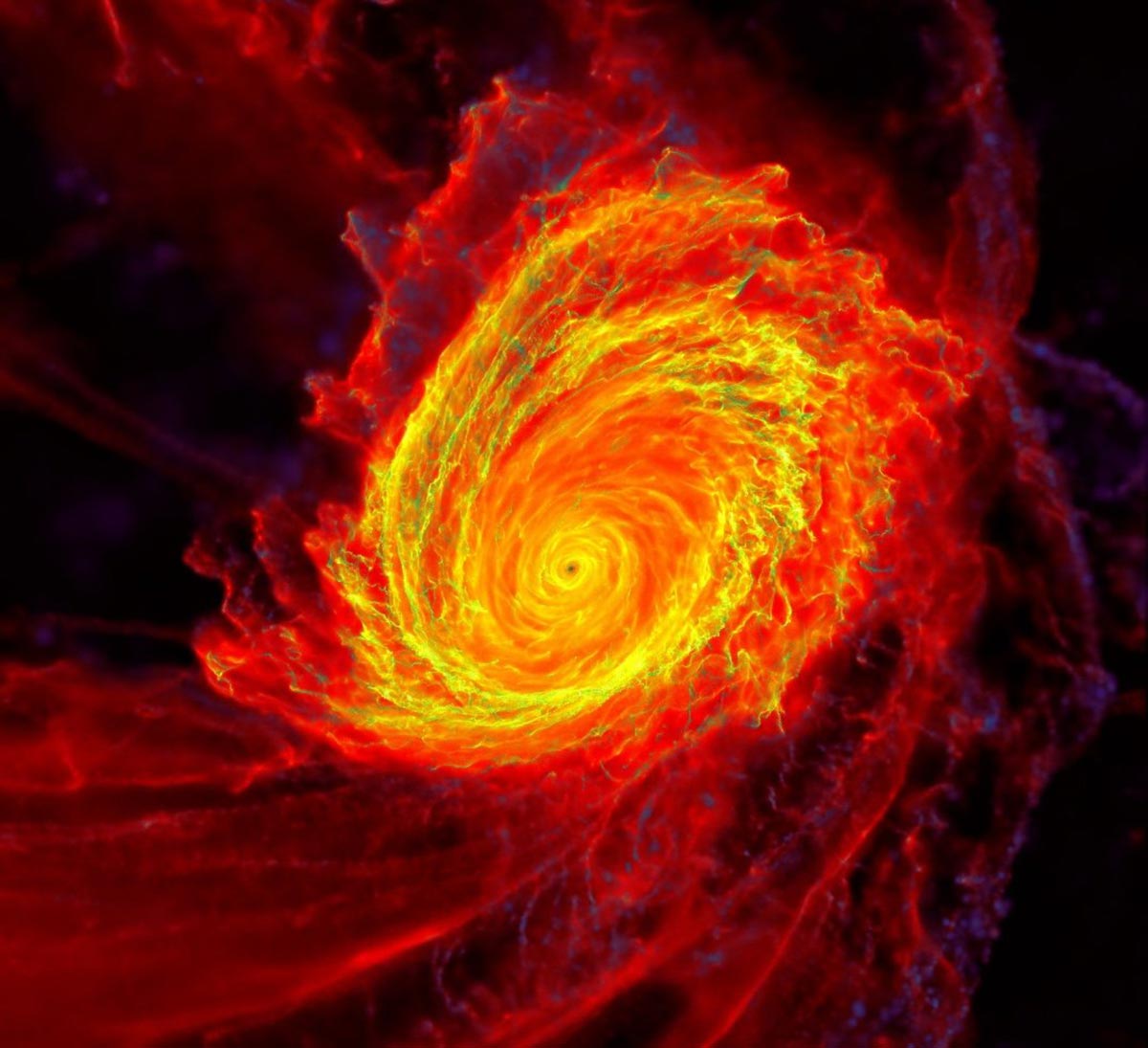
Astounding simulation shows magnetic fields create fluffy, not flat, accretion disks around supermassive black holes, altering our understanding of black hole dynamics.
A team of astrophysicists from Caltech has achieved a groundbreaking milestone by simulating the journey of primordial gas from the early universe to its incorporation into a disk of material feeding a supermassive black hole. This innovative simulation challenges theories about these disks that have persisted since the 1970s and opens new doors for understanding the growth and evolution of black holes and galaxies.
“Our new simulation marks the culmination of several years of work from two large collaborations started here at Caltech,” says Phil Hopkins, the Ira S. Bowen Professor of Theoretical Astrophysics.
Bridging the Scale Gap in Cosmic Simulations
The first project, called FIRE (Feedback in Realistic Environments), investigates large-scale cosmic phenomena such as galaxy formation and collisions. The second, known as STARFORGE, focuses on smaller-scale processes, like star formation within individual gas clouds. “But there was this big gap between the two,” Hopkins explains. “Now, for the first time, we have bridged that gap.” Achieving this required a simulation with over 1,000 times the resolution of any previous efforts in the field.
To the team’s surprise, as reported in The Open Journal of Astrophysics, the simulation revealed that magnetic fields play a much larger role than previously believed in forming and shaping the huge disks of material that swirl around and feed the supermassive black holes. “Our theories told us the disks should be flat like crepes,” Hopkins says. “But we knew this wasn’t right because astronomical observations reveal that the disks are actually fluffy—more like an angel cake. Our simulation helped us understand that magnetic fields are propping up the disk material, making it fluffier.”
Supercomputing Black Hole Accretion Disks
In the new simulation, the researchers performed what they call a “super zoom-in” on a single supermassive black hole, a monstrous object that lies at the heart of many galaxies, including our own Milky Way. These ravenous, mysterious bodies contain anywhere from thousands to billions of times the mass of the Sun, and thus exert a huge effect on anything that comes near.
Astronomers have known for decades that as gas and dust are pulled in by the tremendous gravity of these black holes, they are not immediately sucked in. Instead, the material first forms a rapidly swirling disk called an accretion disk. And as the material is just about to fall in, it radiates a huge amount of energy, shining with a brilliance unmatched by just about anything in the universe. But much is still not known about these active supermassive black holes, called quasars, and how the disks that feed them form and behave.
While disks around supermassive black holes have been imaged previously—the Event Horizon Telescope imaged disks circling black holes at the heart of our own galaxy in 2022 and Messier 87 in 2019—these disks are much closer and more tame than the ones that churn around quasars. To visualize what happens around these more active and distant black holes, astrophysicists turn to supercomputer simulations. They feed information about the physics at work in these galactic settings—everything from the basic equations that govern gravity to how to treat dark matter and stars—into thousands of computing processors that work in parallel. This input includes many algorithms, or series of instructions, for the computers to follow to recreate complicated phenomena. So, for example, the computers know that once gas becomes dense enough, a star forms. But the process is not that straightforward.
“If you just say gravity pulls everything down and then eventually the gas forms a star and stars just build up, you’ll get everything wildly wrong,” Hopkins explains. After all, stars do many things that affect their surroundings. They shine radiation that can heat up or push surrounding gas. They blow winds like the solar wind created by our own Sun, which can sweep up material. They explode as supernovae, sometimes launching material clear out of galaxies or changing the chemistry of their surroundings. So, the computers must know all the ins and outs of this “stellar feedback” as well, as it regulates how many stars a galaxy can actually form.

Unveiling New Insights on Black Hole Dynamics
But at these larger scales, the set of physics that are most important to include and what approximations can be made differ from those at smaller scales. For example, on the galactic scale, the complicated details of how atoms and molecules behave are extremely important and must be built into any simulation. However, scientists agree that when simulations focus on the more immediate area around a black hole, molecular chemistry can be mostly ignored because the gas there is too hot for atoms and molecules to exist. Instead, what is exists there is hot ionized plasma.
Creating a simulation that could cover all the relevant scales down to the level of a single accretion disk around a supermassive black hole was a huge computational challenge—one that also required a code that could handle all the physics. “There were some codes that had the physics that you needed to do the small-scale part of the problem and some codes that had the physics that you needed to do the larger, cosmological part of the problem, but nothing that had both,” Hopkins says.
The Caltech-led team used a code they call GIZMO for both the large- and small-scale simulation projects. Importantly, they built the FIRE project so that all the physics they added to it could work with the STARFORGE project, and vice versa. “We built it in a very modular way, so that you could flip on and off any of the pieces of physics that you wanted for a given problem, but they were all cross-compatible,” Hopkins says.
This allowed the scientists in the latest work to simulate a black hole that is about 10 million times the mass of our Sun, beginning in the early universe. The simulation then zooms in on that black hole at a moment when a giant stream of material is torn off a cloud of star-forming gas and begins to swirl around the supermassive black hole. The simulation can continue zooming in, resolving a finer area at each step as it follows the gas on its way toward the hole.
The new simulation flies into a tangle of merging galaxies, ultimately zooming into an active supermassive black hole, or quasar, surrounded by a swirling disk of material called an accretion disk. A filamentary stream of gas has been wound up into the disk, funneling gas in at a rate sufficient to fuel the brightest known quasars in the universe. Near the end of the simulation, magnetic fields rip away the angular momentum from the rotating disk, which allows material to spiral in further and further until it reaches the event horizon of the black hole, where it can’t escape. During this simulation, which represents one moment in time, the scale zooms in by a factor of a billion. The colors show the density of the gas, with brighter colors representing higher densities. Credit: Caltech/Phil Hopkins group
Revising Theories of Magnetic Influence on Accretion Disks
“In our simulation, we see this accretion disk form around the black hole,” Hopkins says. “We would have been very excited if we had just seen that accretion disk, but what was very surprising was that the simulated disk doesn’t look like what we’ve thought for decades it should look like.”
In two seminal papers from the 1970s that described the accretion disks fueling supermassive black holes, scientists assumed that thermal pressure—the change in pressure caused by the changing temperature of the gas in the disks—played the dominant role in preventing such disks from collapsing under the tremendous gravity they experience close to the black hole. They acknowledged that magnetic fields might play a minor role in helping to shore up the disks. In contrast, the new simulation found that the pressure from the magnetic fields of such disks was actually 10,000 times greater than the pressure from the heat of the gas.
“So, the disks are almost completely controlled by the magnetic fields,” Hopkins says. “The magnetic fields serve many functions, one of which is to prop up the disks and make the material puffy.”
This realization changes a host of predictions scientists can make about such accretion disks, such as their mass, how dense and thick they should be, how fast material should be able to move from them into a black hole, and even their geometry (such as whether the disks can be lopsided).
Looking forward, Hopkins hopes this new ability to bridge the gap in scales for cosmological simulations will open many new avenues of research. For example, what happens in detail when two galaxies merge? What types of stars form in the dense regions of galaxies where conditions are unlike those in our Sun’s neighborhood? What might the first generation of stars in the universe have looked like? “There’s just so much to do,” he says.
The new simulation is detailed in a paper entitled “FORGE’d in FIRE: Resolving the End of Star Formation and Structure of AGN Accretion Disks from Cosmological Initial Conditions,” which appears in The Open Journal of Astrophysics.
Reference: “FORGE’d in FIRE: Resolving the End of Star Formation and Structure of AGN Accretion Disks from Cosmological Initial Conditions” by Philip F. Hopkins, Michael Y. Grudic, Kung-Yi Su, Sarah Wellons, Daniel Angles-Alcazar, Ulrich P. Steinwandel, David Guszejnov, Norman Murray, Claude-Andre Faucher-Giguere, Eliot Quataert and Dusan Keres, 14 March 2024, The Open Journal of Astrophysics.
DOI: 10.21105/astro.2309.13115
Additional authors on the paper include Michael Grudic (PhD ’19) of Carnegie Observatories, Kung-Yi Su (PhD ’19) of Harvard University, Sarah Wellons of Wesleyan University, Daniel Angles-Alcazar of the University of Connecticut and the Flatiron Institute, Ulrich Steinwandel of the Flatiron Institute, David Guszeinov (PhD ’18) of the University of Texas at Austin, Norman Murray (BS ’79) of the University of Toronto, Claude-Andre Faucher-Giguere of Northwestern University, Eliot Quatert of Princeton University, and Dusan Keres of UC San Diego. Hopkins’s work was supported by funding from the National Science Foundation and NASA.
Never miss a breakthrough: Join the SciTechDaily newsletter.
Follow us on Google and Google News.
1 Comment
What governs the way the stuff in the accretion disc spirals into the black hole? Presumably the black hole has a spin so what governs that? And after that, there being umpteen black holes drifting around these days, is there a dominant direction of spin or is it merely random?