
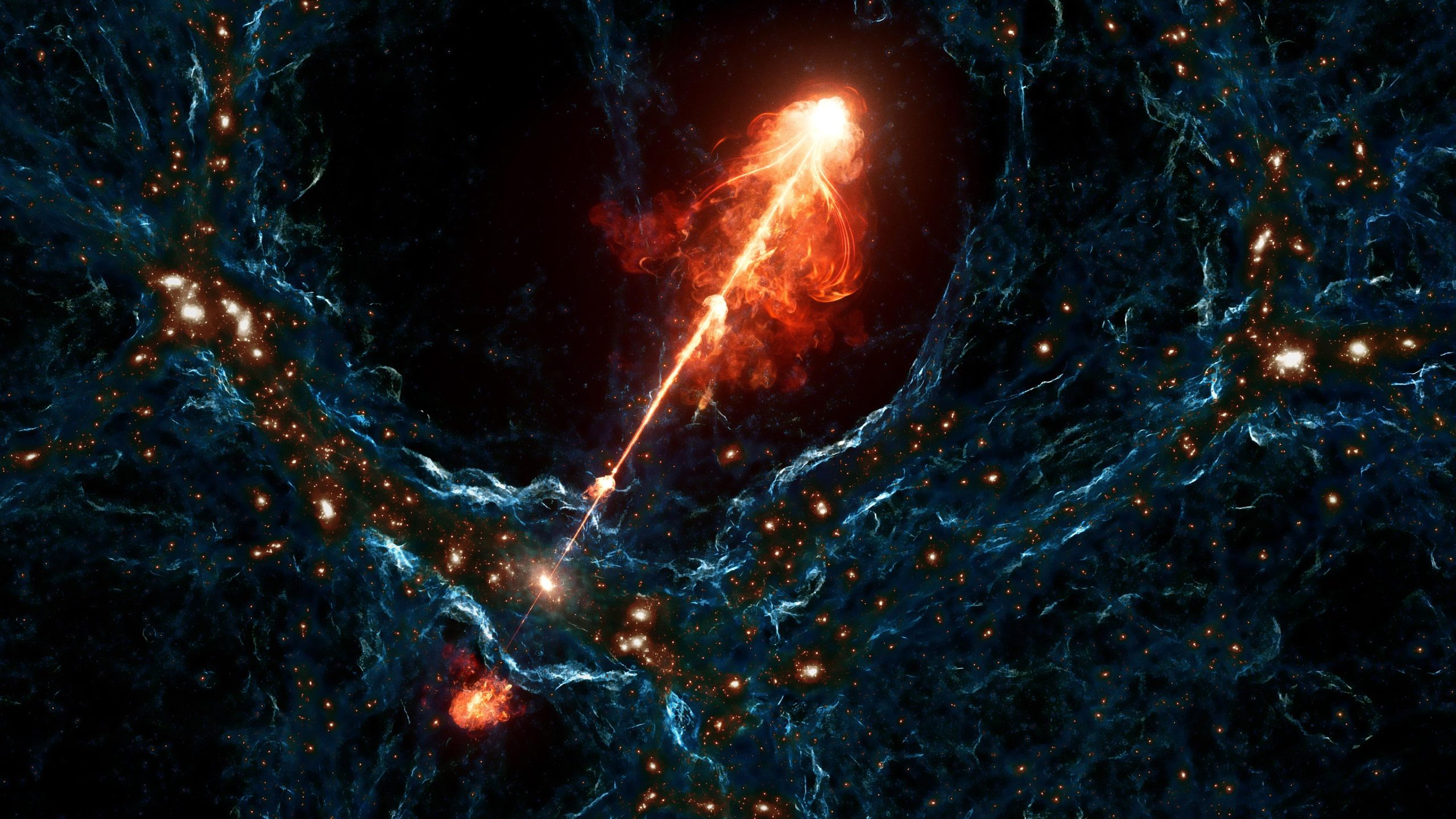
Astronomers have identified the largest black hole jet structure known, named Porphyrion, stretching 23 million light-years across, akin to 140 Milky Way galaxies aligned.
This discovery, emerging from a galaxy about 10 times the mass of our Milky Way, suggests that such jets could significantly impact galaxy formation and cosmic magnetic fields.
Discovery of Colossal Black Hole Jets
Astronomers have spotted the biggest pair of black hole jets ever seen, spanning 23 million light-years in total length. That’s equivalent to lining up 140 Milky Way galaxies back to back.
“This pair is not just the size of a solar system, or a Milky Way; we are talking about 140 Milky Way diameters in total,” says Martijn Oei, a Caltech postdoctoral scholar and lead author of a new Nature paper reporting the findings. “The Milky Way would be a little dot in these two giant eruptions.”

Unveiling Porphyrion: A Record-Breaking Jet System
The jet megastructure, nicknamed Porphyrion after a giant in Greek mythology, dates to a time when our universe was 6.3 billion years old, or less than half its present age of 13.8 billion years. These fierce outflows—with a total power output equivalent to trillions of suns—shoot out from above and below a supermassive black hole at the heart of a remote galaxy.
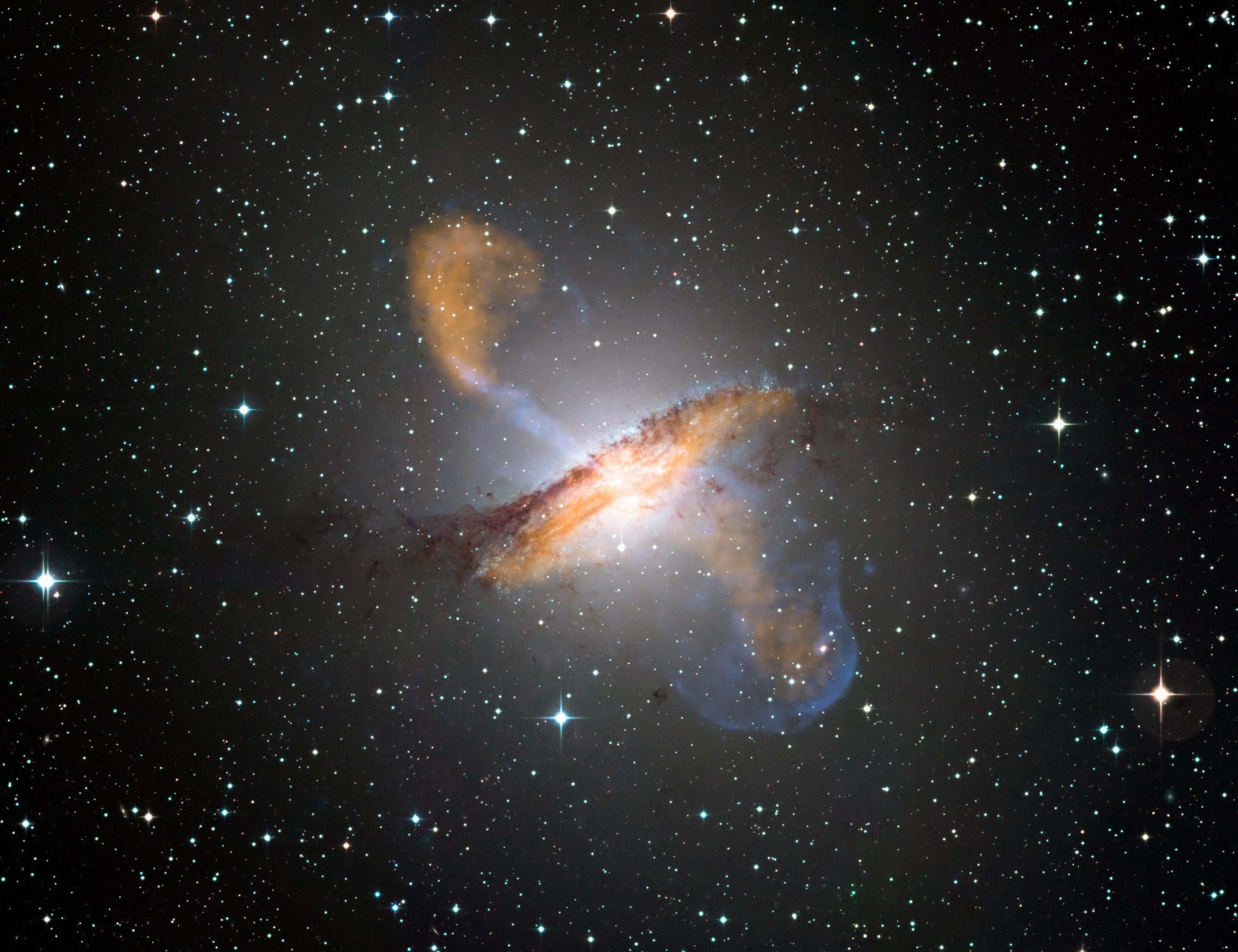
Prior to Porphyrion’s discovery, the largest confirmed jet system was Alcyoneus, also named after a giant in Greek mythology. Alcyoneus, which was discovered in 2022 by the same team that found Porphyrion, spans the equivalent of around 100 Milky Ways. For comparison, the well-known Centaurus A jets (see image below), the closest major jet system to Earth, spans 10 Milky Ways.
Broader Implications for Cosmic Evolution
The latest finding suggests that these giant jet systems may have had a larger influence on the formation of galaxies in the young universe than previously believed. Porphyrion existed during an early epoch when the wispy filaments that connect and feed galaxies, known as the cosmic web, were closer together than they are now. That means enormous jets like Porphyrion reached across a greater portion of the cosmic web compared to jets in the local universe.
“Astronomers believe that galaxies and their central black holes co-evolve, and one key aspect of this is that jets can spread huge amounts of energy that affect the growth of their host galaxies and other galaxies near them,” says co-author George Djorgovski, professor of astronomy and data science at Caltech. “This discovery shows that their effects can extend much farther out than we thought.”
The LOFAR Survey: A Sky Full of Giants
The Porphyrion jet system is the biggest found so far during a sky survey that has revealed a shocking number of the faint megastructures: more than 10,000. This massive population of gargantuan jets was found using Europe’s LOFAR (LOw Frequency ARray) radio telescope.
While hundreds of large jet systems were known before the LOFAR observations, they were thought to be rare and on average smaller in size than the thousands of systems uncovered by the radio telescope.
“Giant jets were known before we started the campaign, but we had no idea that there would turn out to be so many,” says Martin Hardcastle, second author of the study and a professor of astrophysics at the University of Hertfordshire in England. “Usually when we get a new observational capability, such as LOFAR’s combination of wide field of view and very high sensitivity to extended structures, we find something new, but it was still very exciting to see so many of these objects emerging.”

Rediscovery of Cosmic Giants
Back in 2018, Oei and his colleagues began using LOFAR to study not black hole jets but the cosmic web of wispy filaments that crisscross the space between galaxies. As the team inspected the radio images for the faint filaments, they began to notice several strikingly long jet systems.
“When we first found the giant jets, we were quite surprised,” says Oei, who is also affiliated with Leiden Observatory in the Netherlands. “We had no idea that there were this many.”
To systematically search for more hidden jets, the team inspected the radio images by eye, used machine-learning tools to scan the images for signs of the looming jets, and enlisted the help of citizen scientists around the globe to eyeball the images further. A paper describing their most recent batch of giant outflows, containing more than 8,000 jet pairs, has been accepted for publication in the journal Astronomy & Astrophysics.

Tracing Porphyrion’s Origins
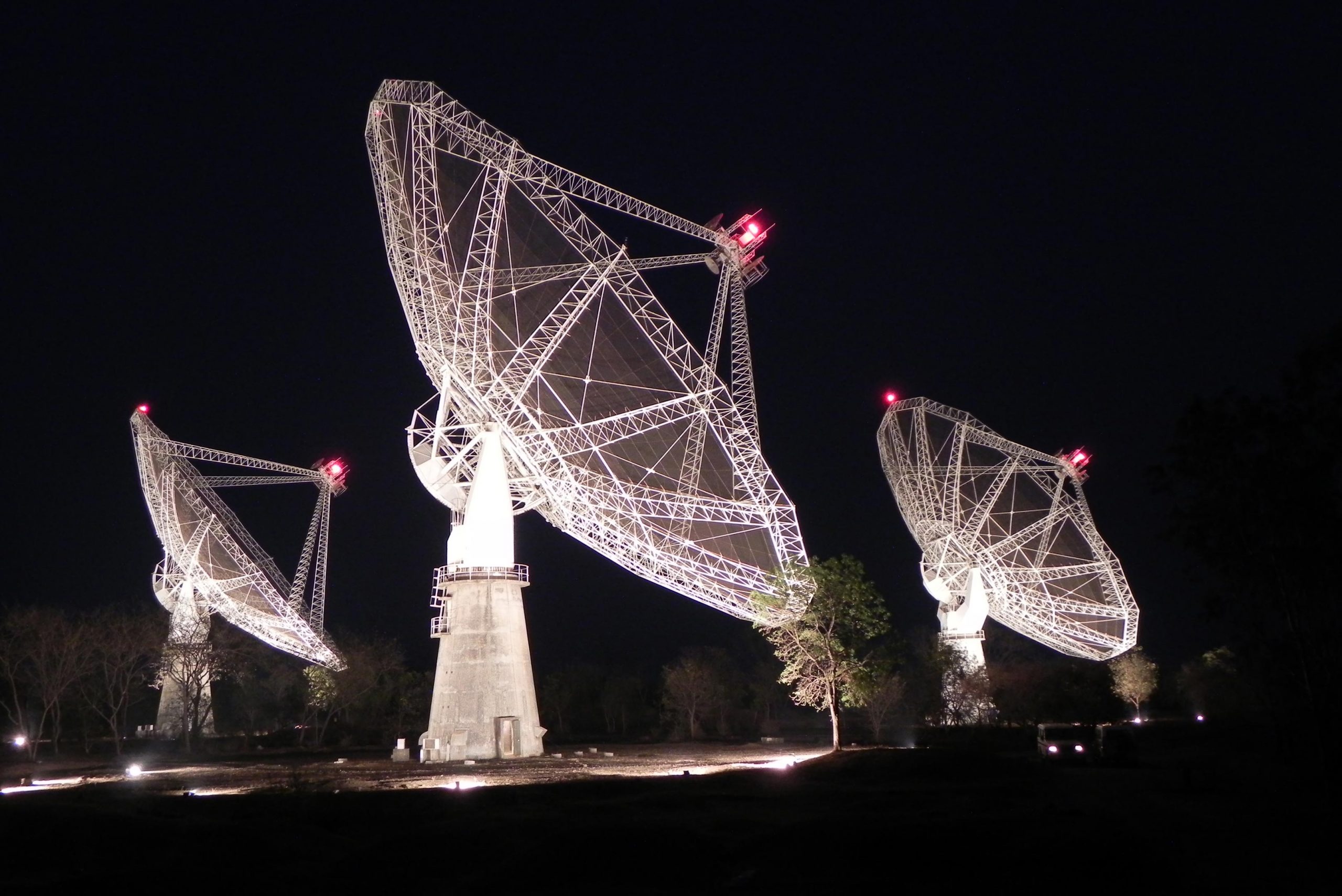
To find the galaxy from which Porphyrion originated, the team used the Giant Metrewave Radio Telescope (GMRT) in India along with ancillary data from a project called Dark Energy Spectroscopic Instrument (DESI), which operates from Kitt Peak National Observatory in Arizona. The observations pinpointed the home of the jets to a hefty galaxy about 10 times more massive than our Milky Way.
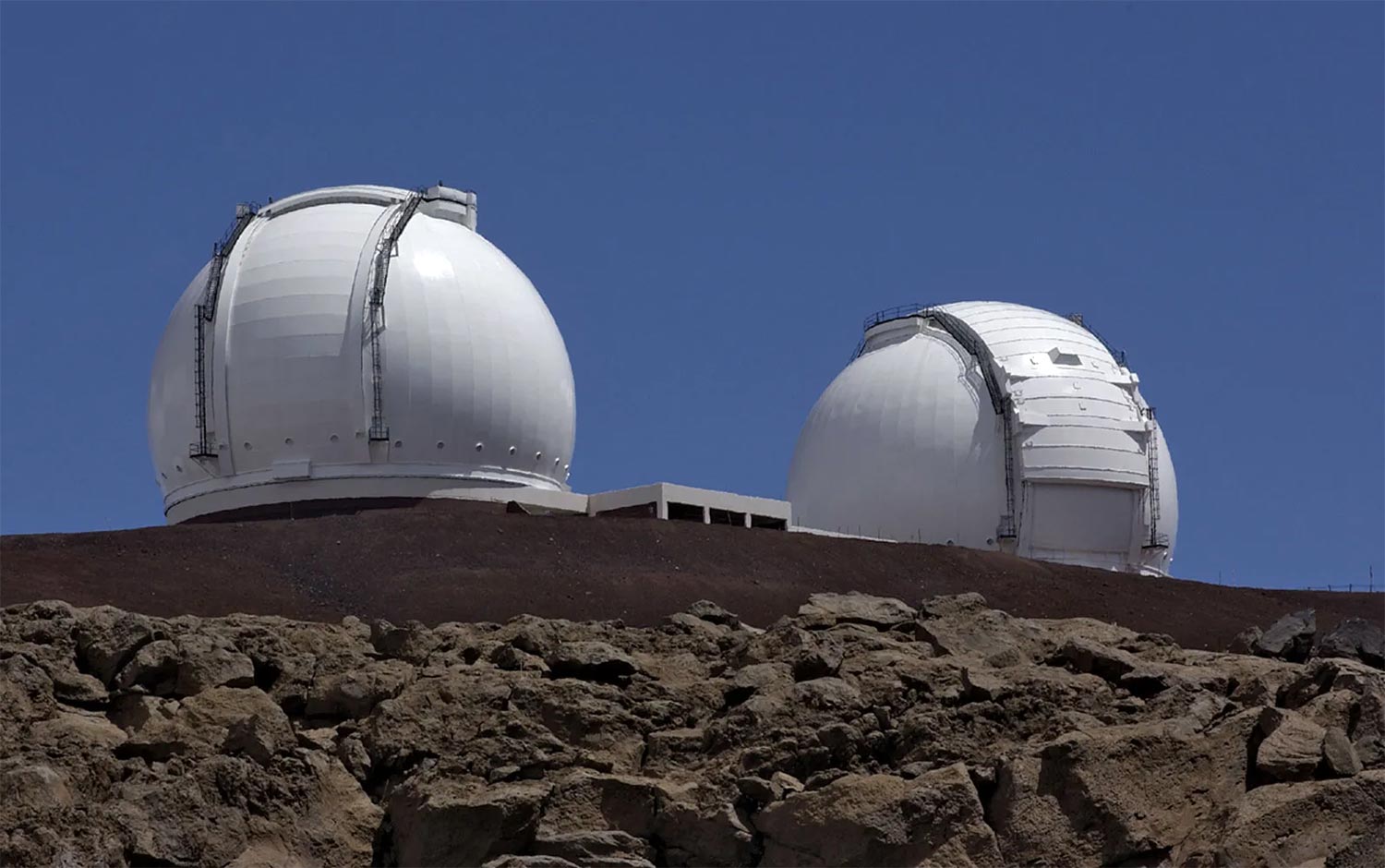
The team then used the W. M. Keck Observatory in Hawai‘i to show that Porphyrion is 7.5 billion light-years from Earth. “Up until now, these giant jet systems appeared to be a phenomenon of the recent universe,” Oei says. “If distant jets like these can reach the scale of the cosmic web, then every place in the universe may have been affected by black hole activity at some point in cosmic time,” Oei says.
Radiative-Mode Black Holes and Unexpected Discoveries
The observations from Keck also revealed that Porphyrion emerged from what is called a radiative-mode active black hole, as opposed to one that is in a jet-mode state. When supermassive black holes become active—in other words, when their immense forces of gravity tug on and heat up surrounding material—they are thought to either emit energy in the form of radiation or jets. Radiative-mode black holes were more common in the young, or distant, universe, while jet-mode ones are more common in the present-day universe.
The fact that Porphyrion came from a radiative-mode black hole came as a surprise because astronomers did not know this mode could produce such huge and powerful jets. What is more, because Porphyrion lies in the distant universe where radiative-mode black holes abound, the finding implies there may be a lot more colossal jets left to be found.
“We may be looking at the tip of the iceberg,” Oei says. “Our LOFAR survey only covered 15 percent of the sky. And most of these giant jets are likely difficult to spot, so we believe there are many more of these behemoths out there.”
Ongoing Mysteries
How the jets can extend so far beyond their host galaxies without destabilizing is still unclear. “Martijn’s work has shown us that there isn’t anything particularly special about the environments of these giant sources that causes them to reach those large sizes,” says Hardcastle, who is an expert in the physics of black hole jets. “My interpretation is that we need an unusually long-lived and stable accretion event around the central, supermassive black hole to allow it to be active for so long—about a billion years—and to ensure that the jets keep pointing in the same direction over all of that time. What we’re learning from the large number of giants is that this must be a relatively common occurrence.”
As a next step, Oei wants to better understand how these megastructures influence their surroundings. The jets spread cosmic rays, heat, heavy atoms, and magnetic fields throughout the space between galaxies. Oei is specifically interested in finding out the extent to which giant jets spread magnetism. “The magnetism on our planet allows life to thrive, so we want to understand how it came to be,” he says. “We know magnetism pervades the cosmic web, then makes its way into galaxies and stars, and eventually to planets, but the question is: Where does it start? Have these giant jets spread magnetism through the cosmos?”
Reference: “Black hole jets on the scale of the cosmic web” by Martijn S. S. L. Oei, Martin J. Hardcastle, Roland Timmerman, Aivin R. D. J. G. I. B. Gast, Andrea Botteon, Antonio C. Rodriguez, Daniel Stern, Gabriela Calistro Rivera, Reinout J. van Weeren, Huub J. A. Röttgering, Huib T. Intema, Francesco de Gasperin and S. G. Djorgovski, 18 September 2024, Nature.
DOI: 10.1038/s41586-024-07879-y
The Nature study, “Black hole jets on the scale of the cosmic web,” was funded by the Dutch Research Council, the European Research Council, the UK Science and Technology Facilities Council, the UK Research and Innovation Future Leaders Fellowship, and the European Union. Other Caltech authors include graduate student Antonio Rodriguez. Additional authors are Roland Timmerman of Durham University; Reinout J. van Weeren, Huub J.A. Röttgering, and Huib T. Intema of Leiden University (Timmerman is also affiliated with Leiden University); Aivin R.D.J.G.I.B. Gast of the University of Oxford; Andrea Botteon and Francesco de Gasperin of the Institute for Radio Astronomy of Italy’s National Institute of Astrophysics; Daniel Stern of the Jet Propulsion Laboratory, which is managed by Caltech for NASA; and Gabriela Calistro Rivera of the European Southern Observatory and the German Aerospace Center.
Never miss a breakthrough: Join the SciTechDaily newsletter.
Follow us on Google and Google News.
4 Comments
I once read in a near death experience account of all places that black holes are the great recycling machines of the universe. This article makes it pretty clear that ultimately many, if not all black holes don’t hold matter forever, but blast it back out as plasma far across deep space, forming new galaxies in time.
It also points towards something Webb keeps alluding to that Astronomers refuse to recognize. There was no likely Big Bang, at least not in the time frames proposed, perhaps some smaller “bangs” where the edge our Universe has collided with other universes, but it’s becoming more and more obvious the universe is steady state and recycles itself endlessly because as the Law states, energy cannot be created or destroyed, only changed in form.
Our view of both gravity and Red Shift being affected by cosmic “dust” (it was assumed wrongly the universe is mostly empty space) is terminally flawed, but instead of admitting our mistakes, we invent mat kludges to explain it all, hence Dark Matter and Dark Energy.
People will defend those made up concepts the sane way they kept insisting Amyloid plaques were the cause of Alzheimers despite every data point showing most people with plaques did not have Alzheimers! Humans are flawed, egotistical and stubborn and those qualities do not mesh well with true science.
I wholeheartedly agree.
It boggles the mind how the “scientific community” still thinks the formation of all these vast cosmic wonders could be crammed into a 13.5 billion years timeline. All things considered, it feels awfully short.
These jets are not emitted from within the black hole. Instead, these jets are made of particles that are accelerated to high speeds by the gravity of the black hole. But then they narrowly miss the black hole and escape to space.
You have to do calculations and not just have a feeling about whether 13.5 billion years is enough time for the universe to create all these structures starting from Big bang. Generally, the scientific consensus is that there was enough time for the universe to do all these things.
That said, there are some doubts and questions that still need to be clarified. One such doubt is about the age of the early-universe black holes found by JWST. But those doubts will likely not completely invalidate the Big bang idea. Any idea replacing the Big bang will have to explain everything that the Big bang explains, including the cosmic microwave background radiation.