
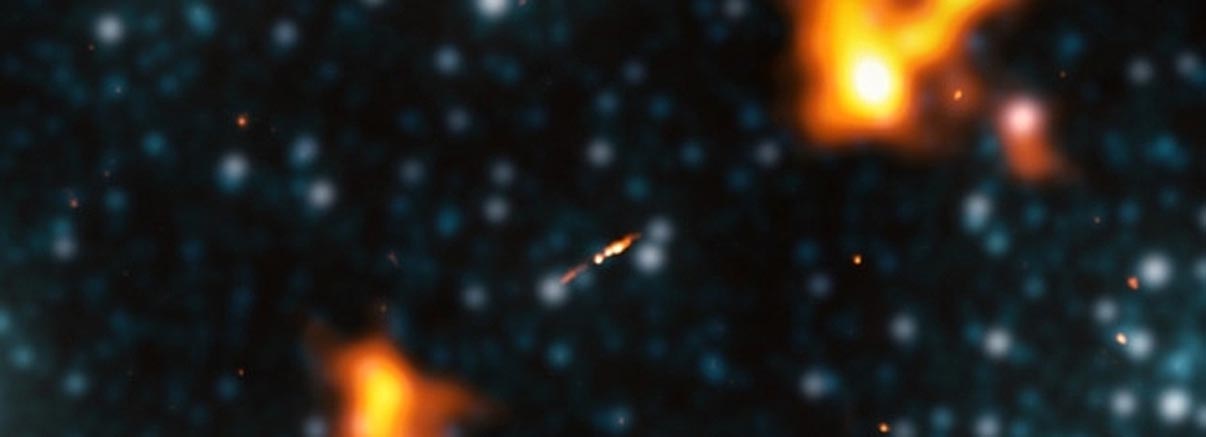
Alcyoneus, the largest known radio galaxy, stretches 16 million lightyears, offering new clues about cosmic structures like the Cosmic Web.
By a stroke of luck, a team led by Dutch PhD student Martijn Oei has discovered a radio galaxy of at least 16 million lightyears long. The pair of plasma plumes is the largest structure made by a galaxy known thus far. The finding disproves some long-kept hypotheses about the growth of radio galaxies.
A supermassive black hole lurks in the center of many galaxies, which slows down the birth of new stars and therefore strongly influences the lifecycle of the galaxy as a whole. Sometimes, this leads to tumultuous scenes: the black hole can create two jet streams, that catapult the building material for baby stars out of the galaxy at almost the speed of light. In this violent process, the stardust heats up so much that it dissolves into plasma and glows in radio light. The international team of researchers from Leiden (The Netherlands), Hertfortshire, Oxford (both UK), and Paris (France) have now collected that light – with the pan-European LOFAR telescope, whose epicenter lies in a marshy Dutch ‘radio dark’ nature reserve, where your smartphone deliberately loses signal.
Record Length
The picture of the two plasma plumes is special, because never before scientists saw a structure this big made by a single galaxy. The discovery shows that the sphere of influence of some galaxies reaches far from their direct environment. How far, exactly? That is hard to determine. Astronomical pictures are taken from a single viewpoint (Earth), and therefore do not contain depth. As a result, scientists can only measure a part of the radio galaxy length: a low estimate of the total length. But even that lower bound, of more than 16 million lightyears, is gargantuan, and comparable to one hundred Milky Ways in a row.

Visible With the Naked Radio Eye
Because Earth does not occupy a special place in the Universe, it was never very likely that such a largest galactic structure would reside in our own backyard. And indeed: the radio giant is three billion lightyears away from us. Despite that mind-boggling distance, the giant looms as large in the sky as the Moon – an indication that the structure had to have a record length. The fact that the radio eyes of the LOFAR telescope only saw the giant just now, is because the plumes are relatively faint. By reprocessing a set of existing images in such a way that subtle patterns stood out, the scientists were suddenly able to spot the giant.
The Giant Alcyoneus
The researchers named the giant structure Alcyoneus, after the son of Ouranos, the Greek primordial god of the sky. This mythological Alcyoneus was a giant that fought against Heracles and other Olympians for supremacy over the cosmos. In the world-famous Pergamon Altar in Berlin, a sculpture of this Alcyoneus is carved out.
Ghostly Dance
Alcyoneus’ plumes possibly reveal information about the mostly elusive filaments of the Cosmic Web. The Cosmic Web is another name for the contemporary, grown-up Universe, that looks like a network of threads and nodes that astronomers call filaments and clusters, respectively. The galaxies in filaments and clusters are clearly visible themselves, but detecting the medium between galaxies has only been successful in clusters – barring a handful of exceptions. Could Alcyoneus change this?
Because Alcyoneus, just like the Milky Way, inhabits a filament, its plumes feel a headwind while moving through the medium. This subtly changes the direction and shape of the plumes: they perform a slow dance with an invisible partner. For many years, scientists have proposed that the shapes of and pressures in the plumes of radio galaxies could relate to filament properties, but never before did they find an example where that connection is as plausible as with Alcyoneus. Namely, Alcyoneus’ plumes are so big and rarefied that the surrounding medium can relatively easily mold them.
Black Holes Are Cosmic Mainstays
The Cosmic Web retains its form because the attractive force of gravity is compensated by the heat pressure of the medium in filaments and clusters. In the past two decennia it has become clear that the glowing stardust that jet streams eject from galaxies, keeps the Web warm. In this way, the central black holes in galaxies contribute to sustain the large-scale structure of our Universe. That is extra noteworthy because black holes are very small compared to filaments and clusters. It is as if something the size of a marble regulates the Earth’s temperature.
Mysterious Origin
What has given Alcyoneus its record length, remains a mystery for now. The scientists first thought of an exceptionally massive black hole, an extensive stellar population (and so a lot of stardust), or extraordinarily powerful jet streams. Surprisingly enough, Alcyoneus appears to be less than average on all these aspects compared to its smaller sisters and brothers. In the times ahead, the team will therefore now investigate whether the environments of radio galaxies could explain the growth of giants instead.
Reference: “The discovery of a radio galaxy of at least 5 Mpc” by Martijn S.S.L. Oei, Reinout J. van Weeren, Martin J. Hardcastle, Andrea Botteon, Tim W. Shimwell, Pratik Dabhade, Aivin R.D.J.G.I.B. Gast, Huub J.A. Röttgering, Marcus Brüggen, Cyril Tasse, Wendy L. Williams and Aleksandar Shulevski, Accepted, Astronomy & Astrophysics.
arXiv:2202.05427
Never miss a breakthrough: Join the SciTechDaily newsletter.
Follow us on Google and Google News.