
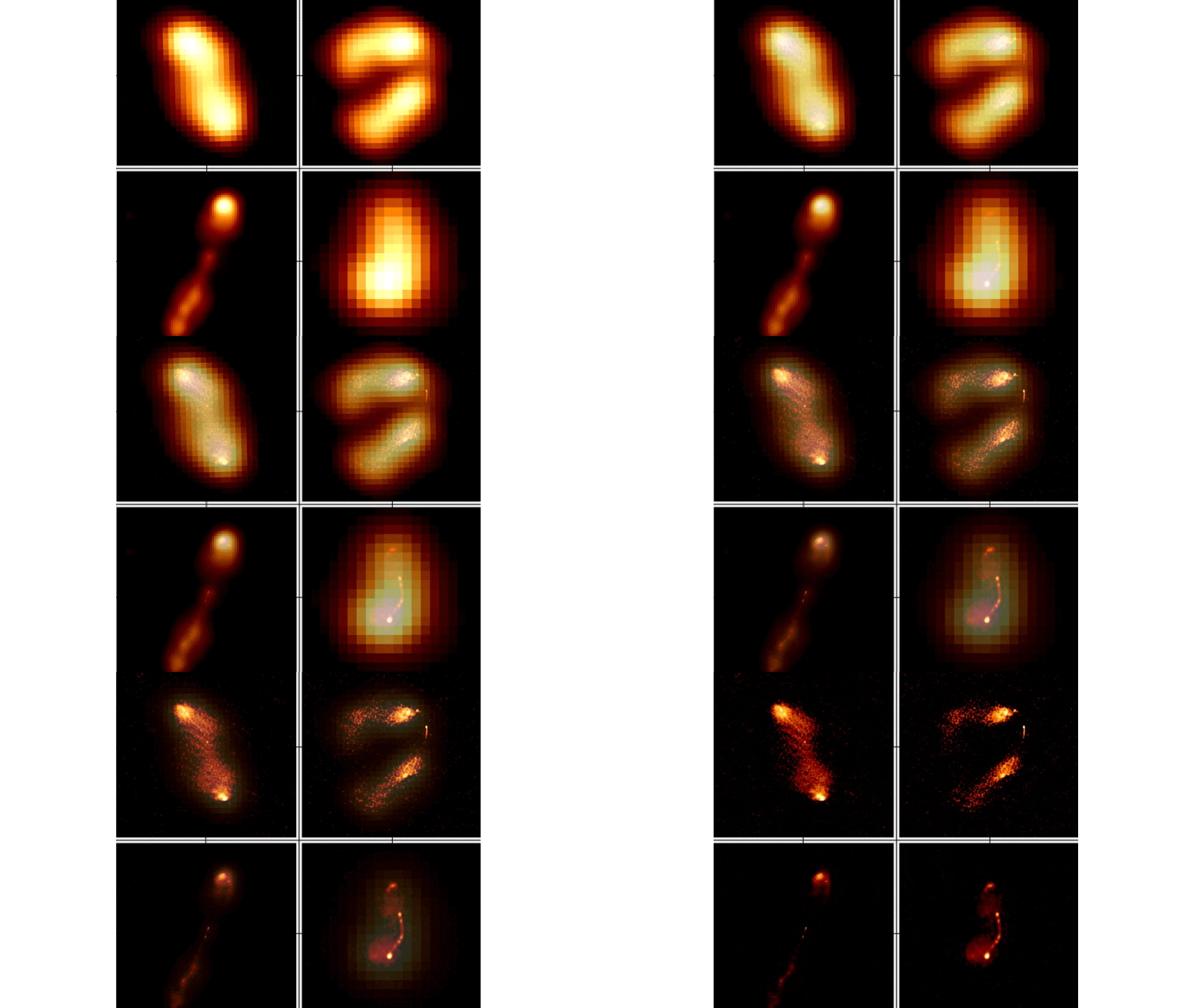
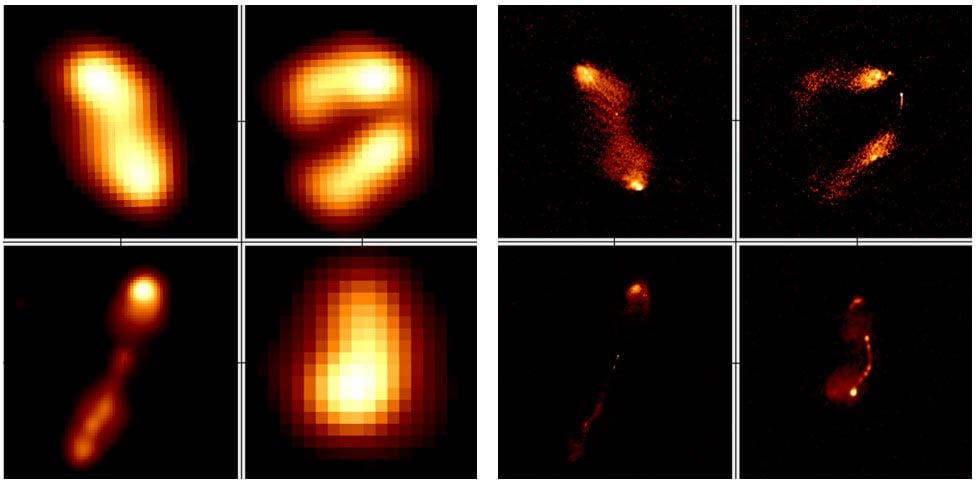
With new algorithms and supercomputers, an incredibly detailed radio map of the universe was created. Now astronomers can look at radio data of galaxies with much more precision. This was published in Nature Astronomy by Leiden PhD student Frits Sweijen and colleagues.
“This single map has almost as many pixels as previous maps of the entire sky had,” says Frits Sweijen, PhD student at Leiden Observatory. The researchers solved the blurring effect of UV radiation in our atmosphere: with special software they managed to correct for this interference. Supercomputers in Leiden and Amsterdam used their enormous computing power to ensure that this also went fairly quickly.
Five by Five Full Moons
Within the foreseeable future, the new method could therefore bring the entire northern sky into sharp focus. Now the researchers show only a small part, Sweijen explains: “Suppose you see a square of five by five full moons in the sky. From that cube of space, we made a map of almost 7 billion pixels, on which almost 2,500 galaxies are sharply visible.”
Cell Phone on Mars
Sweijen: “The map of space was made on the basis of radio waves that we captured from space with the International LOFAR Telescope. This is an enormous radio telescope with tens of thousands of antennas spread across a European area with a diameter of 2000 kilometers. Those antennas listen for cosmic radio rays.”
He continues: “Because of its enormous area and many antennas, LOFAR can ‘see’ radiation in exquisite detail, with a sensitivity that would even allow you to detect a cell phone on Mars.” The data from the telescope can be seen by humans after translation by a computer into a radiation map, a kind of photograph.
Waves Smear the Signal
One problem with taking sharp universe pictures with LOFAR is the UV radiation from the sun. This clouds our atmosphere with charged particles, ions. This ionosphere disturbs radio waves from space before the telescope picks them up. Sweijen: “This makes it seem as if LOFAR is observing the sky from the seabed, where the waves smear the signal. Software recently developed by the Netherlands Institute for Radio Astronomy ASTRON corrected the measured radiation over the entire area. This allowed us to focus and map LOFARs entire field of view.”
“We can now study the evolution of black holes and the galaxies in which they are found in greater detail than before.”
The software works with algorithms that require a lot of computer power. That was available. In Leiden, the recently built Academic Leiden Interdisciplinary Cluster Environment (ALICE) provided its computing power. In Amsterdam, ICT cooperation SURF provided early access to their new Spider platform, which has been specially set up for data-intensive projects such as this research.
Next Plan: The Entire Northern Sky
The data correction of the LOFAR field of view was done in 25 sections, each one full moon in size. This took seven days per area. On a single computer, it would have taken 7 times 25, or 175 days, to create the entire map. Thanks to the large-scale infrastructure of SURF and Leiden with parallel computing power, it took only seven days. That means there is now a fast way to eventually map the entire Northern sky in comparable detail, something Sweijen says could begin in the next few years.
“We can now study the evolution of black holes and the galaxies in which they are found in greater detail than before,” he says. “Galaxies in the earlier universe, for example, which due to their distance or young age were previously too small to see in any detail, can now be seen sharply by the thousands.”
Reference: “Deep sub-arcsecond wide-field imaging of the Lockman Hole field at 144 MHz” by F. Sweijen, R. J. van Weeren, H. J. A. Röttgering, L. K. Morabito, N. Jackson, A. R. Offringa, S. van der Tol, B. Veenboer, J. B. R. Oonk, P. N. Best, M. Bondi, T. W. Shimwell, C. Tasse and A. P. Thomson, 27 January 2022, Nature Astronomy.
DOI: 10.1038/s41550-021-01573-z
Never miss a breakthrough: Join the SciTechDaily newsletter.
Follow us on Google and Google News.