

Close Menu
    Facebook X (Twitter) Instagram
    SciTechDaily
    • Biology
    • Chemistry
    • Earth
    • Health
    • Physics
    • Science
    • Space
    • Technology
    Facebook X (Twitter) Pinterest YouTube RSS
    SciTechDaily
    Home»Science»Toxic Hitchhikers: How Microplastics Carry Heavy Metals Across Our Rivers
    Science

    Toxic Hitchhikers: How Microplastics Carry Heavy Metals Across Our Rivers

    By Tokyo Metropolitan UniversityJuly 9, 2023No Comments4 Mins Read
    Facebook Twitter Pinterest Telegram LinkedIn WhatsApp Email Reddit
    Share
    Facebook Twitter LinkedIn Pinterest Telegram Email Reddit
    Microplastic Particles Illustration
    Tokyo Metropolitan University researchers have found that microplastics, particularly polystyrene foam, in Mongolia’s Tuul River carry high levels of heavy metals like copper and chromium. The study reveals that surface features such as holes and biofilms on microplastics enhance the collection of these pollutants, presenting potential environmental risks.

    Surface cracks and biofilms on plastic particles might help spread pollution.

    A team led by researchers from Tokyo Metropolitan University studied how microplastics in the environment accumulate heavy metals. As the microplastics spread, so do their toxic cargo. Focusing on polystyrene foam, they collected particles along a river running through Ulaanbaatar, Mongolia. They found significant levels of heavy metals accumulated on the particles, reflecting local land use and industries, as well as surface features like holes and biofilms which help pollutants collect.

    The spread of plastic debris into the natural environment is an ecological disaster. As plastic waste makes its way into both terrestrial and marine environments, much of it through mismanagement, particles get weathered and break down, gradually becoming too small to be easily collected and separated. Being lightweight, low density, and highly resilient, they spread extremely rapidly. Though they are largely chemically inert, scientists are now finding that they can also be effective vectors for whatever might be absorbed by them, including deadly pollutants. Much research is now underway on what sorts of toxins they might help transport, and how they do that.
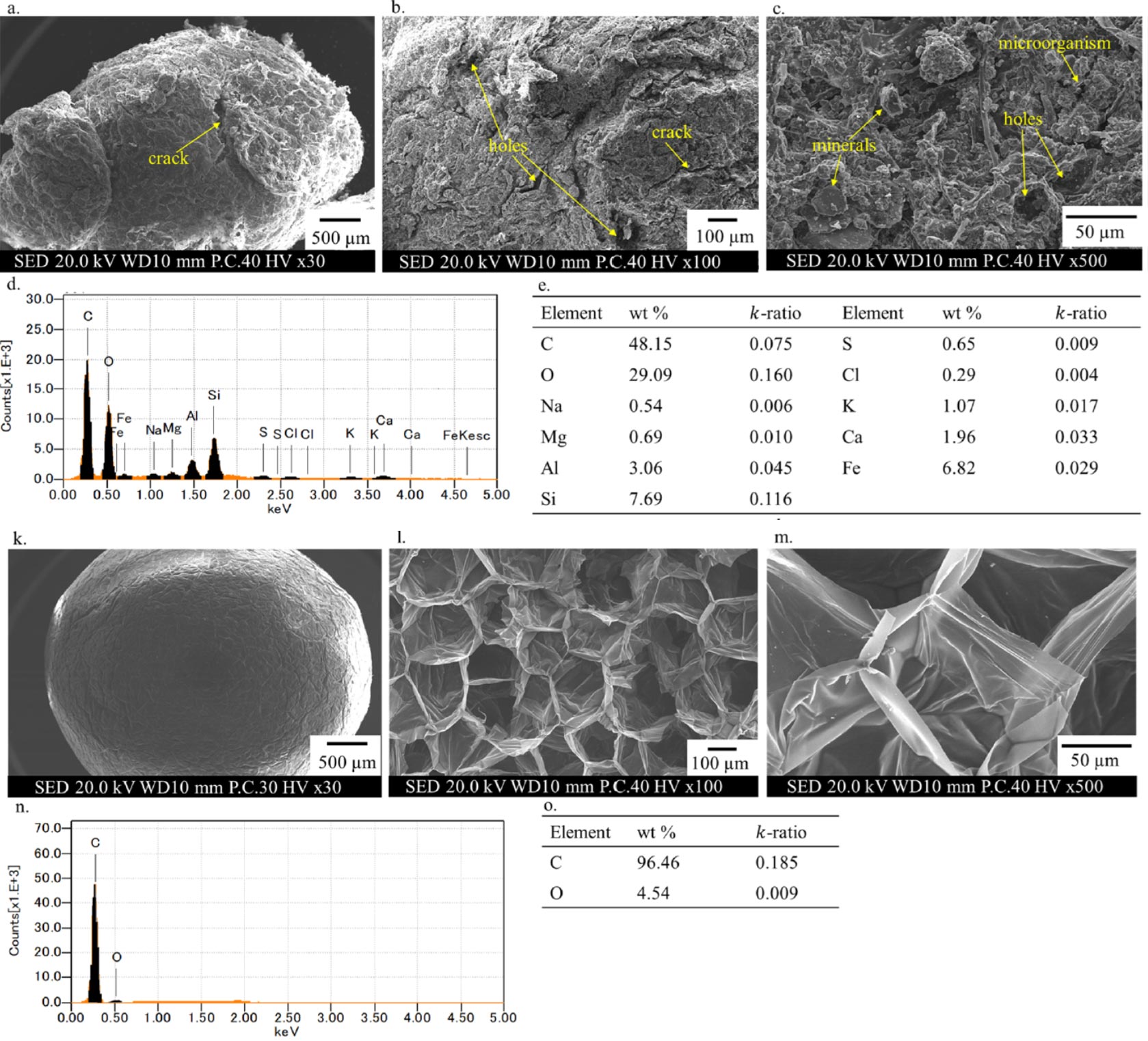
    Plastic Debris and What They Accumulate
    (a-c) and (k-m) show polystyrene foam particles collected from the environment and as manufactured, respectively, imaged at different magnifications using scanning electron microscopy (SEM). (d-e) and (n-o) show the composition of the same two types of particles, as found from energy-dispersive X-ray spectroscopy. Credit: Tokyo Metropolitan University

    A team led by Dr. Batdulam Battulga, an affiliated researcher of the Department of Geography of Tokyo Metropolitan University now in the Japan Atomic Energy Agency, and Professor Masayuki Kawahigashi from Tokyo Metropolitan University have been examining the properties of polystyrene foam particles collected at various locations along the Tuul River running through Ulaanbaatar, Mongolia. Due to the continued development of the capital city, plastic waste arising from construction materials has become ubiquitous in the environment, particularly polystyrene foam used in insulation. The tiny fragments were subjected to a range of diagnostics to ascertain how they had changed, and what they now contained. They found a range of metallic contaminants that are not present in the original material, particularly large amounts of copper and chromium. Strong signals were found for metals associated with specific land uses or industries in the city, such as chemicals used in glass and ceramic manufacture and pollutant-enriched sediments from wastewater treatment plants.

    They also looked in detail at the physical properties of the particles themselves. Scanning electron microscopy (SEM) images of the particles showed that exposure to the environment had significantly changed the surface properties of the particles, creating fractures, holes, and pits. Many of the images also showed mineral crystal particles, showing how the roughened surface could become home to inorganic pollutants absorbed from the environment. They also found traces of biofilms, layers of bacteria that adhere to surfaces. Such films are known to develop electric charges and chemical groups on their surfaces which can effectively absorb metallic contaminants. Combined with the stronger accumulation of metals in meso-sized (5-20mm) particles than in micro-sized (<5mm) particles, the team concluded that these surface features played a key role in the collection of heavy metals on plastic debris.

    Through insights into the mechanism by which metals are adsorbed onto plastic fragments, the team hopes to get to grips with the scope of the impact of plastic pollutants in our environment, and the hidden dangers they might pose.

    Reference: “Plastic-associated metal(loid)s in the urban river environments of Mongolia” by Batdulam Battulga, Mariko Atarashi-Andoh, Jun Koarashi, Bolormaa Oyuntsetseg and Masayuki Kawahigashi, 6 June 2023, Ecotoxicology and Environmental Safety.
    DOI: 10.1016/j.ecoenv.2023.115100

    This work was supported by a Tokyo Metropolitan Government Advanced Research Grant, Grant Number R4-2

    Never miss a breakthrough: Join the SciTechDaily newsletter.
    Follow us on Google and Google News.

    Microplastics Plastic Pollution Tokyo Metropolitan University
    Share. Facebook Twitter Pinterest LinkedIn Email Reddit

    Related Articles

    Microplastics Are Leaking Invisible Chemical Clouds Into Rivers and Oceans

    Scientists Develop Plastic Substitute That Could Fight Ocean Pollution

    How Everyday Plastics Quietly Turn Into DNA-Damaging Nanoparticles

    Could Plastic-Eating Bugs Be the Key to Solving Our Microplastic Problem?

    Goodbye Microplastics: New Recyclable Plastic Breaks Down Safely in Seawater

    New Plant-Based Plastic Releases 9 Times Less Microplastics

    Unseen Hazard: The Invisible World of Plastics and Oligomers in Your Laundry

    Science Made Simple: What Are Microplastics?

    How Is It Raining Plastic?! [Video]

    Leave A Reply Cancel Reply

    • Facebook
    • Twitter
    • Pinterest
    • YouTube

    Don't Miss a Discovery

    Subscribe for the Latest in Science & Tech!

    Trending News

    289-Million-Year-Old Reptile Mummy Reveals Origin of Human Breathing System

    New Brain Discovery Challenges Long-Held Theory of Teenage Brain Development

    Scientists Discover Plants “Scream” – We Just Couldn’t Hear Them Until Now

    Scientists Discover a Surprising Reason Intermittent Fasting Extends Life

    This Simple Fruit Wash Could Make Produce Safer and Last Days Longer

    Scientists Say Adding This Unusual Seafood to Your Diet Could Reverse Signs of Aging

    Scientists Say a Hidden Structure May Exist Inside Earth’s Core

    Doctors Surprised by the Power of a Simple Drug Against Colon Cancer

    Follow SciTechDaily
    • Facebook
    • Twitter
    • YouTube
    • Pinterest
    • Newsletter
    • RSS
    SciTech News
    • Biology News
    • Chemistry News
    • Earth News
    • Health News
    • Physics News
    • Science News
    • Space News
    • Technology News
    Recent Posts
    • Missing Medieval Relic of Legendary English King Found After Being Missing for 40 Years
    • New Study Challenges Long-Held Assumptions About Cancer and Aging
    • Major Review Finds Alzheimer’s Amyloid Drugs Offer No Real Benefit
    • Could This New Weight-Loss Pill Disrupt the Entire Market? Here’s What You Should Know About Orforglipron
    • Nearly 1 in 5 Gray Whales That Enter San Francisco Bay Die There
    Copyright © 1998 - 2026 SciTechDaily. All Rights Reserved.
    • Science News
    • About
    • Contact
    • Editorial Board
    • Privacy Policy
    • Terms of Use

    Type above and press Enter to search. Press Esc to cancel.