
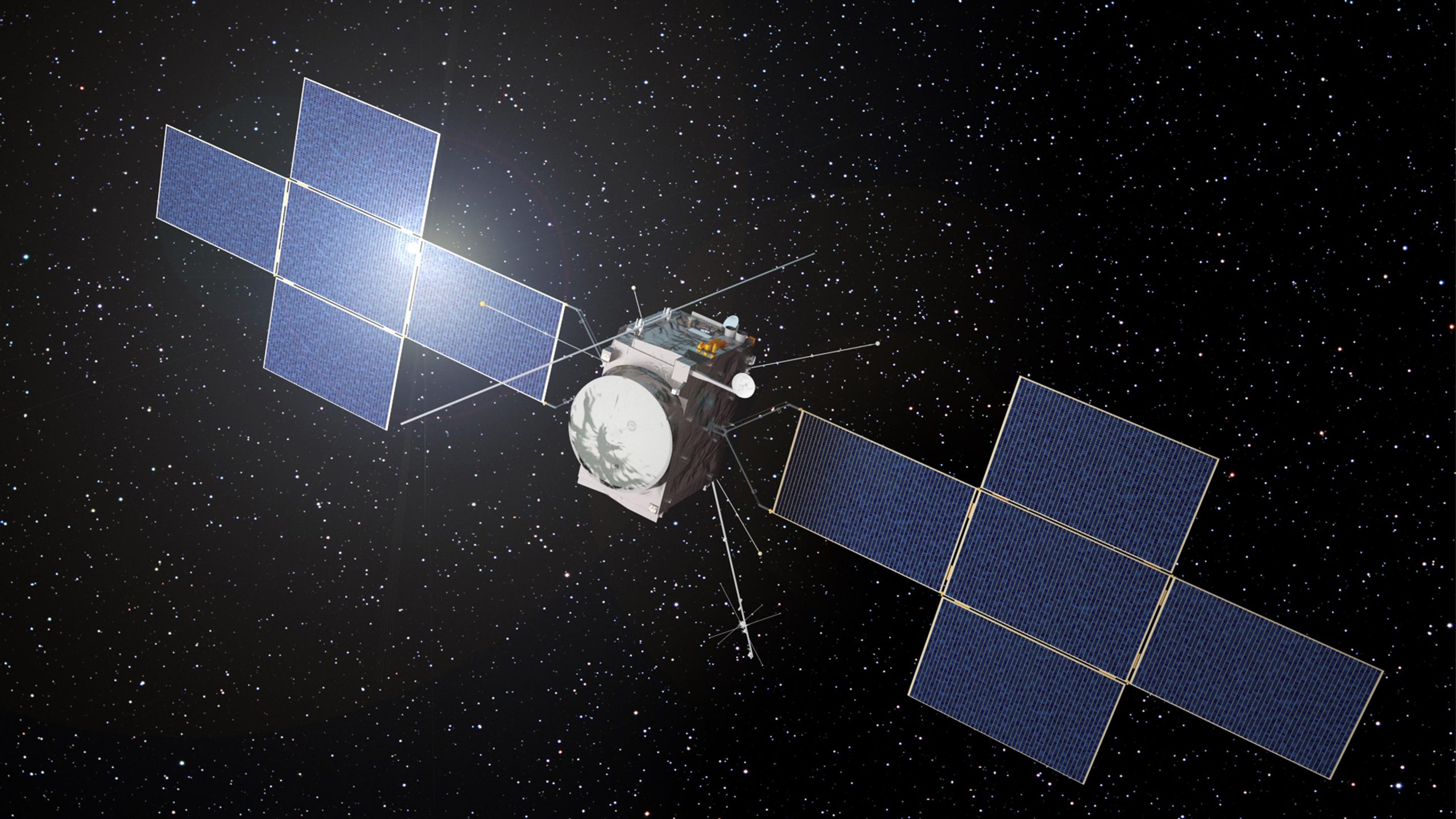
The Southwest Research Institute’s Ultraviolet Spectrograph (UVS), part of the ESA’s Jupiter Icy Moons Explorer (JUICE) spacecraft, has successfully completed its initial testing. UVS will study Jupiter’s icy moons, with a focus on Ganymede’s potential habitability, during an eight-year mission to the Jupiter system.
The Southwest Research Institute-led Ultraviolet Spectrograph (UVS) aboard ESA’s Jupiter Icy Moons Explorer (JUICE) spacecraft has successfully completed its initial commissioning following the April 14 launch. The UVS instrument is one of three instrument projects comprising NASA’s contribution to the JUICE mission. The mission’s science goals focus on Jupiter and its system, making multiple flybys of the planet’s large, ocean-bearing satellites with a particular emphasis on investigating Ganymede as a potentially habitable planetary body.
UVS is one of 10 science instruments and 11 investigations for the JUICE spacecraft. The mission has overarching goals of investigating potentially habitable worlds around the gas giant and studying the Jupiter system as an archetype for gas giants in our solar system and beyond. As it begins a roundabout 4.1-billion-mile (6.6-billion-kilometer), eight-year journey to the Jupiter system, the spacecraft has been busy deploying and activating its antennas, booms, sensors, and instruments to check out and commission all its important subsystems. SwRI’s UVS instrument is the latest to succeed in this task.

“Our team of SwRI scientists traveled to Darmstadt, Germany, to put JUICE-UVS through its paces,” said Dr. Randy Gladstone, JUICE-UVS principal investigator. “On June 20, we opened the UVS aperture door to collect UV light from space for the first time. Soon after, we observed a swath of the sky to verify the instrument was performing well.”
The team imaged a segment of this data, as the instrument scanned a swath of the Milky Way.
SwRI has provided ultraviolet spectrographs for other spacecraft, including ESA’s Rosetta comet orbiter, as well as NASA’s New Horizons mission to Pluto, Lunar Reconnaissance Orbiter mission in orbit around the Moon, and Juno mission to Jupiter.
An Advanced Ultraviolet Spectrograph
“JUICE-UVS is the fifth in this series, and it benefits greatly from the design experience gained by our team from the Juno-UVS instrument, launched in 2011, as it pertains to operating in Jupiter’s harsh radiation environment,” said Steven Persyn, program manager for UVS. “Each successive instrument we build is more capable than its predecessor.”
Weighing just over 40 pounds (18 kilograms) and drawing only 7.5 watts of power, UVS is smaller than a microwave oven, yet this powerful instrument will determine the relative concentrations of various elements and molecules in the atmospheres of Jupiter’s moons once in the Jovian system. A similar instrument, Europa-UVS, will launch in 2024 aboard NASA’s Europa Clipper, which will take a more direct route to arrive at the Jupiter system 15 months before JUICE and focus on studying the potential habitability of Europa.
“Having two UVS instruments making measurements in the Jupiter system at roughly the same time will offer exciting complementary science possibilities,” said Dr. Kurt Retherford, principal investigator of Europa-UVS and deputy PI for JUICE-UVS.
Investigating Jupiter’s Moons and Magnetosphere
Aboard JUICE, UVS will get close-up views of the Galilean moons Europa, Ganymede and Callisto, all thought to host liquid water beneath their icy surfaces. UVS will record ultraviolet light emitted, transmitted and reflected by these bodies, revealing the composition of their surfaces and tenuous atmospheres and how they interact with Jupiter and its giant magnetosphere. Additional scientific goals include observations of Jupiter itself as well as the gases from its volcanic moon Io that spread throughout the Jovian magnetosphere.
JUICE is the first large-class mission in ESA’s Cosmic Vision 2015–2025 program. The spacecraft and science instruments were built by teams from 15 European countries, Japan and the United States. SwRI’s UVS instrument team includes additional scientists from the University of Colorado Boulder, the SETI institute, the University of Leicester (U.K.), Imperial College London (U.K.), the University of Liège (Belgium), the Royal Institute of Technology (Sweden) and the Laboratoire Atmosphères, Milieux, Observations Spatiales (France). The Planetary Missions Program Office at NASA’s Marshall Space Flight Center oversees the UVS contribution to ESA through the agency’s Solar System Exploration Program. The JUICE spacecraft was developed by Airbus Defence and Space.
Never miss a breakthrough: Join the SciTechDaily newsletter.
Follow us on Google and Google News.