
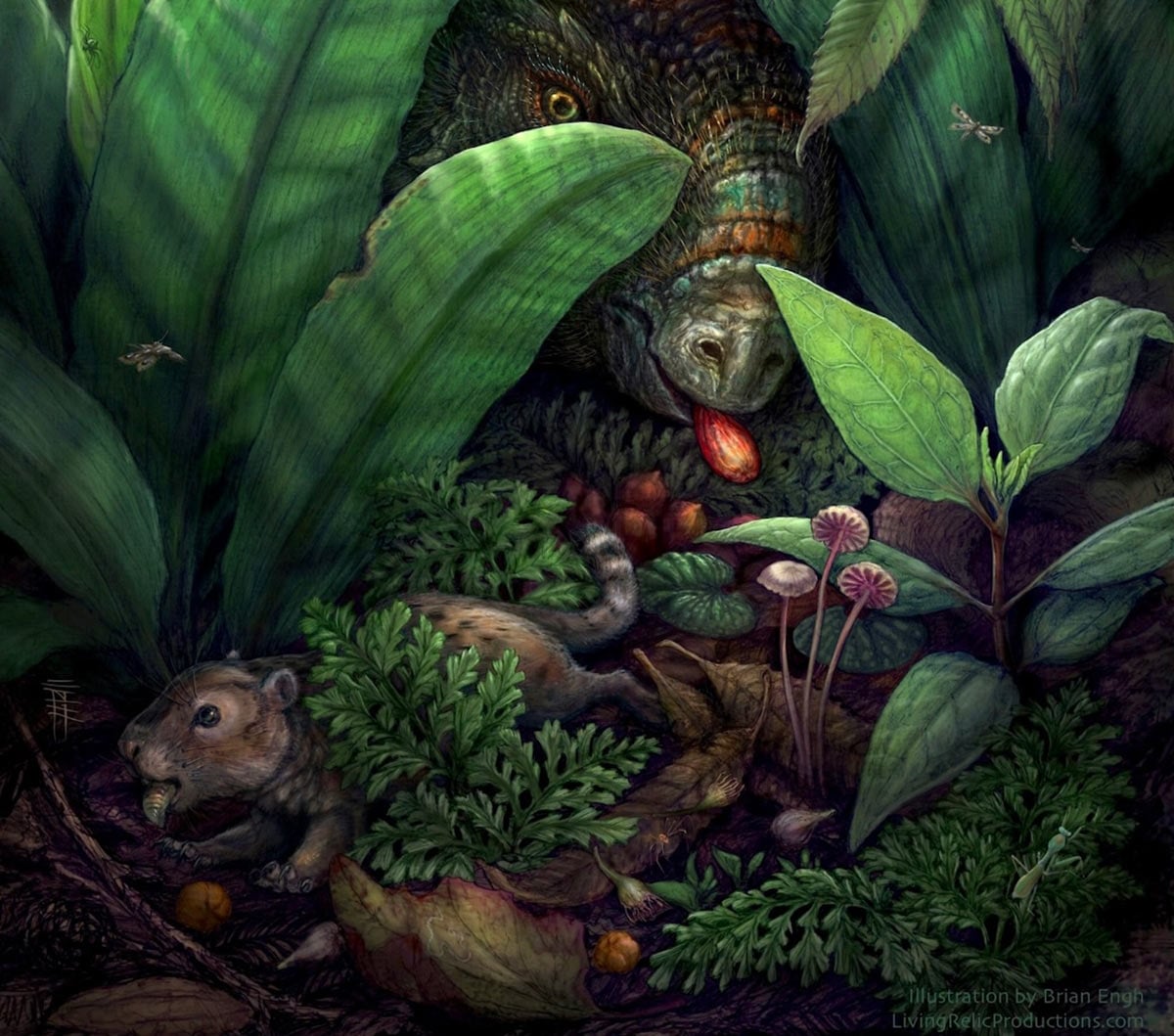
An exceptionally preserved 74-million-year-old forest in New Mexico is revealing unexpected details about ancient plant life.
Dinosaurs may have been eating a much wider variety of fruits than scientists once believed. Fossils from a 74-million-year-old forest in New Mexico show that some flowering plants were already producing surprisingly large fruits millions of years before the asteroid impact that ended the age of non-avian dinosaurs.
The findings, published in the journal Science, challenge the longstanding theory that larger fruits and more complex seed dispersal strategies evolved primarily after the extinction event 66 million years ago. They also suggest that dinosaurs and other prehistoric animals may have helped spread the seeds of flowering plants much earlier than previously thought.
A Prehistoric Forest Preserved in Volcanic Ash
The research centers on an exceptionally preserved fossil forest near Truth or Consequences, New Mexico. James Saulsbury, a postdoctoral researcher at the University of Kansas Biodiversity Institute and Natural History Museum, helped collect, classify, and analyze the plant fossils discovered there.
“This paper focuses on a fossil forest in New Mexico and the preserved fruits, seeds and other reproductive structures of the plants that lived there,” Saulsbury said. “These fossils change how we understand the way flowering plants became modern in terms of their reproductive ecology.”
The forest was buried beneath volcanic ash that eventually hardened into rock. The preserved deposit stretches more than a kilometer (about 0.6 miles), capturing plants from approximately the same period and retaining evidence of how they were arranged across the ancient landscape.
“The New Mexico fossil site is exceptional,” Saulsbury said. “My co-authors have referred to it as a ‘botanical Pompeii’ because of its remarkable preservation. The site contains a layer of volcanic ash preserved as rock, known as tuff, that stretches for more than a kilometer. The deposits formed at essentially the same time, preserving many plants where they lived and died. It provides a snapshot of a forest from about 74 million years ago and even preserves aspects of its spatial arrangement.”
Ancient Fruits Challenge a Longstanding Theory
Flowering plants first appeared approximately 136 million years ago, but researchers have traditionally believed that their reproductive strategies remained relatively simple throughout much of the Cretaceous Period. Early flowering plants generally produced small seeds and fruits, with wind and other non-animal mechanisms thought to play major roles in seed dispersal.
“For much of their early history, they were relatively small, weedy plants that did not dominate forest canopies,” Saulsbury said. “Although they gradually diversified and occupied more ecological niches, it was thought their seeds and dispersal structures remained small and were primarily dispersed by wind or without fleshy fruit.”
Many early flowering plant seeds were thought to have ranged from dust-sized particles to roughly the size of poppy seeds. By contrast, the New Mexico fossils include fruits approximately as large as modern grapes. Such fruits are much larger than those previously expected from flowering plants of that age.
“The prevailing view has been that this more diverse reproductive ecology emerged only after the end-Cretaceous extinction,” Saulsbury said. “Our study suggests that transition began much earlier. The largest fruits in our fossil flora are about the size of a grape. That may not sound especially large today, but it is remarkably large for flowering plants of that period.”
Hundreds of Fossils Reveal an Unusual Ancient Ecosystem
The team examined hundreds of fossilized seeds, sorting them according to their physical characteristics. Because fossil material often lacks the features necessary to identify an exact species, researchers organized specimens into groups based on their shapes and structures.
“We sorted hundreds of fossil seeds into what we call morphotypes,” Saulsbury said. “These are groupings based on form rather than confirmed species because it is often impossible to determine whether similar-looking fossils represent one species or several.”
The fossil assemblage contains an unusual diversity of fruits, seeds, and reproductive structures. Although the exceptional preservation helped researchers recover this material, Saulsbury believes the forest itself differed from many other known Cretaceous environments.
“However, we don’t believe these findings are simply the result of preservation bias,” he said. “It appears to represent a genuinely unusual forest.”
How Fruit Size Connects to Ancient Forests
Fruit size can provide information about the environments in which plants evolved and how their seeds may have spread. Today, many flowering plants produce fleshy fruits that attract animals, which can transport seeds away from the parent plant after eating the fruit.
“Large fruits tend to occur in moist environments with densely packed forests,” Saulsbury said. “Our findings indicate that modern-looking forest structure and reproductive ecology were developing earlier than previously believed. The diversification of flowering plant reproductive strategies did not have to wait until after the end-of-Cretaceous extinction.”
The discovery also complicates an established explanation for the evolution of fruit-bearing plants. Scientists had proposed that large, fleshy fruits became more widespread as mammals diversified following the extinction of non-avian dinosaurs, creating new opportunities for plants to disperse their seeds through animals.
“As mammals expanded into newly available ecological niches, flowering plants were thought to have diversified their seed dispersal strategies in response,” Saulsbury said. “Our findings suggest that story began earlier. If diverse, large fruits already existed in Cretaceous forests, they were likely being dispersed not only by early mammals but also by large dinosaurs and other animals.”
Reference: “Diversification of angiosperm reproductive strategies predated the end-Cretaceous extinction” by Jaemin Lee, Dori L. Contreras, James G. Saulsbury, Garland R. Upchurch and Cindy V. Looy, 25 June 2026, Science.
DOI: 10.1126/science.adw9457
Never miss a breakthrough: Join the SciTechDaily newsletter.
Follow us on Google and Google News.