
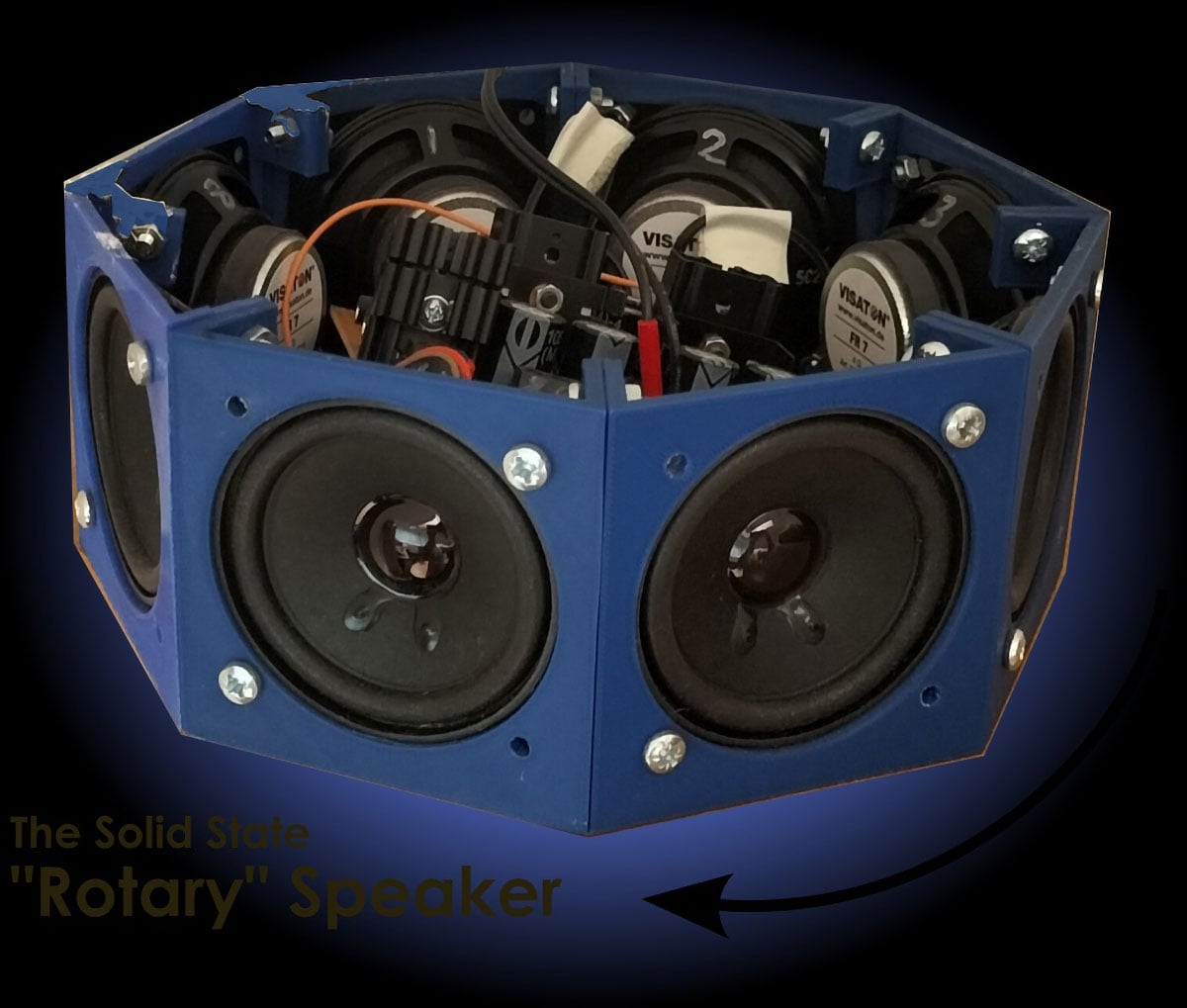
Researchers have demonstrated a solid-state approach to sound modulation that electronically creates the acoustic sensation of a moving sound source.
A new speaker system developed at the University of Nottingham creates audio effects by manipulating sound waves around the listener rather than modifying only the electronic signal. The solid-state design recreates aspects of a classic rotary speaker without motors, belts, or other moving components, offering a new approach that sits between mechanical and digital audio effects.
Researchers in the university’s Faculty of Engineering built the system from a circular array of speakers. Instead of physically rotating a horn or other sound source, the device electronically shifts the audio signal around the array, producing the acoustic impression of movement. The work has been published in the Journal of the Audio Engineering Society.
Moving the Sound, Not Just the Signal
Most electronic and digital audio effects alter a signal before it reaches a speaker. The Nottingham system takes a different approach. Its phase modulation occurs through the physical sound waves approaching and surrounding the listener, rather than solely within an electronic signal sent to a single loudspeaker.
The concept was inspired by the Leslie speaker (the Leslie speaker), an electromechanical system developed in the 1930s for electric organs. Traditional Leslie speakers use motors and belts to rotate horns and baffles, changing how sound reaches the listener and creating characteristic modulation through physical motion.
Recreating a Classic Effect Without Moving Parts
The Leslie sound became deeply embedded in popular music and has since inspired numerous electronic, digital, and software emulations (phasers, chorus, etc). These systems can reproduce aspects of the effect by electronically altering an audio signal, but they do not physically move the sound source through space in the way the original mechanism does.
The Nottingham prototype is designed to reproduce more of that spatial behavior without the mechanical complexity of a traditional rotary speaker. Because the apparent movement is generated across an array of stationary speakers, the researchers describe the system as a solid-state “rotary” speaker.
Blurring the Boundary Between Mechanical and Digital Audio
Fernando Perez-Cota, Assistant Professor in the Department of Electrical and Electronic Engineering, said the approach occupies a largely unexplored area between conventional acoustic and electronic effects. “Sound modulation for music application is either acoustic-mechanical like the original Leslie, or electronic-digital – there is no in-between. This work represents the first attempt to blur this boundary.”
The researchers see the prototype as more than a replacement for the Leslie speaker, viewing it as a broader platform for manipulating sound in physical space. Different signal patterns across the speaker array could potentially produce forms of modulation that are difficult to achieve with either conventional moving hardware or standard digital processing.
A New Direction for Music Production
Nicholas Wolstenholme, a Masters Engineering student who developed the prototype, said the same principle could extend beyond recreating established rotary effects. “We believe this concept can not only be used to achieve sound modulation like the Leslie speaker but also represents a completely new paradigm in sound effects and sound modulation with new possibilities. It has the potential to offer high-quality sound effects at a cost and scale accessible to anyone making music.”
Reference: “The Solid-State “Rotary” Speaker” by Nicholas Wolstenholme and Fernando Perez-Cota, 16 September 2026, Journal of the Audio Engineering Society.
DOI: 10.17743/jaes.2026.0285
Never miss a breakthrough: Join the SciTechDaily newsletter.
Follow us on Google and Google News.
4 Comments
I designed a very similar system in the 1970’s . In Michigan USA.
I was going to mention that theater techies have been doing this for decades now. It is a staple tool of the theater sound industry. The Indiana Jones show in Florida was a particularly fun demonstration of it. The big rolling boulder ball had the sound it made, over the many speakers, track the ball adding to the gag’s effect. But, it was far from being the first such use. To the Masters student, it was a good idea you had, so good many others had it decades ago. Jump on your advisor for not knowing this, pass along these messages of shame.
{^_^}
Core Concept: Bypassing the Underwater Barrier
The Problem: Conventional radio frequency (RF) waves suffer heavy attenuation in water, while traditional acoustic systems (like standard sonar) are slow, low-bandwidth, and vulnerable to multi-path interference.
The Solution: Applying the Torsion Hill Framework to utilize a Traveling Bubble (localized rotational boundary layer) around signal carriers. This decouples transmissions from hydrodynamic drag and spatial impedance, allowing high-speed data transmission without brute-force power.
Bio-Inspiration & Signal Mechanics
Nature’s Model: Whale communication—specifically the click patterns and rhythmic “codas” used by toothed whales—serves as the ideal template for digital pulse coding.
Discrete Wave-Knots: Instead of continuous waves, transmissions use ultra-short, high-frequency rotational pulses (“clicks”) that create sharp temporal boundaries and drop local impedance (Delta Z -> 0), allowing signals to slip cleanly through the water matrix.
Scaling the Torsional Frequency Bands
Macro-Rotational Low-Band (Hz to Low kHz): Analogous to whale infrasound; built for long-range, basin-scale communication and deep-water penetration.
Mid-Range Torsional Band (Megahertz): Balanced for regional navigation, tactical telemetry, and mid-distance data exchange with moderate boundary decoupling.
Ultra-High Frequency / Attosecond Band (Gigahertz to Terahertz): Analogous to high-speed data streaming; synchronizes with molecular oscillation rates to achieve near-zero impedance (Delta Z -> 0) for real-time, high-bandwidth communication.
Full Voice Synthesis and Symmetrical Transceivers
Full-Duplex Communication: True two-way communication requires a symmetrical transceiver architecture where every unit features a compatible transition module to swap seamlessly between transmitting and receiving.
Voice Pattern Mimicry: By dynamically shifting internal rotational phase geometry (Omega_pi) and local temporal gradient impedance (Z_T) in real-time sync with an audio input, the system encodes and decodes full voice overtones, amplitude, and harmonic frequencies without bandwidth congestion.
Prototype Test-Bench Specifications
To prove the theory in a controlled environment (pool, tank, or pond) at a manageable scale, a two-unit prototype is structured as follows:
Submersible Probe (Emitter-Sensor Head): Approximately 6 to 8 inches long and 2 to 3 inches in diameter, housing the solid-state elements that generate rotational pulses and establish the micro-boundary layer (Z_T) underwater.
Control and Processing Unit (Surface/Dry Housing): Housed in a portable field case (approximately 12 x 10 x 6 inches), containing the power supply, signal generation boards, and transition module logic (Omega_pi) to encode/decode audio and click codes. The full Torsion hill advanced physics reference link :https://docs.google.com/document/d/1TYml7QS-Ngr2_iIolOnUl7ab558IeMji9njzU1THSNo/edit?usp=drive_link
Reference link specific to the article : https://docs.google.com/document/d/14NK9oDN5gJZjbbVotnxSqvyNaMYz-LEky3FGKkmKJVA/edit?usp=drive_link