
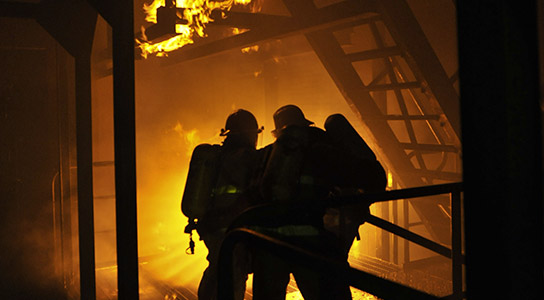
Working on innovative approaches to firefighting, DARPA has been exploring technologies to manipulate and extinguish flames using physics. They were able to suppress fire using electromagnetic and acoustic waves that interact with the plasma of the flames, instead of the traditional approach of interfering with chemical reactions used in combustion.
Fire in enclosed military environments such as ship holds, aircraft cockpits, and ground vehicles is a major cause of material destruction and jeopardizes the lives of warfighters. For example, a shipboard fire on the aircraft carrier USS George Washington in May 2008 burned for 12 hours and caused an estimated $70 million in damage. For nearly 50 years, despite the severity of the threat from fire, no new methods for extinguishing or manipulating fire were developed. In 2008, DARPA launched the Instant Fire Suppression (IFS) program to develop a fundamental understanding of fire with the aim of transforming approaches to firefighting.
Traditional fire-suppression technologies focus largely on disrupting the chemical reactions involved in combustion. However, from a physics perspective, flames are cold plasmas. DARPA theorized that by using physics techniques rather than combustion chemistry, it might be possible to manipulate and extinguish flames. To achieve this, new research was required to understand and quantify the interaction of electromagnetic and acoustic waves with the plasma in a flame.
The IFS program was executed in two phases. In Phase I, performers studied the fundamental science behind flame suppression and control, exploring a range of approaches before down-selecting to electromagnetics and acoustics. In Phase II, performers determined the mechanisms behind electric and acoustic suppression and evaluated the scalability of these approaches for defense applications.
One of the technologies explored was a novel flame-suppression system that used a handheld electrode to suppress small methane gas and liquid fuel fires. In the video below, performers sweep the electrode over the ignited burner array and progressively extinguish the 10-cm2 (1.6-in²) gas flame. Since the electrode is sheathed in ceramic glass, no current is established between the electrode and its surroundings. A visualization of gas flows during the suppression would show that the oscillating field induces a rapid series of jets that displace the combustion zone from the fuel source, leading to extinguishment of the fire. Put simply, the electric field creates an ionic wind that blows out the flame. This same approach was not able to suppress a small heptane pool flame.
Performers also evaluated the use of acoustic fields to suppress flames. In the video below, a flame is extinguished by an acoustic field generated by speakers on either side of the pool of fuel. Two dynamics are at play in this approach. First, the acoustic field increases the air velocity. As the velocity goes up, the flame boundary layer, where combustion occurs, thins, making it easier to disrupt the flame. Second, by disturbing the pool surface, the acoustic field leads to higher fuel vaporization, which widens the flame, but also drops the overall flame temperature. Combustion is disrupted as the same amount of heat is spread over a larger area. Essentially, in this demonstration, the performers used speakers to blast sound at specific frequencies that extinguish the flame.
IFS Phase II was completed in December 2011. IFS performers succeeded in demonstrating the ability to suppress, extinguish and manipulate small flames locally using electric and acoustic suppression techniques. However, it was not clear from the research how to effectively scale these approaches to the levels required for defense applications.
Remarking on the overall impact of the IFS program, Matthew Goodman, DARPA program manager, said, “We have shown that the physics of combustion still has surprises in store for us. Perhaps these results will spur new ideas and applications in combustion research.”
For example, the data collected by the IFS program could potentially be applied to the inverse challenge of fire extinguishment, namely increasing the efficiency of combustion. Such technology could be especially beneficial to defense technologies that employ small engines.
Never miss a breakthrough: Join the SciTechDaily newsletter.
Follow us on Google and Google News.