
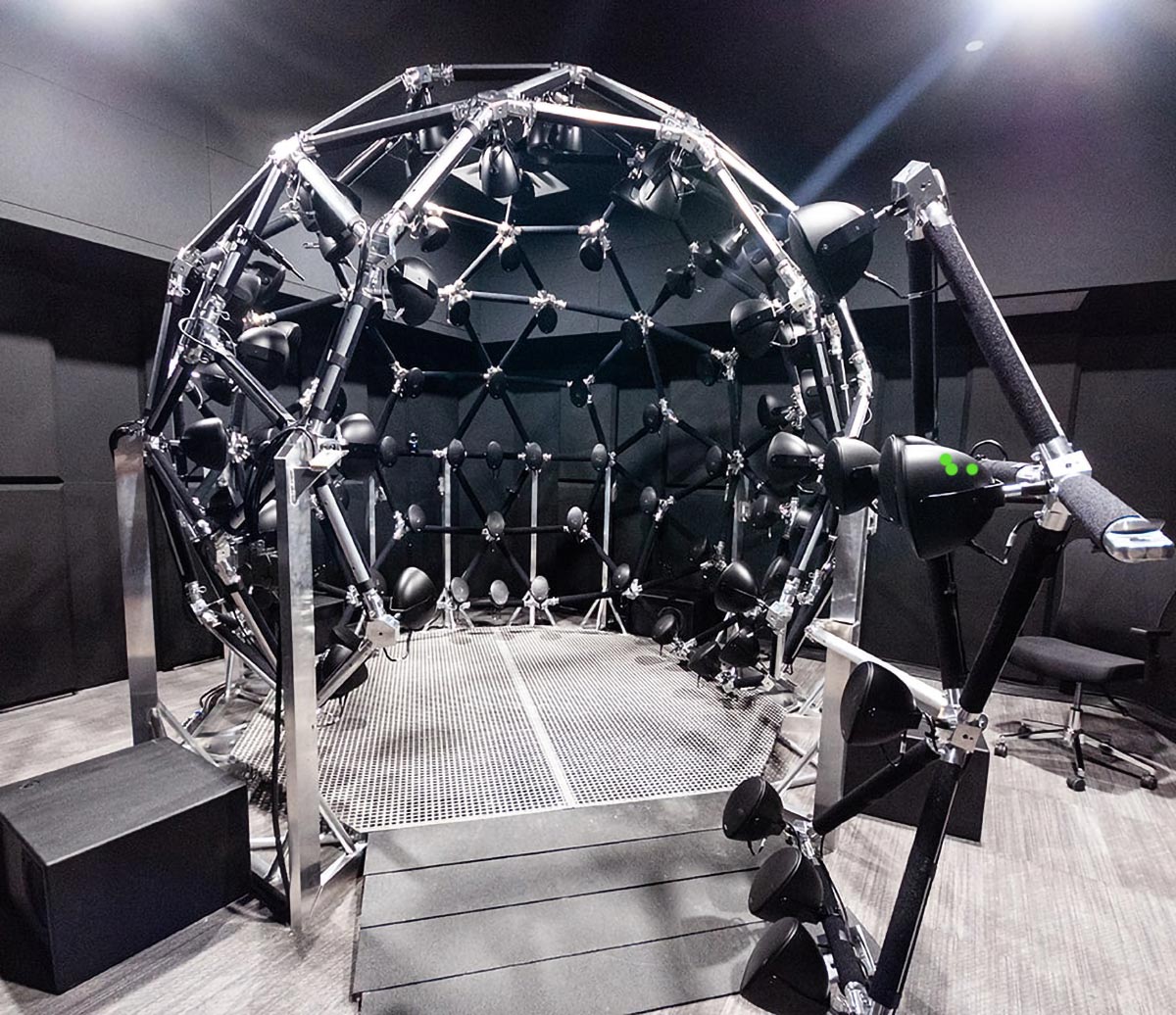
The Ambisonics algorithm generates immersive virtual soundscapes by utilizing a dome-shaped array of loudspeakers.
Surround-sound systems can enhance a multimedia experience, but imagine a speaker setup capable of fully recreating a three-dimensional sound environment.
Enter the AudioDome — not just a speaker array, but a dome-shaped structure designed to deliver immersive, 360-degree sound. When a listener sits at the center, the system can accurately reproduce the position and movement of sound sources from any direction.
In a study published in The Journal of the Acoustical Society of America, researchers from Western University in London, Ontario, explored the capabilities of ambisonic sound reproduction using their custom-built AudioDome array.
Ambisonic rendering is a way to simulate the precise locations of sounds in 3D, using an array of loudspeakers. The ambisonics algorithm has allowed researchers to create rich virtual “soundscapes,” with each sound appearing to come from precisely the location it occurred in the recording.
“The ambisonics technology promises highly focal sound source reproduction which is enormously valuable to researchers wishing to maintain tight experimental control while also studying human auditory spatial perception in the type of complex, dynamic, three-dimensional soundscapes that the auditory system evolved to handle,” said researcher Nima Zargarnezhad.
Validating Sound Perception in the AudioDome
However, whether the ambisonics algorithm that the AudioDome uses to simulate soundscapes is appropriate for studying human perception is unknown. It depends on how precisely and focally it can simulate sound location, and how well it can reproduce the energy composition of sounds. Since Zargarnezhad’s team is interested in performing human experiments using the setup, they wanted to validate the effectiveness of the AudioDome’s ambisonics technology to simulate real life.
“We already knew that some reconstruction errors were theoretically predicted and confirmed with simulations, but we did not know how and to what extent they would affect human perception of sound location and identity,” Zargarnezhad said.
Human-Like Spatial Acuity in Reproduced Sound
Our ability to distinguish between stimuli in different locations, known as spatial acuity, is high in front of our faces but decreases around the sides of our head. The researchers’ experiments obtained very similar results from listeners in the AudioDome, proving that the loudspeaker array can reproduce sound locations at a spatial scale beyond the human limits of perception.
They also found that the accuracy and precision of a sound’s simulated location doesn’t depend on how far it is from an actual speaker location, which suggests that the spatial resolution of the ambisonics algorithm is appropriate for studying human perception nearly everywhere in three-dimensional space. However, they also observed that the ambisonics algorithm accurately reproduced sound energy up to about 4 kilohertz in frequency, sufficient to reproduce speech although it would sound somewhat degraded, as though heard over a telephone. They showed that the erroneous reproduction of higher frequencies fakes localization cues related to the perception of sound sources’ elevation, and sound sources with high frequency components are perceived from an unexpected altitude.
“We conclude that the ambisonics algorithm can accurately reproduce the identity and location of many common sounds, including speech, at a spatial resolution that is at the level of human spatial acuity, if not better,” said Zargarnezhad. “This is sufficient to ensure the reproduced soundscapes are accurately simulating the real world.”
Reference: “Focality of sound source placement by higher (ninth) order ambisonics and perceptual effects of spectral reproduction errors” by Nima Zargarnezhad, Bruno Mesquita, Ewan A Macpherson and Ingrid Johnsrude, 15 April 2025, The Journal of the Acoustical Society of America.
DOI: 10.1121/10.0036226
Never miss a breakthrough: Join the SciTechDaily newsletter.
Follow us on Google and Google News.
3 Comments
Or I can just use my free ears
Ears make lousy loudspeakers, although with a little work one might attach speaker-coils to the eardrum.
The low-frequency output would still be suboptimal.
thank you for the last information