
Close Menu
    Facebook X (Twitter) Instagram
    SciTechDaily
    • Biology
    • Chemistry
    • Earth
    • Health
    • Physics
    • Science
    • Space
    • Technology
    Facebook X (Twitter) Pinterest YouTube RSS
    SciTechDaily
    Home»Technology»A Recipe for 3D-Printing Food: Additive Manufacturing of Edible Materials
    Technology

    A Recipe for 3D-Printing Food: Additive Manufacturing of Edible Materials

    By American Institute of PhysicsMarch 22, 2023No Comments3 Mins Read
    Facebook Twitter Pinterest Telegram LinkedIn WhatsApp Email Reddit
    Share
    Facebook Twitter LinkedIn Pinterest Telegram Email Reddit
    3D Printing Food Concept
    Researchers at the University of Ottawa have identified factors that influence the quality and complexity of 3D-printed food. Published in Physics of Fluids, the study highlights the importance of considering these factors for better quality, control, and efficiency in additive manufacturing of edible materials. This could potentially help address global food supply and nutrition challenges.

    Researchers identify factors affecting the quality of edible materials produced by additive manufacturing.

    3D-printing food could address global challenges in food supply and nutrition. But there are hurdles involved in adapting additive manufacturing to produce edible materials.

    In the journal Physics of Fluids, from AIP Publishing, University of Ottawa researchers Ezgi Pulatsu and Chibuike Udenigwe identify a range of factors that affect the print quality and shape complexity of food created with additive manufacturing. Accounting for these features can increase food quality, improve control, and speed up printing.

    Additive manufacturing of food involves designing (3D shapes and their geometric codes), pre-processing (food ink preparation), manufacturing (deposition of layers to create shapes), and post-processing (baking, boiling, cooking, freezing, frying, or drying). Each step is an opportunity to create innovative foods.

    Factors Influencing Print Quality and Food Texture

    Changing the printing patterns and ingredients of the initial mix or paste can affect the food’s matrix and microstructures and therefore its texture.

    The flow of that mix in additive manufacturing is also crucial and is sometimes encouraged or discouraged by controlling ingredients and process conditions.
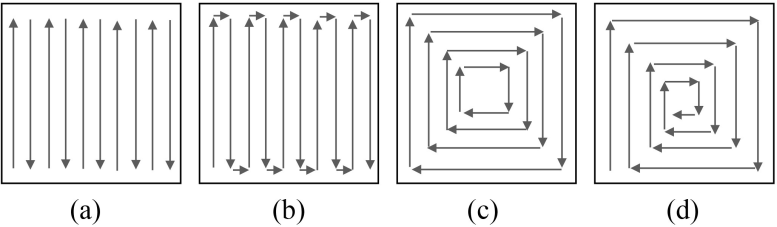
    Common Toolpath Patterns Used in Additive Manufacturing Technologies
    Common toolpath patterns used in additive manufacturing technologies: a) raster, b) zigzag, c) contour, and d) spiral. Credit: Ezgi Pulatsu and Chibuike Udenigwe

    “Extrusion-based 3D printing is the most applicable technique for food,” said Pulatsu. “It involves a syringe loaded with a food paste – such as puree, dough, or frosting – being forced out of a nozzle by direct (pushing the plunger) or indirect force (compressed air).”

    Creating a stable continuous flow is the first step to successful printing, so designed shapes can be produced by layering stringlike material in a controlled way.

    “Once a layer is deposited, we no longer want it to flow; otherwise, it will destroy the shape we created,” said Pulatsu.

    Post-Processing: Transforming Texture and Taste

    Post-processing – through baking, boiling, cooking, freezing, frying, or drying – physically and chemically transforms the food’s micro- and macromolecules and leads to various textures and tastes. At the same time, the shape should be conserved or carefully controlled.

    “We also have other mechanisms of creating food structures via different 3D-printing techniques,” Pulatsu said. “For example, material jetting uses liquid binders deposited on powder to form self-supporting layers, and liquid inks that harden after deposition can also be used.”

    One way to make additive manufacturing more efficient for the food industry is by establishing a printing path (a series of computer-controlled movements), which is often skipped for food applications.

    “Future studies should explore the cost efficiency of different technologies in terms of build time, where shape complexity and toolpath strategies – which involve the printing path, moving head speed, and nonprinting movements – are also considered,” said Pulatsu. “Food is essential to living, and it’s becoming more critical due to the increasing global population and environmental changes. Therefore, novel foods and matrices should be designed in consultation with chefs, food scientists, and engineers, and in line with current needs.”

    Reference: “Perspectives, analyses, and progress in additive manufacturing of food” by Ezgi Pulatsu and Chibuike Udenigwe, 21 March 2023, Physics of Fluids.
    DOI: 10.1063/5.0137328

    Never miss a breakthrough: Join the SciTechDaily newsletter.
    Follow us on Google and Google News.

    3D Printing American Institute of Physics Food Science
    Share. Facebook Twitter Pinterest LinkedIn Email Reddit

    Related Articles

    Fresh 3D-Printing Platform: Advanced Tissue Fabrication Paves Way for Bioprinting Tissues and Organs

    Bioengineers Use 3D Printer to Print Ears that Look and Act like Natural Ears

    3D Printing Using DNA Could Make Drugs

    NASA’s 3D Printing of Rocket Engine Parts Might Boost Larger Manufacturing Trend

    Japanese Super Cellophane Keeps Fruit Fresh for Months

    LiquiGlide Prevents Waste and Increases Recycling Rates

    Fiber Optic Probe Measures Carotenoids in the Skin

    Cost Effective Sensor Measures Fruits’ Ripeness

    3-D Printer Makes Custom Human Bones

    Leave A Reply Cancel Reply

    • Facebook
    • Twitter
    • Pinterest
    • YouTube

    Don't Miss a Discovery

    Subscribe for the Latest in Science & Tech!

    Trending News

    Beyond Pain Relief: Scientists Discover a Protein That Could Stop Osteoarthritis in Its Tracks

    Scientists Discover Why Alcohol Prevents the Liver From Healing, Even After You Quit

    Scientists Stunned As Volcano Removes Methane From the Air

    Scientists Discover Signs Africa May Be Splitting Apart Beneath Zambia

    Common Blood Pressure Drug Supercharges Cancer Treatment in Surprising New Study

    540-Million-Year-Old Fossils Reveal a Huge Surprise About Early Life on Earth

    Scientists Reverse Stroke Damage Using Stem Cells in Breakthrough Study

    Eating One Egg a Day Could Cut Alzheimer’s Risk by 27%

    Follow SciTechDaily
    • Facebook
    • Twitter
    • YouTube
    • Pinterest
    • Newsletter
    • RSS
    SciTech News
    • Biology News
    • Chemistry News
    • Earth News
    • Health News
    • Physics News
    • Science News
    • Space News
    • Technology News
    Recent Posts
    • Giant “Last Titan” Dinosaur Discovered in Thailand Was Bigger Than 9 Elephants
    • This “Longevity Gene” May Protect the Brain From Aging and Dementia
    • Scientists Discover Surprising Effect of Ultra-Processed Foods Inside Thigh Muscles
    • Common Cleaning Chemical Could Triple Your Risk of a Dangerous Liver Disease
    • New Brain “Bypass” Technology Could Transform Treatment for Neurological Disorders
    Copyright © 1998 - 2026 SciTechDaily. All Rights Reserved.
    • Science News
    • About
    • Contact
    • Editorial Board
    • Privacy Policy
    • Terms of Use

    Type above and press Enter to search. Press Esc to cancel.