
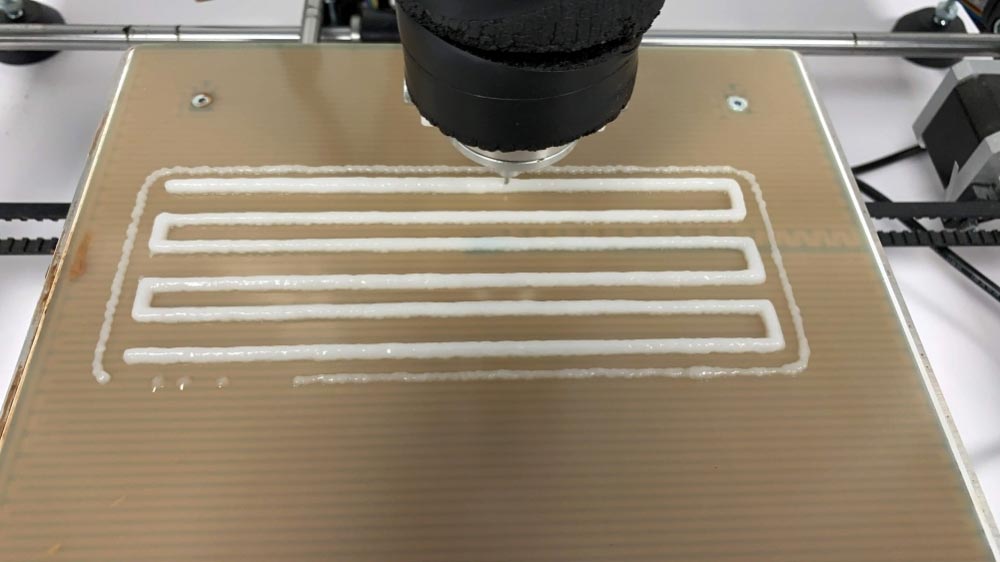
Food engineers in Brazil and France developed gels based on modified starch for use as “ink” to make foods and novel materials by additive manufacturing.
It is already possible to produce food with a 3D printer, potentially delivering products that suit consumer preferences regarding taste, texture, cost, convenience, and nutrition. In the near future, it will be possible to produce food with personalized shapes, textures, flavors, and colors considered attractive and healthy for children and the elderly, for example.
A group of researchers at the University of São Paulo’s Luiz de Queiroz College of Agriculture (ESALQ-USP) in Brazil, partnering with colleagues in France at Nantes Atlantic College of Veterinary Medicine, Food Science and Engineering (Oniris) and the National Institute for Research on Agriculture, Food and Environment (INRAE), have made strides toward achieving this goal. They are developing hydrogels based on modified starch for use as “ink” in 3D printing of foods.
Recent results of the project, supported by FAPESP, are published in the journal Food Research International.
“In the past few years we’ve developed different technologies to modify starch and obtain gels with ideal characteristics for use as ‘ink’ to produce food by 3D printing,” Pedro Esteves Duarte Augusto, a professor at ESALQ-USP and principal investigator for the project, told Agência FAPESP.
The first gels produced by the researchers were based on cassava starch. They themselves developed the method used to modify the structure and properties of the starch with ozone during a previous project also supported by FAPESP.
They produced ozone by applying an electrical discharge to oxygen, bubbled the gas in a container with a mixture of water and cassava starch in suspension, and dried the mixture by removing the water. The result was modified starch.
By varying aspects of the process such as ozone concentration, temperature, and time, they were able to obtain gels with different properties in terms of the right consistency for use in 3D printing.
“Control of the conditions enabled us to obtain weaker gels for other applications and firmer gels that are ideal for 3D printing because they retain the shape of the printed structure without flowing or losing moisture,” Augusto said.
In the past two years, the researchers have developed another starch modification method. This involves dry heating of cassava and wheat starch in an oven while controlling both temperature and time.
Using the new method they were also able to obtain gels based on modified starch that displayed optimal printability, defined as the ability to make a 3D object by additive manufacturing (layer-by-layer deposition) and to maintain its structure once printed. Dry heat treatment also extended the textural possibilities of printed samples based on wheat starch hydrogels.
“We obtained good results with both methods. They’re simple, cheap, and easy to implement on an industrial scale,” Augusto said.
Samples of gel based on cassava and wheat starch were printed at Oniris and INRAE in France via a project to develop functional starch-based gels for 3D printing funded by the Pays de la Loire regional innovation agency under a program called “Food 4 Tomorrow”.
Through the partnership with French scientists, ESALQ-USP researcher Bianca Chieregato Maniglia conducted postdoctoral research at Oniris and INRAE, applying the ozone and dry heating techniques to produce gels based on modified cassava and wheat starch for 3D printing of foods.
The techniques were developed with the collaboration of other researchers in ESALQ-USP’s Process Engineering Research Group (Ge²P).
“The combined experience of all the researchers involved in the project enabled us to obtain gels with better printability, resulting in foods with better shape, definition, and texture, which are essential parameters for product acceptability,” Maniglia said.
Novel ingredients
The ESALQ-USP group now plans to study other methods of modification and sources for the production of 3D food printing gels. ESALQ-USP has recently purchased a 3D printer, which they will use to produce the structures developed with the new gels.
The gels based on modified cassava and wheat starch can be used to print other things apart from food, such as biomedical products including drug capsules and nutraceuticals – foods designed not only to nourish but also to confer health benefits.
“We’ve demonstrated the feasibility of food production by 3D printing and fabrication of tailor-made ingredients. Now we plan to extend the applications and test other raw materials,” Augusto said.
Reference: “Dry heating treatment: A potential tool to improve the wheat starch properties for 3D food printing application” by Bianca C. Maniglia, Dâmaris C. Lima, Manoel da Matta Júnior, Anthony Oge, Patricia Le-Bail, Pedro E.D. Augusto and Alain Le-Bail, 22 September 2020, Food Research International.
DOI: 10.1016/j.foodres.2020.109731
Never miss a breakthrough: Join the SciTechDaily newsletter.
Follow us on Google and Google News.
2 Comments
Earl gray, hot!🖖👽
Great, I guess, if all you want is starch & you don’t care what it tastes like.