
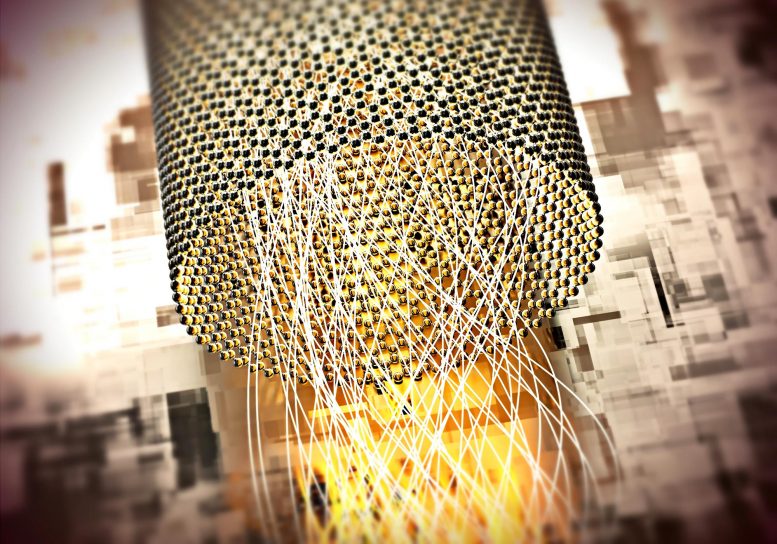
Researchers developed printable graphene nano-inks for micro-supercapacitors, combining fast charging, flexibility, and eco-friendly manufacturing to advance graphene’s commercial potential.
Research led by Kansas State University’s Suprem Das, assistant professor of industrial and manufacturing systems engineering, in collaboration with Christopher Sorensen, university distinguished professor of physics, shows potential ways to manufacture graphene-based nano-inks for additive manufacturing of supercapacitors in the form of flexible and printable electronics.
As researchers around the world study the potential replacement of batteries by supercapacitors, an energy device that can charge and discharge very fast — within a few tens of seconds — the team led by Das has an alternate prediction. The team’s work could be adapted to integrate them to overcome the slow-charging processes of batteries. Furthermore, Das has been developing additive manufacturing of small supercapacitors — called micro-supercapacitors — so that one day they could be used for wafer-scale integration in silicon processing.
“Additive manufacturing is fascinating, cost-effective, and has versatile design considerations,” Das said.
The team has developed supercapacitors that have been tested for 10,000 cycles of charging and discharging cycles, a number that is promising to evaluate the reliability of these devices, Das said. The team is also studying the versatility of these micro-supercapacitors by printing on mechanically flexible surfaces. For this, they used 20-micrometer-thin polyimide — plastic — substrates with high reliability. Das is highly interested in translating emerging materials to devices.
“When you think about best materials and wish to make the best devices, it is not simple and straightforward,” Das said. “One needs to then understand the underpinning physics and chemistry involved in devices.”
Another advantage of Das’ invention is the green aspects of the research that he visualized through constructive discussions with Sorensen. When Das met Sorensen, he realized he could use his expertise in additive manufacturing to transform these materials into useful things; in this case, making tiny energy storage devices.
A few months later, Das filed for a U.S. patent after developing a nano-ink technology and used it to demonstrate printed micro-supercapacitors.
Synergy Between Graphene Production and Printing
Das is particularly interested in forming this synergistic collaboration with Sorensen because of the energy-efficient, highly scalable and chemical-free nature of the graphene production process and his own group’s graphene ink manufacturing process. Both of these processes are patented/patent-pending technologies and are industrially relevant, Das said.
“We make high-quality, multilayer graphene by detonating fuel-rich mixtures of unsaturated hydrocarbons such as acetylene with oxygen in a multi-liter chamber,” Sorensen said. “Our patented method is simple requires very little energy, hence is ecologically benign; requires no toxic chemicals; and has been scaled up to yield high-quality, inexpensive graphene.”
Graphene has been recognized as a wonder material with much potential because of its many superlative physical properties Many graphene manufacturing methods have been developed across the globe and graphene has been produced in ton quantities. Technologists, however, are well aware that graphene is not yet in the marketplace because none of these methods have had the right combination of economy, ecology and product quality to allow graphene to fulfill its potential. But both the methods of producing graphene and nano-inks pursued at Kansas State University are on target to address all of these requirements, according to Sorensen and Das.
The printed supercapacitor research, Graphene Aerosol Gel Ink for Printing Micro-Supercapacitors, was recently published as the cover article in the journal ACS Applied Energy Materials.
Reference: “Graphene Aerosol Gel Ink for Printing Micro-Supercapacitors” by Anand P. S. Gaur, Wenjun Xiang, Arjun Nepal, Justin P. Wright, Pingping Chen, Thiba Nagaraja, Shusil Sigdel, Brice LaCroix, Christopher M. Sorensen and Suprem R. Das, 11 June 2021, ACS Applied Energy Materials.
DOI: 10.1021/acsaem.1c00919
Former postdoctoral researcher Anand Gaur from the Das research team, several graduate students in Das and Sorensen’s groups, and associate professor Brice LaCroix in the K-State geology department have contributed to this work. The work was supported by a grant from the National Science Foundation.
Never miss a breakthrough: Join the SciTechDaily newsletter.
Follow us on Google and Google News.
1 Comment
The fundamental problem with long term energy storage is quite simple. Storing electrical energy in a box as battery or super cap is always going to be almost infinitely more expensive at least 10,000 times the cost of storing chemical energy in fuels or billions times the cost of energy storage in the atom. When we use chemical energy and esp nuclear energy, there is zero need for grid energy storage. When those power sources are load following, zero storage period.
The only practical use for supercaps is always going to be for their very fast response times in electronic circuits and in regenerative energy systems, not for storing any significant amount of renewable energy. Even then using materials that are highly engineered from atomic chemistry processes suggests they will have very high embedded energy costs to make. If a super cap were to be used for RE bulk energy storage, it’s embedded energy costs would completely dwarf the value of any stored energy even for all of its lifetime store & release energy cycles.
FWIW, per capita US energy use is about 300GJ/yr of primary energy. As all electrical it might be 100GJ/yr but that requires infinitely expensive energy storage if it comes from intermitent renewabales. Possibly 10% of that might have to be stored longterm for weeks or months to cover the downtime of solar and wind.
How expensive is energy storage, a $1 bucket can store maybe 30KWh of chemical energy worth 10KWh of electrical energy worth $1. A 1KWh Li-ion battery might be $100-400 so atleast 1000 times as much. One ton of uranium or thorium stores 1GWyr of equiv electrical energy when fully fissioned and is about the size of a 17″ ball of metal worth a few $k but worth a $B in produced energy. It will hold that energy for billions of years too given the half life limit. Thats a super cap by any other name.