
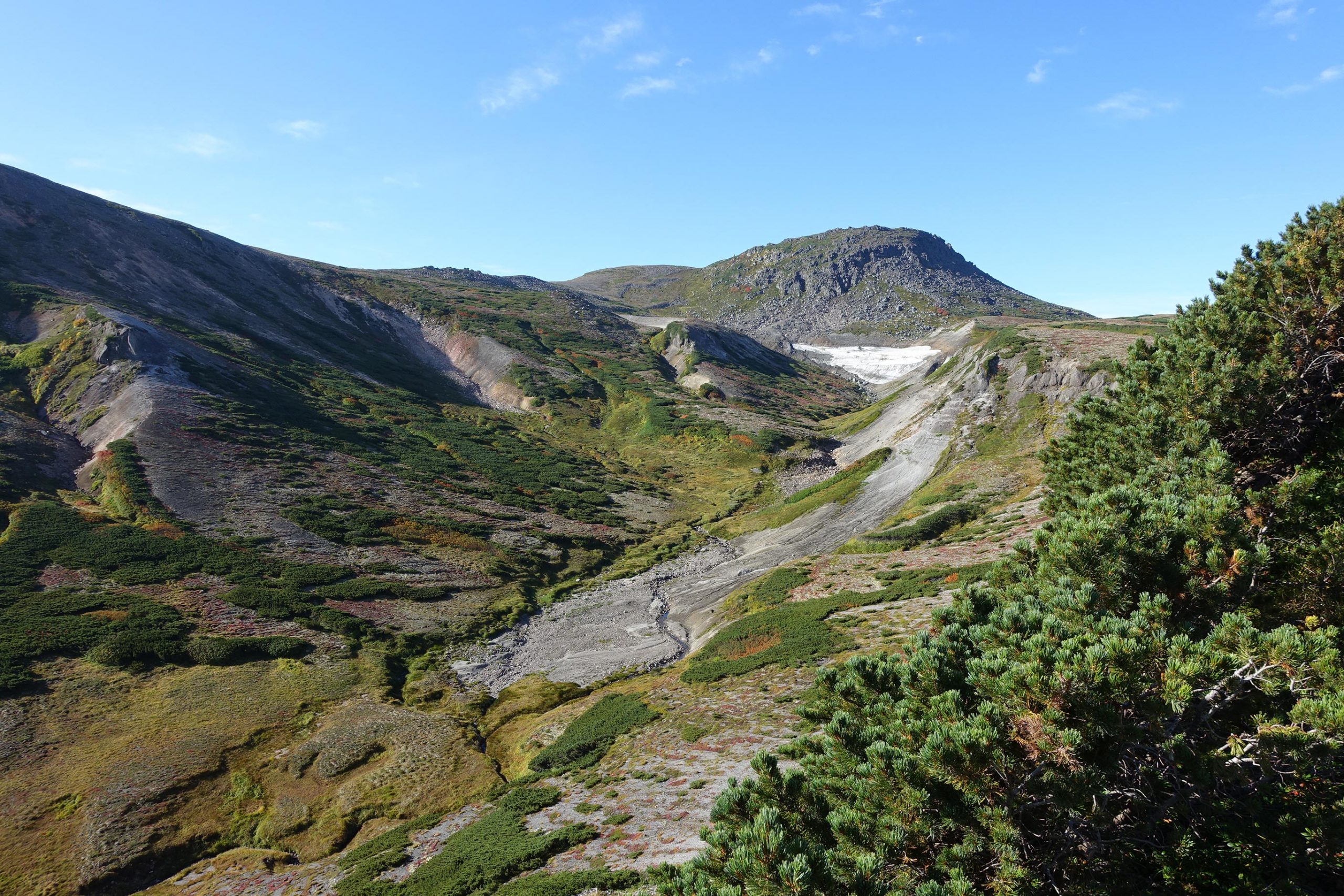
Modeling shows that permafrost in Japan’s Daisetsu Mountains is projected to shrink drastically over the century, even with strong climate action. Thawing threatens unique alpine ecosystems and could increase landslide hazards.
Areas with ground temperatures that remain below 0°C (32°F )for more than two years are referred to as permafrost, and approximately one-quarter of the Northern Hemisphere and 17% of the Earth’s exposed land surface is permafrost. Permafrost is found in mountainous areas as well as in high-latitude tundra and taiga regions. Recent observations have shown that the permafrost in mountainous areas is thawing in the European Alps, Scandinavia, and the Tibetan Plateau.
The islands that make up Japan form a long arc that extends from tropical regions in the south to Palearctic regions in the north. Permafrost has been reported to exist in the Daisetsu Mountains, Mt. Fuji, and Mt. Tateyama. The Daisetsu Mountains on the northern island of Hokkaido, which are known to support a variety of alpine plants and animals, are also a valuable natural resource that is visited by numerous climbers every year (Picture 1). However, there is some concern that the thawing of permafrost will have a major impact on this mountain ecosystem. No projections of future permafrost distribution have been undertaken in East Asia, including in Japan, to date.
In this study, by applying the statistical method developed in a previous study for estimating the permafrost distribution to outputs from bias-corrected and downscaled climate model with a 1 km (0.6 mi) resolution for the area of interest, we investigated the climatic conditions required to sustain permafrost in the Daisetsu Mountains.
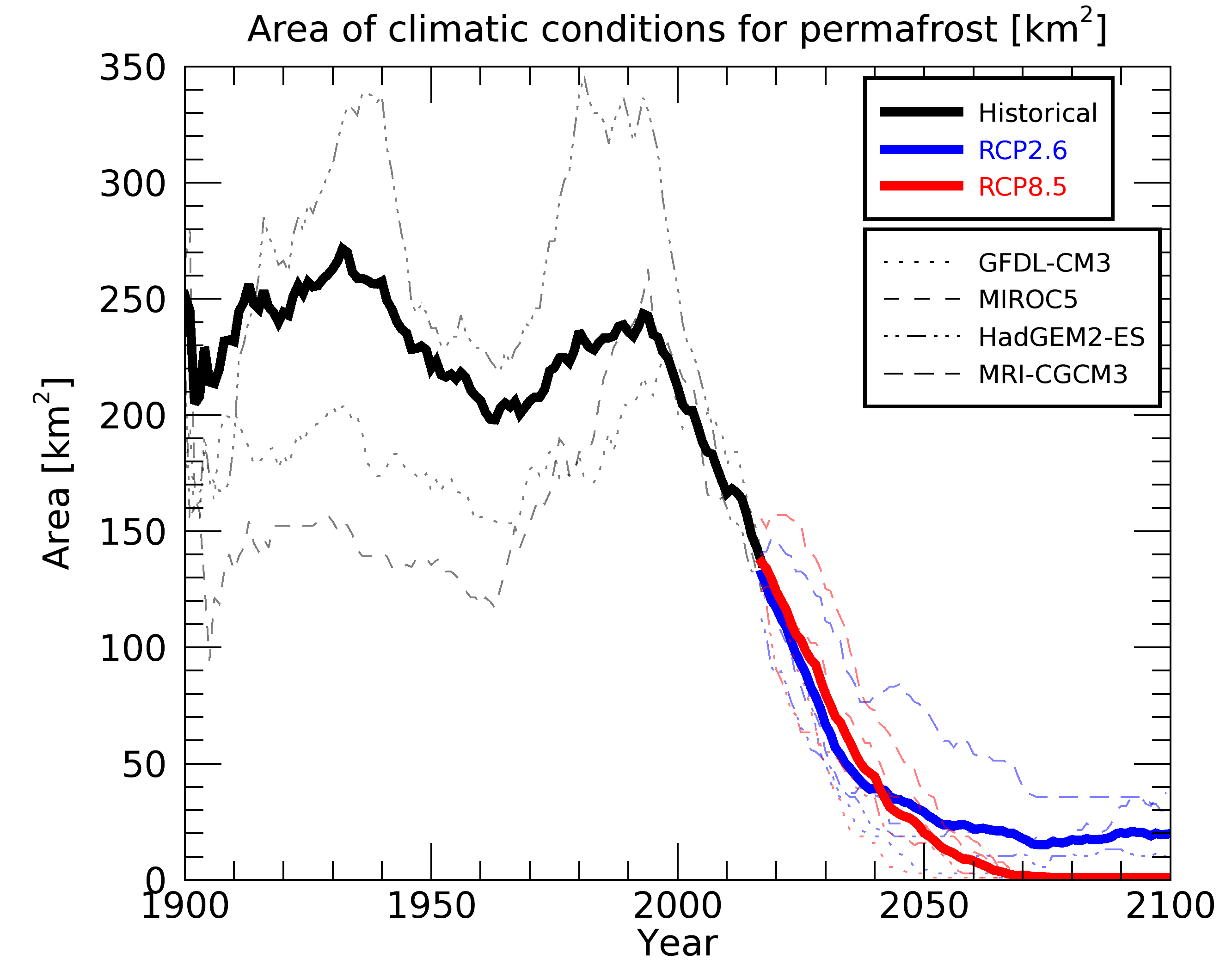
Figure 1 shows the time series of the region of the climate conditions suitable to maintain permafrost in the Daisetsu Mountains. According to Figure 3, the region of the climate conditions suitable to maintain permafrost starts to decrease significantly in size from around 2000, and under both the low-carbon scenario consistent with the Paris target (RCP2.6) and business-as-usual scenario (RCP8.5). The steep decline in the region at the end of the 20th century occurred because the surface air temperature increased significantly from around the year 2000 onward. The size of the area in the Daisetsu Mountains where climatic conditions were suitable for permafrost was estimated to be approximately 150 km² (58 mi²) in 2010. Under the RCP8.5 scenario, this area is projected to disappear by around 2070. Under the RCP2.6 scenario, the area is projected to decrease to approximately 20 km² (7.7 mi²) by 2100.
Ecological and Safety Risks of Thawing Permafrost
The finding that the climatic conditions of the Daisetsu Mountains are projected to shift towards conditions where permafrost will disappear regardless of the climate scenario used, indicates the importance of impact assessments and developing adaptation measures to climate change. Thawing of permafrost can have a significant impact on the surface vegetation and alpine ecosystems. Previous studies have shown that the thawing of permafrost can have a variety of adverse effects, including lowering groundwater levels and replacement of alpine meadows by steppes, extensive desertification such as that in the eastern and western parts of the Tibetan Plateau, and a decrease in species diversity due to warming. Moreover, thawing of the frozen ground reduces the stability of the ground in mountain regions, potentially increasing the frequency and magnitude of rockfalls and landslides, which may affect the safety of trekkers who visit the Daisetsu Mountains annually.
In order to deal with these problems, it is very important to monitor the environmental changes in mountainous areas. In addition to accurately monitoring changes in mountain environments, providing local governments with appropriate measures to prepare for major future environmental changes, as shown in this study, is an important issue for the future.
Reference: “Projections of surface air temperature required to sustain permafrost and importance of adaptation to climate change in the Daisetsu Mountains, Japan” by Tokuta Yokohata, Go Iwahana, Toshio Sone, Kazuyuki Saito, Noriko N. Ishizaki, Takahiro Kubo, Hiroyuki Oguma and Masao Uchida, 30 July 2021, Scientific Reports.
DOI: 10.1038/s41598-021-94222-4
Funding: The Ministry of Education, Culture, Sports, Science and Technology of Japan, The Arctic Challenge for Sustainability II, JSPS KAKENHI
Never miss a breakthrough: Join the SciTechDaily newsletter.
Follow us on Google and Google News.