
Software program predicts environmental noise and modulates voices to simulate sound on other planets.
Timothy G. Leighton has developed software that simulates sounds on distant planets and predicts changes in human voices. Acoustic studies have become important in understanding other planets’ environments, as sound can reveal information about chemical compositions, temperature changes, and surface roughness.
You may know how other planets look, like the rust orange, dusty surface of Mars or the vibrant teal of Uranus. But what do those planets sound like?
Timothy G. Leighton from the University of Southampton in the U.K. designed a software program that produces extraterrestrial environmental sounds and predicts how human voices might change in distant worlds. He will demonstrate his work at the upcoming 184th Meeting of the Acoustical Society of America, running May 8-12 at the Chicago Marriott Downtown Magnificent Mile Hotel. His presentation will take place Thursday, May 11, at 12:00 p.m. Eastern U.S. in the Chicago room.
The presentation is part of a special session that brings together the acoustics and planetary science communities. Acoustical studies became essential during the Huygens lander’s descent into Titan’s atmosphere in 2005 and in the more recent Mars InSight and Mars 2020 Perseverance Rover missions. These successful missions carried customized active and passive acoustic sensors operating over a wide spectrum, from very low frequencies (infrasound, below the human hearing threshold) to ultrasound (above human hearing).
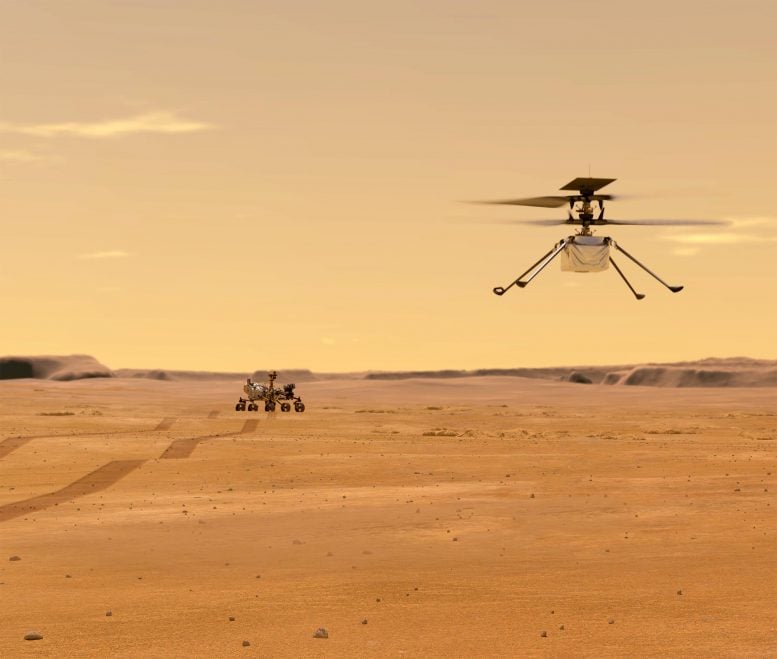
“For decades, we have sent cameras to other planets in our solar system and learned a great deal from them. However, we never really heard what another planet sounded like until the very recent Mars Perseverance mission,” said Leighton.
The Challenges of Sound on Alien Planets
Scientists can harness sound on other worlds to learn about properties that might otherwise require a lot of expensive equipment, like the chemical composition of rocks, how atmospheric temperature changes, or the roughness of the ground.
Extraterrestrial sounds could also be used in the search for life. At first glance, Jupiter’s moon Europa may seem a hostile environment, but below its shell of ice lies a potentially life-sustaining ocean.
“The idea of sending a probe on a seven-year trip through space, then drilling or melting to the seabed, poses mind-boggling challenges in terms of finance and technology. The ocean on Europa is 100 times deeper than Earth’s Arctic Ocean, and the ice cap is roughly 1,000 times thicker,” said Leighton. “However, instead of sending a physical probe, we could let sound waves travel to the seabed and back and do our exploring for us.”
Atmospheric Impacts on Sound
Planets’ unique atmospheres impact sound speed and absorption. For example, the thin, carbon dioxide-rich Martian atmosphere absorbs more sound than Earth’s, so distant noises appear fainter. Anticipating how sound travels is important for designing and calibrating equipment like microphones and speakers.
Hearing the sound from other planets is beneficial not just for scientific purposes, but also for entertainment. Science-fiction films contain vivid imagery to mimic the look of other worlds but often lack the immersive quality of how those worlds would sound.
Leighton’s software will showcase predictions of the sounds of other worlds at planetariums and museums. In the case of Mars, it will include actual sounds thanks to the U.S./European Perseverance team and China’s Zhurong mission.
The special session, chaired by Leighton and Andi Petculescu, is the third forum on acoustics in planetary science organized at a meeting of the Acoustical Society of America.
“The success of the first two ASA special sessions on this subject has led to quite a few collaborations between the two communities, a trend that we hope will carry on,” said Petculescu.
Meeting: ASA 184th Meeting
This talk is part of a special session, “Physical Acoustics, Engineering Acoustics, and Structural Acoustics and Vibration: Acoustic Sensing in Planetary Environments,” which will take place Thursday, May 11, in the Chicago room of the Chicago Marriott Downtown Magnificent Mile Hotel from 9:05 a.m. to 1:00 p.m. Eastern Time.
Since the last session on the same topic at an ASA meeting, the community has seen the success of the Perseverance and Ingenuity mission on Mars. The session will include analysis of the sound from the Ingenuity helicopter on Mars (presented by Ralph Lorenz of the Johns Hopkins Applied Physics Lab) and the signal from the Perseverance microphone due to the Martian wind (presented by Alexander Stott of the University of Toulouse).
A particularly useful sound source has been generated on Mars using the impact of Perseverance’s laser on rock 10 meters away from the probe. This generates shock waves (presented by Baptiste Chide of Los Alamos Lab). The detection of these waves by Perseverance’s microphone can probe the atmospheric turbulence near the surface of Mars (presented by Sylvestre Maurice of the Institut de Recherche en Astrophysique et Planétologie) and test acoustic propagation models for the Martian atmosphere (presented by Xavier Jacob and Martin Gillier of the University of Toulouse).
Other talks in the session explore possibilities for future missions, such as the use of balloons to detect Venus-quakes (presented by Gil Averbuch of the Woods Hole Oceanographic Institute and Siddharth Krishnamoorthy of Jet Propulsion Lab). Future Mars missions could range from large-scale measurements of sonic booms (presented by Lily Hetherington of Penn State University) to small-scale acoustic anenometers (presented by Robert White of Tufts University).
Never miss a breakthrough: Join the SciTechDaily newsletter.
Follow us on Google and Google News.