
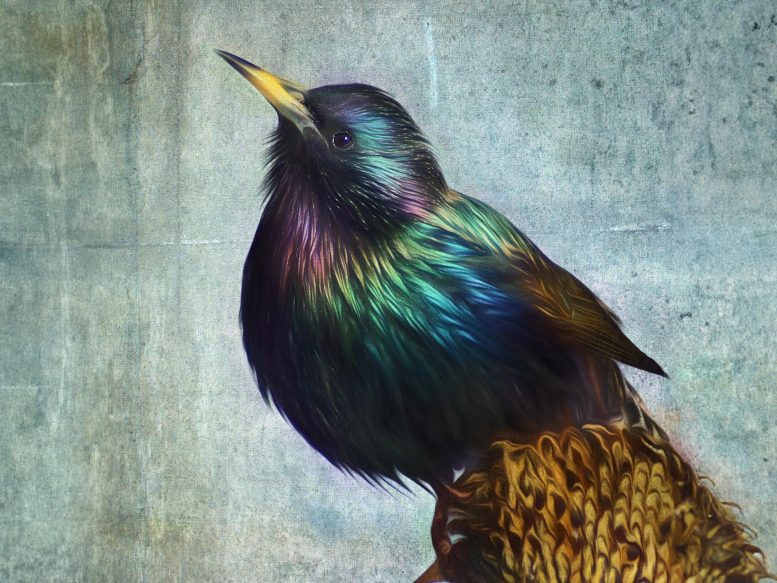
A study reveals European starlings are not just advanced vocal learners but also adept problem solvers, suggesting a co-evolution of vocal learning, cognitive abilities, and relative brain size.
The European starling has an impressive array of skills. Known for their adaptability in learning various warbles, whistles, and songs throughout their lives, starlings are considered among the top-tier avian vocal learners. A recent study in the journal Science reveals that starlings and other intricate vocal learners are also exceptional problem solvers.
“There is a long-standing hypothesis that only the most intelligent animals are capable of complex vocal learning,” says Jean-Nicolas Audet, a research associate in the laboratory of Erich Jarvis at The Rockefeller University. “If that is true, then complex vocal learners should also be better at cognitive tasks, but no one had ever demonstrated that before.”
Defining Vocal Learners
A select few animal groups display the ability for complex vocal learning—essentially, the proficiency to learn and recall a wide array of sounds. This list includes humans, elephants, whales, seals, and bats from the mammal group, with songbirds, parrots, and hummingbirds representing the avian category. The Jarvis lab primarily studies songbirds, assessing their vocal learning using three criteria: the diversity of songs and calls in the bird’s repertoire, the bird’s ability to continue learning new vocalizations throughout its lifespan, and its skill in mimicking other species.
Research Methodology
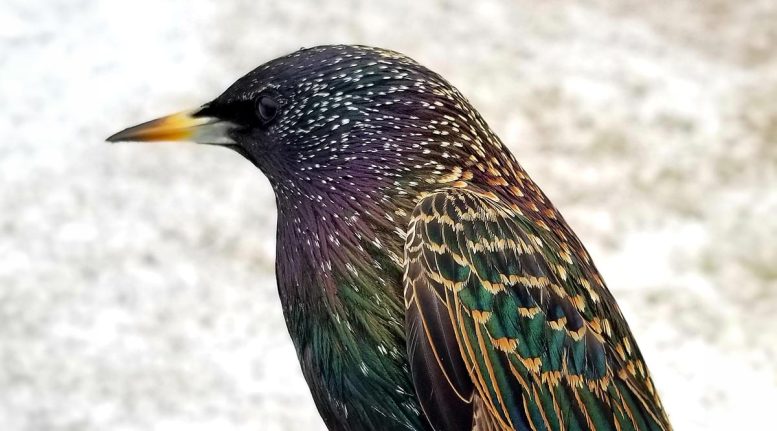
To explore the potential connection between vocal learning and cognitive abilities in songbirds, Audet and his team caught hundreds of wild birds from 21 species over three years using mist nets at The Rockefeller University Field Research Center, a vast 1,200-acre protected area housing varied ecosystems in New York’s Hudson Valley.
“It’s a protected area, which means the animals have limited exposure to humans,” says Mélanie Couture, a research assistant who worked on the study. “This is ideal for studying the behaviors of wild birds—what they can do, and how they react to cognitive tasks.”
When the team evaluated the vocal learning skills of the captured birds, three stood out: starlings, blue jays, and gray catbirds (relatives of mockingbirds). Intriguingly, these were the sole species able to mimic other species, which Audet deems “the epitome of vocal learning.”
Cognitive Tests on Birds
The team then ran a battery of cognitive tests on 214 birds from 23 species (including two lab-raised bird species that were added to the wild-caught birds). They tested problem-solving abilities by challenging the birds to remove a lid, pierce foil, or pull a stick to retrieve a treat. Self-control was assessed by placing a transparent barrier between each bird and a snack, and recording how long it took the birds to stop butting up against the barrier and go around it. Other tests analyzed whether the birds could learn to associate a certain color with a food reward, and how quickly the birds adapted when the associated color changed.
Statistical analyses revealed a strong correlation between problem-solving abilities and vocal learning abilities. Starlings, bluejays, and catbirds were not only the most advanced vocal learners, but also the most adept at solving puzzles, and the better a bird was at working its way around obstacles to nab a treat, the more complex its vocal learning ability. There was no association between the other cognitive tests and vocal learning complexity.
Brain Size and Vocal Learning
The researchers also found that advanced vocal learners and problem solvers had larger brains relative to the sizes of their bodies—a potential biological basis for the observations. “Our next step is to look at the brains of the most complex species and try to understand why they are better at problem-solving and vocal learning,” Audet says. “We have a pretty good idea of where vocal learning happens in the brain, but it’s not yet clear where problem-solving occurs.”
In summary, the research proposes a co-evolution of vocal learning, problem-solving abilities, and brain size, perhaps as a way of increasing biological fitness. Building on this and prior research on the ability of vocal learners to dance to a rhythmic beat, Jarvis introduces the term “vocal learning cognitive complex” to describe this suite of traits.
“Our findings help support a previously unproven notion: that the evolution of a complex behavior like spoken language, which depends on vocal learning, is associated with co-evolution of other complex behaviors,” Jarvis says.
Reference: “Songbird species that display more-complex vocal learning are better problem-solvers and have larger brains” by Jean-Nicolas Audet, Mélanie Couture and Erich D. Jarvis, 14 September 2023, Science.
DOI: 10.1126/science.adh3428
Never miss a breakthrough: Join the SciTechDaily newsletter.
Follow us on Google and Google News.